






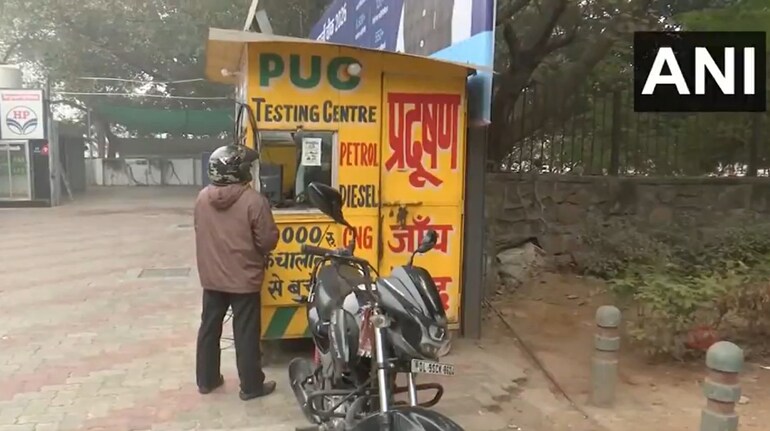
As Delhi continues to battle severe air pollution, the government has tightened checks on vehicle emissions under the strict Stage IV of the Graded Response Action Plan (GRAP). Environment Minister Manjinder Singh Sirsa said that since the implementation of GRAP-IV, more than 10,000 vehicles have failed emission tests, and over 2 lakh have been issued Pollution Under Control (PUC) certificates.
The minister said the sharp rise in PUC testing followed the enforcement of the “No PUC, No Fuel” rule, which makes it mandatory for vehicles to have a valid PUC certificate to refuel.
To strengthen the system further, Sirsa said the government is upgrading all PUC centres with high-capacity testing equipment. The move is aimed at reducing long waiting times, improving accuracy and making emission testing more reliable.
In addition, a third-party inspection mechanism will soon be introduced to improve transparency and credibility in the certification process.
Are current emission tests effective enough?
Experts say that the current on-road vehicle emission testing system has serious limitations. At present, PUC tests are based mainly on idle testing, where emissions of carbon monoxide (CO) and hydrocarbons (HC) are measured when the engine is running at low speed. For diesel vehicles, a smoke density test is conducted, while petrol vehicles also undergo a lambda test.
Experts point out that this method does not reflect real-world driving conditions, where vehicles emit higher levels of pollutants during acceleration and high-speed driving.
Researchers from Delhi Technological University (DTU) have earlier proposed an improved system similar to the Air Quality Index (AQI), known as an Exhaust Emission Index (EEI). This system also considers the mileage and maintenance status of vehicles while assessing emissions.
Call for testing beyond idle emissions
Dr Rajeev Kumar Mishra, associate professor at DTU’s department of environmental science and engineering, said emission testing and re-certification for in-use vehicles must go beyond idle conditions. “Currently, PUC certificates are issued based only on CO and hydrocarbon emissions when the engine is idle. This does not capture emissions like nitrogen dioxide (NO₂), fine particulate matter (PM2.5) and volatile organic compounds (VOCs), which are released in higher amounts during fast idling or acceleration,” he was quoted by TOI as saying.
Mishra added that emissions at higher engine speeds, such as 2,500 rpm, are sometimes recorded but are not considered while issuing certificates. He stressed that decisions on whether a vehicle should be allowed to operate or phased out should depend on accumulated mileage, maintenance history and overall emission performance, not just the age of the vehicle.
He also noted that there are no clear emission testing standards for BS-VI vehicles, and testing norms vary across different Bharat Stage categories.
Vehicles major contributor to Delhi’s pollution
According to studies by the Centre for Science and Environment (CSE), vehicle emissions are among the largest contributors to air pollution in Delhi and have a direct impact on public health. While PUC checks can help identify highly polluting vehicles, they do not fully address harmful pollutants such as PM2.5 and toxic gases.
“Vehicles are the second-largest source of particulate emissions in Delhi. Their emissions are especially dangerous because they occur at breathing height,” TOI quoted Shambhavi Shukla, programme manager for air pollution at CSE, as saying.
She suggested adopting advanced vehicle emission surveillance systems, including remote sensing technologies, to detect polluting vehicles more effectively.
What are the issues at PUC centres?
Experts also highlighted long-standing problems at PUC centres. An audit conducted by CSE and the Environment Pollution (Prevention and Control) Authority (EPCA) in 2017 found serious irregularities. In some cases, certificates were issued without inserting probes into vehicle exhausts. Some centres allegedly had only printers, with no proper testing equipment, and results varied widely between centres.
Shukla said staff at PUC centres are required to have proper technical training, but this is often not enforced. She stressed that unless these issues are fixed, emission testing will continue to fall short of its goal.
Discover the latest Business News, Sensex, and Nifty updates. Obtain Personal Finance insights, tax queries, and expert opinions on Moneycontrol or download the Moneycontrol App to stay updated!
Find the best of Al News in one place, specially curated for you every weekend.
Stay on top of the latest tech trends and biggest startup news.




