






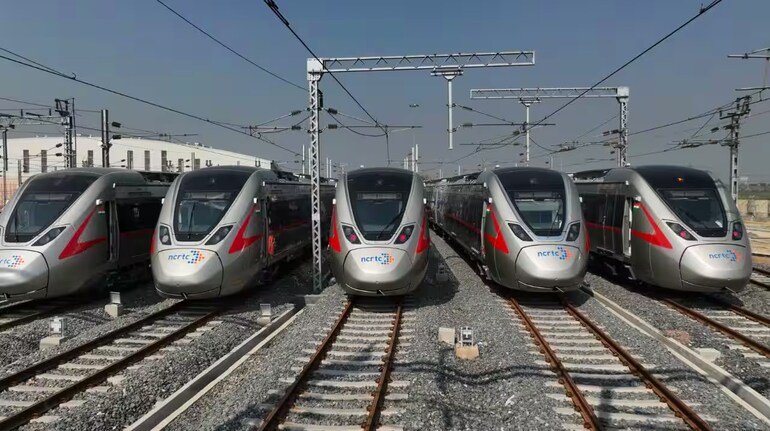

Following the complete opening of the 82-km Delhi-Meerut Namo Bharat corridor, the National Capital Region Transport Corporation (NCRTC) is set to rapidly expand the region's rapid rail network. The central government is expected to approve two new corridors — connecting Delhi to Alwar and Delhi to Karnal — within the current financial year.
In a significant update on the region's transit future, NCRTC Managing Director Shalabh Goel was cited by The Indian Express as saying in an interview that both the proposals are in the final stages of clearance.
"Both these corridors are under consideration at a very senior level, and are expected to get approved this financial year," Goel said. These high-speed regional transit systems, designed to complement existing metro networks, will originate from a major transport hub being developed at Sarai Kale Khan in Delhi.
While the Delhi-Karnal corridor is projected to cost approximately Rs 240-250 crore per kilometre, the Delhi-Alwar route is expected to be more expensive due to a larger proportion of underground sections.
Goel noted that the Ghaziabad-Jewar and Noida-Faridabad-Gurgaon corridors are also advancing, though they are at a comparatively earlier stage of planning. Regarding speculation that the Ghaziabad-Jewar line might originate from Delhi instead, the MD stated that no final decision has been made, as multiple options are still being explored.
Cost efficiency and global partnerships
Leveraging lessons learned from the pioneering Delhi-Meerut project, the NCRTC anticipates significant savings in future constructions. "Costs are expected to come down by at least 10-15% in the upcoming projects," Goel told The Indian Express, attributing the efficiency to streamlined processes and established expertise.
The corporation is also looking to replicate the public-private partnership (PPP) model used successfully on the Meerut corridor. Key components, such as the rolling stock supply bundled with a 15-year maintenance contract, have ensured quality and fostered domestic manufacturing.
"These contracts were awarded through open competitive bidding...the rolling stock is being manufactured in Savli, Gujarat. This is a clear example of Make in India, generating employment and expertise within the country," Goel explained.
Furthermore, the engagement of Germany's state-owned rail firm, Deutsche Bahn (DB), for operations and maintenance has introduced international best practices. Goel described the partnership as a "win-win situation," noting that it has helped reduce operational costs and limit the NCRTC's permanent manpower requirements.
AI surveillance and green energy push
Beyond expansion, the NCRTC is integrating cutting-edge technology to enhance safety and sustainability. The corporation is deploying a sophisticated drone-based surveillance system equipped with acoustic sensors to detect cable tampering.
"If a specific sound pattern is detected, a drone will automatically fly to the location, capture images and videos, and alert security agencies," Goel said. Additionally, AI-driven camera analytics will monitor crowd density at stations, automatically alerting the control centre to deploy extra trains or manage entry protocols during peak hours.
Environmental sustainability remains a core focus. With the Delhi-Meerut corridor now fully operational, the NCRTC estimates that approximately one lakh vehicles will be taken off the road annually, leading to a reduction of about 2.5 lakh tonnes of CO2 emissions. This shift is expected to boost public transport usage along the route from 37% to 63%.
To power this network, the corporation is aggressively pursuing renewable energy. It is in the process of finalising bids for a 110-megawatt land-based solar power plant in Uttar Pradesh, complementing existing rooftop solar installations.
While current renewable energy usage is modest, Goel has set an ambitious target. "I expect that within the next five to six years, we should be able to provide at least 50% of our power through renewable sources, predominantly solar."
Energy conservation and regenerative tech
Energy conservation is also being engineered at the train level. The Namo Bharat trains feature a regenerative braking system that captures kinetic energy and converts it into electricity.
"If we take 100 million units of electricity, we are able to give back 30 to 33 million units to the grid during braking," Goel revealed, adding that lifts and escalators are also equipped to feed power back into the grid.
Transit-oriented development and future expansion
The NCRTC is also focusing on transit-oriented development (TOD) to monetise the increased land value around its corridors. By collaborating with the Uttar Pradesh government on a joint TOD policy, the agency is utilising "value capture finance" instruments.
This means that as property values rise near transit hubs, a portion of that increment — through mechanisms like additional floor area ratio (FAR) or higher stamp duty — is shared with the government and NCRTC. While specific plans for the Sarai Kale Khan hub are pending approval from the Delhi Development Authority, the principle is set to guide future development.
Looking beyond the NCR, Goel hinted at broader applications for the rapid rail model. He emphasised that an RRTS is most effective when integrated with a mature metro system, citing cities like Hyderabad, Bengaluru, Chennai, Mumbai and Ahmedabad as ideal candidates.
"Metros typically serve within a 30 km radius, while RRTS serves regions up to 200 km. India has taken initial steps with the Delhi-Meerut corridor and many cities are now mature enough for such systems," he said.
With a target to double its non-fare box revenue (from sources like advertising) from the current 12-13% to roughly a quarter of total earnings within five years, the NCRTC is building a financially robust and technologically advanced blueprint for regional connectivity.
Discover the latest Business News, Sensex, and Nifty updates. Obtain Personal Finance insights, tax queries, and expert opinions on Moneycontrol or download the Moneycontrol App to stay updated!
Find the best of Al News in one place, specially curated for you every weekend.
Stay on top of the latest tech trends and biggest startup news.





