

India's gross market borrowing for the financial year 2026-27 is expected to rise to Rs 15–17 lakh crore due a sharp surge in redemptions even as the government stays committed to fiscal consolidation while focusing on debt sustainability, a Moneycontrol pre-Budget poll has found.
Net borrowing is estimated in the range of Rs 10.5–14 lakh crore, with most market participants expecting the fiscal deficit to be contained around 4.3–4.4 percent of GDP in FY27. Economists, treasury heads and money market experts participated in the poll.
The government budgeted Rs 14.82 lakh crore as gross borrowing for FY26, higher than the Rs 14.01 lakh crore the previous year.
Government borrowings are among the most important determinants of interest rates in the economy. Higher-than-expected borrowings can push up rates for all bond issuers — sovereign and corporate — while interest rates can decline if it tightens its belt and borrows less than anticipated.
Borrowings are loans taken by the government to fund its spending on public services. Usually, the government borrows the money through securities such as government securities and treasury bills.
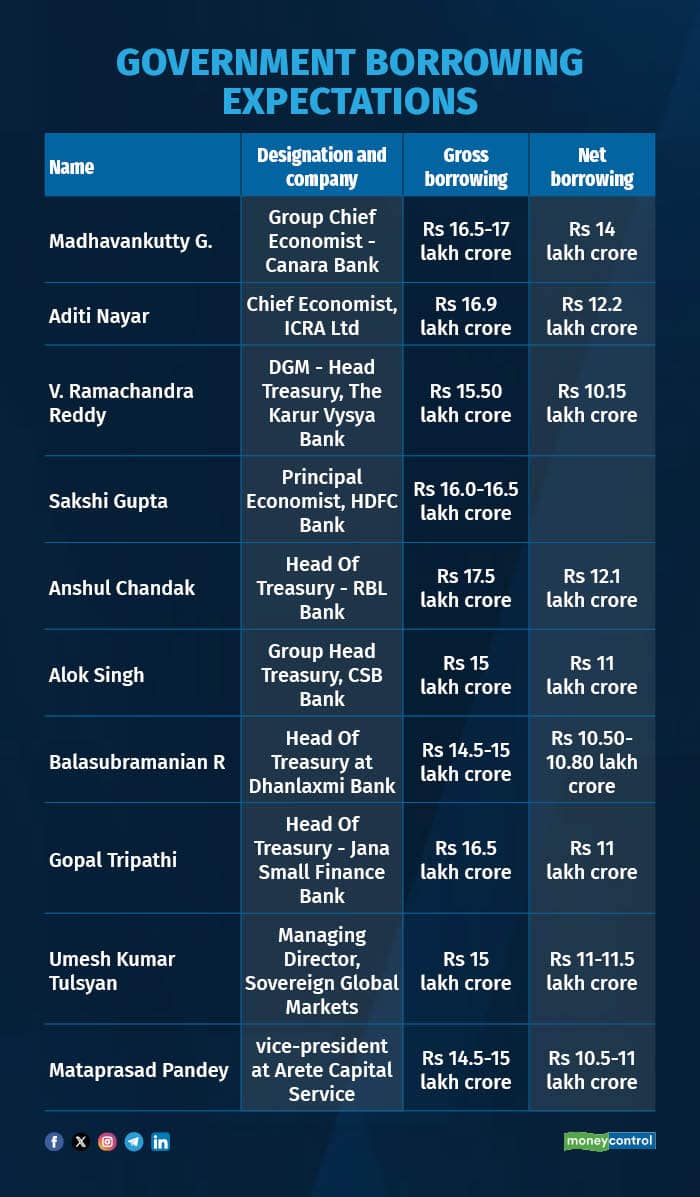 Government borrowing expectations
Redemptions to drive higher gross supply
The increase is largely being driven by higher bond maturities, estimated at Rs 5.47 lakh crore in FY27, compared with about Rs 3.3 lakh crore in FY26. This will push up headline borrowing numbers even if the deficit ratio continues to decline.
“Redemptions are expected to surge in FY27, which will mechanically push gross market issuances higher,” said Aditi Nayar, chief economist at ICRA, who estimates gross borrowing at around Rs 16.9 lakh crore, with net issuances of about Rs 12.2 trillion.
Fiscal consolidation remains intact
Despite higher supply, market participants do not see any major deviation from the fiscal glide path. The government is expected to rely on nominal GDP growth, steady tax buoyancy and non-tax revenues to keep borrowing in check.
Mataprasad Pandey, vice-president at Arete Capital Service, said the lower end of borrowing estimates reflects the government’s “continued emphasis on fiscal consolidation” and the potential support from India’s inclusion in the Bloomberg Global Aggregate Index, which could ease borrowing pressures.
At the same time, risks remain. Pandey said “weaker indirect tax collections following GST rate cuts” could push borrowing higher if the weakness persists into FY27.
Net borrowing seen manageable
Net borrowing is expected to remain broadly stable, clustered around Rs 11-12.5 lakh crore, supported by steady demand from domestic institutional investors and incremental foreign inflows.
Balasubramanian R, head of treasury at Dhanlaxmi Bank, said net supply of around Rs 10.5 lakh crore is “manageable for the market”, with pension funds and foreign portfolio inflows aiding absorption.
Borrowing strategy: maturity mix in focus
The government is expected to avoid a heavy tilt towards ultra-long bonds, given limited appetite for duration. Issuance is likely to remain balanced across short- and long-term maturities, with tactical use of treasury bills and selective long-tenor bonds to meet investor demand.
“There is no expectation of a sharp increase in long-term borrowings; the mix is likely to remain broadly similar,” said Alok Singh, group head of treasury at CSB Bank.
Some expect the government to rationalise issuances beyond 15 years to contain borrowing costs amid elevated spreads.
Green bonds to stay limited
Sovereign green bonds are likely to remain part of the borrowing programme but without any meaningful increase in issuance due to the absence of a green premium.
“Despite the absence of a greenium for sovereign green bonds, the government is likely to include them in its borrowing programme,” Pandey said, adding issuance levels are unlikely to rise.
Estimates for green bond issuance range from Rs 20,000-25,000 crore, or around 5 percent of the total borrowing.
“Green bond around 5 percent of the issuance,” said Gopal Tripathi, head of treasury at Jana Small Finance Bank.
Shift towards debt-to-GDP anchor
A broader shift in the fiscal framework is also underway, with policymakers placing greater emphasis on debt-to-GDP metrics alongside annual deficit targets.
“There is a clear shift from focusing only on the fiscal deficit to managing the debt-to-GDP ratio,” said Umesh Kumar Tulsyan, managing director at Sovereign Global Markets, DDING the Centre aims to gradually bring down its debt ratio towards 50 percent over the medium term.

Discover the latest Business News, Sensex, and Nifty updates. Obtain Personal Finance insights, tax queries, and expert opinions on Moneycontrol or download the Moneycontrol App to stay updated!
Find the best of Al News in one place, specially curated for you every weekend.
Stay on top of the latest tech trends and biggest startup news.