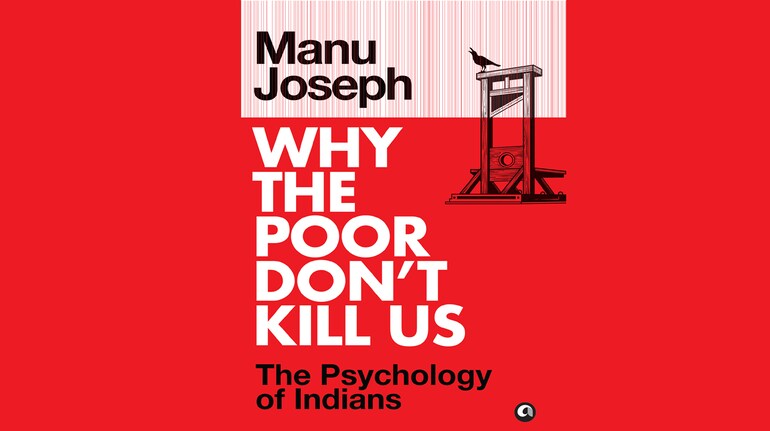
The book begins with a question so grotesque it’s dark and genius: why, in one of the most unequal societies on earth, do the poor not rise up and slaughter the rich?
This is the spine of a book that dissects the Indian psyche with Manu’s trademark cocktail of wit, scorn and uncomfortable empathy.
He starts with scenes from the 2001 Bhuj earthquake. Amid collapsed homes and dead families, the poor display not rage, but astonishing pragmatism. A man calmly gives directions while his wife and children are trapped under rubble; others hound photojournalists for proof of death that can help them claim compensation. This is the India Manu knows, where even tragedy becomes resilient-calm, and survival is lived-reality.
He turns his gaze to the daily absurdities of class. We make our maids squat like frogs to pull out our hair from bathroom drains, he writes. We cram millions into unreserved train compartments “so many of them per square foot that if they were cows, it would be illegal.” We send men into manholes where they suffocate, and then debate whether we should call them “sanitation workers” or “manual scavengers.” Manu’s question —“Why don’t they crawl out of their catastrophes and finish us off?”— is brutally-sharp.
The Republic of NobodiesManu calls India “a republic of nobodies,” and it’s a description from societal realities, much distant from the financial-political narrative of “emerging economy.”
He writes that the poor do not kill us because they belong to the ugliness we have built. Most nations strive to look richer than they are; India, perversely, looks poorer than it is.
Then there’s politics. Manu argues that politicians protect the privileged not out of morality but through perceived-association with the poor. He writes that corrupt-neta is closer to the poor than the upright activist or the moralising intellectual. A bribe, even in form of schemes, in Manu’s telling, is a form of insurance and a mutual understanding that keeps the blood from spilling.
It’s persuasive logic: the system survives because it gives almost everyone, especially at the bottom, a small stake in its rottenness.
The book’s sharpest moments are its cruelest. Manu’s description of a five-star hotel buffet is savage social anthropology disguised as stand-up: “The whole buffet scene is like a rave party, with distressed waiters dealing in sugar and maida; and the addicts wanting more and more, shouting for the attention of dealers, asking why something is taking so long, how long must they wait; how long must their poor starving children wait before the next fix.” You laugh—then you realise you’ve been to that buffet.
This is Manu’s great trick. His writing is psychological ambush.
The middle class, he notes, loves to believe it is now kinder to its servants than its parents were. The new-age madam might tweet about how maids are “expected to be invisible.” Yet she won’t let her maid use the toilet or the cutlery. In this, Manu exposes the Indian contradiction: we are modern in consumption, feudal in instinct, and hypocritical in morality.
He writes that most reform is driven by self-interest. “The young,” he says, “should quit full-time activism, sack themselves as humanitarians, and instead make money—or at least start a doomed business. They are more useful to society this way.”
The Grace of DiscomfortThis book is a psychological portrait of a nation. His lens is social instinct, not GDP. Manu’s critics - who I assume are plenty - have cribbed that book has no data, no footnotes, no academic scaffolding—only observation, assertion and wit. Expecting him to supply empirical proof for every uncomfortable truth he voices is like asking a stand-up comic to publish footnotes.
At one point, Manu turns his gaze upward, writing that “in almost everything they do, billionaires and their children are not in competition with the rest of society. They have their own charmed universe where they do not even properly mingle with people who do not come close to their wealth.” It’s a devastating observation - because in Manu’s world, the rich don’t oppress the poor so much as they simply drift beyond them, insulated in an altitude where empathy can’t breathe.
Manu wants complicity—your admission that you, too, benefit from the silent truce between comfort and deprivation. The poor don’t kill us because we’ve taught them that revenge is futile and endurance is holy. We call it resilience, but it’s resignation dressed up as virtue.
Must-read bookThe book borrows its title from Manu Joseph’s Mint column published in June 2017, where he first asked why India’s poor, despite crushing inequality, never revolt. In that essay, he argued that the answer lies not in saintly restraint but in a system that offers just enough inclusion—and just enough illusion—to keep the peace.
Manu’s voice is cynical, his wit cruel. He writes as someone who sees too much and expects too little—and that, in today’s moral economy, is refreshing. Even when you disagree with him - and you will - his provocations force you to think about how our society maintains order in chaos. The book holds up a mirror to both privilege and poverty and asks the question no economist, politician or influencer ever will: what if the only reason there’s peace is because we’ve perfected the art of injustice?
Manu mocks us, forgives no one, and explains what statistics can’t. Why, perhaps, the poor don’t kill us is because we have already done it to ourselves - with guilt, denial, and the quiet luxury of looking away. Manu, thank you for waking us up, at least those who want to.
Discover the latest Business News, Sensex, and Nifty updates. Obtain Personal Finance insights, tax queries, and expert opinions on Moneycontrol or download the Moneycontrol App to stay updated!
Find the best of Al News in one place, specially curated for you every weekend.
Stay on top of the latest tech trends and biggest startup news.