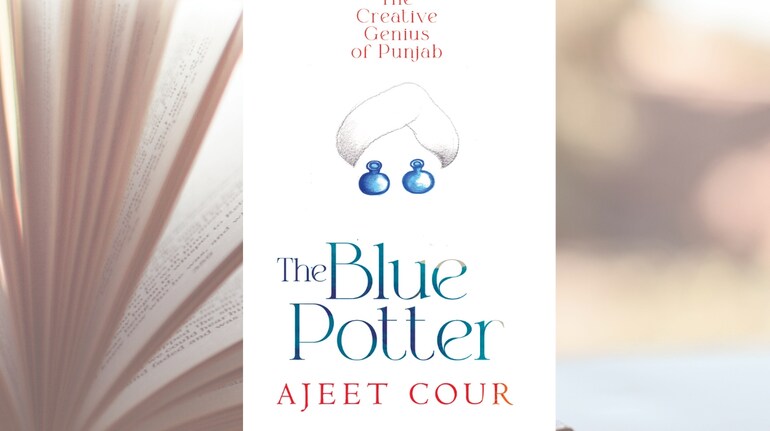
Excerpted with permission from the publisher The Blue Potter: The Creative Genius of Punjab, Ajeet Cour, published by Aleph Book Company.
***
THE KING OF ANGUISH
I first met Shiv Kumar Batalvi at Amritaji’s Patel Nagar house.
Authors used to meet frequently at Amritaji’s house.
I had previously read a couple of poems by him, but had never met him.
The meeting probably happened in 1958.
Slender body! Hair like an actor’s! Ruffled! Sharp features and sad eyes!
He was telling Amritaji, ‘Bas! I will not live any more. I will die soon. I feel as if I have got tuberculosis.’
‘But Shiv, why don’t you get yourself tested? If there is anything wrong with you, you should get it treated and take medication for it. Every disease is curable these days.’
‘No! I will not take medicine. I will die.’ His eyes were filled with tears.
I said, ‘Shiv, you write such beautiful poetry. And I have heard that you also sing your lyrics and when you do, people are mesmerized. They become intoxicated listening to you. You have become so famous at such a young age! What more could any writer possibly want?’ I tried to indulge and flatter him.
Amritaji urged, ‘Please recite some of your poems.’
Shiv placed one hand behind his ear, then rolled it in his hair and began to sing!
Oh my God! His voice seemed as if it were emerging from the depths of a deep well. Agony! Anguish! It echoed with such a depth, soaked in pain!
Both of us, Amritaji and I, were drowning in the pathos of that voice.
He inquired, ‘Where do you live?’ I don’t know if I was older than him, but he addressed me using ‘tusi’.
‘I don’t live anywhere, Shiv. I live at my husband’s house. I live like the nomads.’
He smiled. ‘Then two refugees have come together!’
There was silence for a short while.
‘But where can I meet you?’
‘Here only. Within the chamber of friends. At Amritaji’s residence.’ I giggled.
There was a big park in front of my husband’s house at Patel Nagar.
And my friend Darshan Singh and his wife Lochan lived across the park.
Sometimes, I would take their children, Preeti and Mattu, along with my daughters in the pram for a walk, and sometimes they would take my daughters for a walk along with their children.
Darshan and Lochan also met Shiv at Amritaji’s house and they invited him to dinner at their house. They extended an invitation to me as well. He began to feel at home in the home of Darshan and Lochan. Even though Shiv would recite poetry in Amritaji’s house, he was not comfortable there and would remain somewhat demure and submissive. All new and emerging writers remained silent out of reverence for Amritaji. Everybody held her in high regard. She was a famous writer and a towering literary figure too. And a great poet. Besides, she was working at the radio station. Back then, working at the radio station was considered a prestigious and important role. Shiv used to feel very comfortable at Darshan and Lochan’s house and started to open up gradually. Especially when Darshan and Lochan would take their children, as well as mine, for a walk in the pram, and I would sit alone with Shiv, he began to share his personal life with me without hesitation. Darshan would keep a bottle of vodka for him. He was working at the Russian Embassy, and so had access to bottles of vodka. All the people who worked at the embassy used to get cartons of vodka.
Shiv would take a sip of vodka and start talking. He used to sing his poems for us.
One day, he started gently caressing my braid. He softly pulled out the end of my braid, which was tucked under me, and gently ran his fingers over the entire braid with love. He said, ‘My Anu also had hair like this, very long, and flowing.’
I asked, ‘Who is Anu?’
‘Anu is lost. They stole her from me. Stole her and sent her to Moscow.’
Gradually, he started narrating his story over several days. It was interspersed with heavy sighs and he would often cry while narrating it.
Anu was the youngest daughter of Sardar Gurbaksh Singh of Preet Nagar.
When I was studying at Camp College in 1951, the daughters of Gurbaksh Singh were also studying there—the elder one was Rana and the younger one was Anu. Both of them were staying in a working girls’ hostel. My biji used to send parathas and many other delicacies to them through me. ‘The poor girls must be fed up of the hostel meals,’ Biji used to say.
Shiv said that when Anu graduated, Sardar Gurbaksh Singh married her off to the son of a rich family.
The couple did not have a cordial relationship and used to quarrel often. Sardarji would often have to mediate and reconcile them.
One day, both of them had gone to a club. The husband was sitting with his friends. Some of his friends had brought their wives along with them. Anu was chatting and laughing with everyone. The waiter had brought a plate of sandwiches, and Anu’s husband had offered the plate to her. But she had refused to take it. The plate was passed on to the others.
After a while, another plate had started going around the table. This time, a friend of Anu’s husband was offering sandwiches to everyone. Unknowingly and innocently, Anu picked up a sandwich and started nibbling on it. Anu’s husband got up, went to the washroom, took a pistol out of his pocket, and shot himself in the temple.
After that, Anu was completely wrecked. She was so lost that it felt like she had disappeared.
She was completely silent!
Gurbaksh Singhji brought her to his house.
He would plead with her to eat.
She had completely fallen apart. She would lie on the bed sadly, staring at the wall.
She had drifted away from life.
And she was unable to comprehend what had happened. She would often feel guilty; she would feel that she was the culprit. Everything happened because she did not eat a sandwich offered by her husband but accepted food from someone who was merely his friend—an outsider. Then she would feel that her husband had punished her as if she had committed a great crime. She felt like she had committed a big crime.
Then suddenly, one day, Shiv arrived in Preet Nagar to get his nazm published in Preet Lari.
Navtej was sitting in the office. He said, ‘I have heard that you sing your nazms aloud.’
‘Ji. I recite them on the stage.’
‘Now it’s time for food. Ours is a common langar. We all eat together. Why don’t you join us for food and recite your poems too?’
Shiv smiled and agreed like an obedient child even though he was a bit hesitant about eating in front of a great personality like Sardar Gurbaksh Singh. Still, he considered it a matter of pride and privilege.
Anu was also sitting there when they were having langar. Navtej asked Shiv to sing his melodious songs after the meal was over. And Shiv sang a few in a deep and powerful voice.
But at that time, it was only a simple, deep voice devoid of any feeling or pathos.
Gradually, Anu started to feel comfortable with Shiv and developed a soft corner for him.
Shiv’s visit would cause Anu to wake up from a deep slumber.
Shiv’s presence would make her start talking to her family members. Gradually, her wound started to heal.
Gurbaksh Singhji was feeling happy that his daughter was becoming normal again. Navtej was also pleased to see his previously lost sister return to her old self. Anu’s family members provided them with ample opportunities to meet alone. Shiv started spending most of his time in Preet Nagar.
I don’t exactly remember whether Shiv was working as a patwari (accountant) at that time, but it was around the same period when he did work as one.
When the relationship between Anu and Shiv began to grow more intense, Sardar Gurbaksh Singh and Navtej became worried. To pamper Anu was one thing but to marry her off to a conceited, poor, and reckless person like Shiv was entirely out of the question. This could never happen.
And they did not want it to happen.
Both of them—Anu and Shiv—were willing to marry.
What was to be done?
There was only one solution; Anu should be sent away.
So, Sardar Gurbaksh Singh tried to convince her ‘We are ready to let you two get married. We also like Shiv. But he gets such a meagre salary that it will not be sufficient to support a family of two. As a result, you would have to work as well. If you go to Moscow now and study for one year, you will be able to find a good job here upon coming back. That way both of you can lead a comfortable life. It would be better for both of you.’
Anu fell into the trap. At least her family members had agreed to let her marry Shiv. It was only a matter of a year, and after a year-long separation they were going to be together forever.
In those days, a communist would go to Moscow in case of a crisis. The children of all the communists were sent to study in Moscow. Therefore, it was completely natural for Anu to be sent to Moscow too.
Anu went to Moscow and Shiv felt as if she had taken a part of his soul along with her.
There were no mobile phones at that time. It took the whole day and night to get someone on the line after booking a call. The operator on the other end spoke only in Russian. How could they understand the Punjabi spoken here? After a few moments of scolding in Russian, the operator would just disconnect the call. All the avenues connecting Shiv to Anu were closed.
Her family had hidden her in such a secure place where Shiv’s sighs and sobs could never reach her.
Shiv used to say, ‘They have used me and then discarded me.’
‘Anu returned to life and went abroad to start anew. She left me here, alone, to cry,’ he would often say with deep sighs.
He used to sing ‘Maai ni mai ik shikra yaar banaya’. There used to be a profound pathos in his voice.
O my mother, I have befriended a hawk,
I make a sweet bread but it doesn’t eat,
And I have fed it with the flesh of my heart.
It took off in such a flight
That it has not returned home.
He would sing on the stage, make people cry, and drink endlessly.
**********
Ajeet Cour, The Blue Potter: The Creative Genius of Punjab, Aleph Book Company, 2025. Hb. Pp.424
The Blue Potter: The Creative Genius of Punjab is a collection of seventeen character sketches by Ajeet Cour. It is a personal tribute to some of Punjab’s most iconic personalities who have shaped India’s social, political, cultural, and literary soul. Sahitya Akademi Award-winning author Ajeet Cour shares unrecorded, unheard, and undisclosed stories of the creative legends of her time with signature candour and insight. At times, it seems as if these are oral transcripts of her recalling her memories and sharing them with whoever is recording/noting down. These seem to have been lightly edited for the purposes of static consumption via a book publication. The giveaways are tiny repetitions in the text. If you get past these, and you should, then the vignettes have their own charm. Cour offers rare glimpses into the inner world of Amrita Pritam, the simplicity and genius of Khushwant Singh, the poet-politician V. P. Singh, and the poetic brilliance of Shiv Kumar Batalvi. Her sketches capture the calm and restraint of Kartar Singh Duggal, extol the overlooked contributions of Mohinder Singh Randhawa, showcase the regality of Krishna Sobti, eulogize the literary voice of Padma Sachdev, and hail Jagjit Singh’s mastery over ghazals.The Blue Potter is special not just because of the dazzling list of personalities it features, but also for the affection, wit, and deep emotional insight with which Ajeet Cour tells their stories. It is a memorable celebration of some of the country’s greatest legends of art, music, and literature.
Padma Shri Ajeet Cour, well-known Punjabi fiction writer, is the spirit behind the Academy of Fine Arts and Literature (1977) and the Foundation of SAARC Writers and Literature (1987). She is the author of 31 collections of short stories, novelettes, and novels, nine creative translations of fiction and poetry, over 35 edited works, and numerous articles as an accredited journalist. Her books in English translation include The Other Woman, Leftovers, Pebbles in a Tin Drum, Gauri, Dead End, Water Weaver, and Life Was Here Somewhere. She writes in Punjabi but has been widely translated into several Indian and foreign languages.Ajeet Cour’s forte lies in the passion and commitment she brings to bear on everything she takes up—from creative writing to cultural activism, from the preservation of the environment and historical heritage to the empowerment of marginalized women. She has been a visiting scholar, lecturing across the globe on Indian cultural heritage. She is the recipient of several national and international awards, including the Sahitya Akademi Award in 1986, the Padma Shri in 2006, and the Sahitya Akademi Fellowship in 2024. She is also one of the ‘1000 PeaceWomen Across the Globe’ who were nominated collectively for the 2005 Nobel Peace Prize.
Discover the latest Business News, Sensex, and Nifty updates. Obtain Personal Finance insights, tax queries, and expert opinions on Moneycontrol or download the Moneycontrol App to stay updated!
Find the best of Al News in one place, specially curated for you every weekend.
Stay on top of the latest tech trends and biggest startup news.