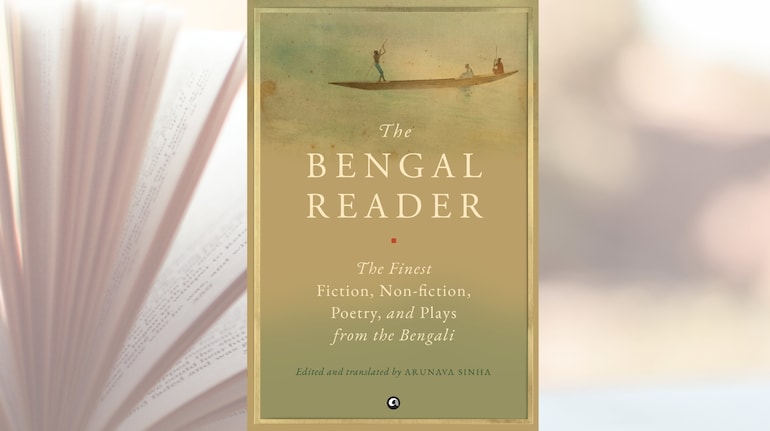
Excerpted with permission from the publisher The Bengal Reader: The Finest Fiction, Non-Fiction, Poetry, and Plays from the Bengali, Arunava Sinha (editor and translator), published by Aleph Book Company.
******
“Modern Science and the Hindu Dharma” by Meghnad Saha
‘IT’S ALL IN THE BYAD’
Many readers are unhappy at my use of the phrase ‘it’s all in the Byad’. A number of them have assumed I have expressed my contempt about the Vedas. But this is a misconception. There is some personal history behind the use of the phrase. The incident took place nearly eighteen years ago, when I had recently returned from England. I had acquired some fame in the scientific world. A renowned lawyer from the city of Dhaka (my compatriot, therefore) expressed a desire to learn of the scientific work that I had done. Fired by the enthusiasm of my early years, I gave him a detailed description of research at that time (on the natural state of the sun and the stars, which can be understood clearly with the help of the theory of ionization of elements). He proceeded to explain, at intervals of one or two minutes, ‘What’s new about this, it’s all in the Byad.’ Having objected mildly once or twice already, I said, ‘Sir, could you kindly show me which section of the Vedas contains these theories?’ He said, ‘I have not read the Byad, but I believe that what all of you claim to have achieved through science today is all in the Byad.’ This gentleman had passed the highest examination of the university with great honours.
Needless to add, I have scoured all the texts of the Hindu shastras, including the Vedas, Upanishads, Puranas, et cetera, as well as ancient books on Hindu astronomy and related sciences, but nowhere have I discovered the primary theories of modern science concealed within them. Learned men and women of all ancient civilizations have reflected on the position of the earth in the universe, on the movements of the sun, the moon, and the stars, on chemistry, on biology, but in spite of this, present-day science is in fact born of the collective research, judgement, and perseverance of European scholars over the past 300 years. Let me offer an example. Many in our country are of the opinion that in the eleventh century, Bhaskaracharya had indirectly referred to the force of gravity and was therefore comparable to Newton. In other words, there was nothing new about Newton’s discovery. But these logicians of the ‘a-little-learning-is a-dangerous-thing’ category forget that nowhere has Bhaskaracharya said that the earth and other planets move around the sun on an elliptical path. Nowhere has he proved that applying the laws of gravitational force and kinetics makes it possible to determine the orbits of planets. Therefore, it is nothing but the ranting of a madman to state that Bhaskaracharya or any other Hindu, Greek, or Arabic scholar had discovered the theory of gravity long before Kepler, Galileo, or Newton. Regrettably, there is no lack of such disseminators of non-science, who are spreading pure lies under the guise of the truth.
That people in this category are not yet rare is proven by the critic Anilbaran Roy. He, too, belongs to the ‘it’s-all-in-the-Byad’ league, though possibly he has read the Vedas, in translation if not the original. Accordingly, it has been possible for him to assert even more vehemently that it’s all in the Vedas. In the use of the phrase ‘it’s all in the Byad’, I have not expressed any manner of contempt towards the Vedas. I have merely articulated my position on those with the mentality of Anilbaran Roy.
WHAT IS IN THE VEDAS?
At the time of the incident alluded to above, that is to say, eighteen years ago, I had not read the Vedas. Needless to add, by the Vedas, I am referring to the Rig Veda. I went on to read the Rig Veda Samhita in its English and Bengali translations, for I do not have the ability to read it in the original Vedic Sanskrit. The critic Anilbaran Roy has possibly not read the Vedic Sanskrit original either, and even if he has, it will be of no particular use, because the Rig Veda was already impenetrable by the time of Panini (in the sixth or fifth century BCE). In the fourteenth century CE, Sayanacharya attempted to extract its meaning (Sayanabhashya). But it was primarily European scholars who collected and published the complete Vedas, and tried to unravel the meaning of the indecipherable portions of these texts. But despite their efforts, the meaning of much of the Vedas is not clearly obtained. There are many reasons for this—one of the primary ones is that various sections of the Vedas were composed in ancient times, and the times, places, and various conditions in which they were written, along with the identity of the class of people who wrote them, were completely forgotten by those who lived in the subsequent ages. Without a background of knowledge in these matters, understanding the real meaning is arduous, and those who come afterwards have to resort to laboured imagination. The first thing to find out is, when was the Rig Veda written? There are references to several astronomical events in it. Identifying the time of their occurrence is not very difficult. Professor Jacobi, Shankar Balakrishna Dixit, Bal Gangadhar Tilak, Probodh Chandra Sengupta, and other Indian and foreign scholars have conducted a scientific analysis of all these astronomical references in an attempt to identify the period in which the aforementioned sections of the Rig Veda were composed. If Basantakumar Chattopadhyay and other critics of the present writer who have studied mathematics in the past were to read these articles instead of broadcasting their redundant verbosity, they would be able to rid themselves of their mental inertia. It has been established in all these articles that none of the astronomical events referred to in the Rig Veda can be placed 4,000 years before the birth of Christ. Many scholars contend that various sections of the text were, in reality, composed or collated between 2500 BCE and 800 BCE. Where older events are cited, it is on the basis of oral records. For instance, in the almanacs currently in circulation here, Ashwini or Head of Aries is considered the first of the constellations. At present this is only an oral history, for in reality Ashwini was considered that way in 505 CE, not in 1939. Today’s almanac writers are passing off an astronomical event from 1,434 years ago as a current one out of mental inertia. According to many experts, even the oldest portions of the Rig Veda are only a collection of oral records of incidents and events that took place nearly a thousand years earlier. In any event, European scholars are not opposed to locating the oldest sections of the Rig Veda at about 2500 BCE.
Therefore the idea of the Satya Yuga mentioned in the Puranas, lasting 1,728,000 years and ending 2,165,040 years ago, is completely incorrect and imaginary.
By 2500 BCE, several great civilizations had originated in various parts of the world. The beginning of the Egyptian Civilization can be extended back to 4200 BCE. The pyramids and other structures were constructed in Egypt circa 2700 BCE. In 2600 BCE the Sumerian race was firmly at the pinnacle of civilization in Iraq. It was possibly in 1900 CE that the city of Babylon became the capital of Iraq as the centre of the ancient civilized world. A variety of evidence has been used to determine that the signs of pre-Vedic Indian civilization found in Mahenjodaro and Harappa can be dated to within two centuries on either side of 2500 BCE. Now the question is: in which lands was Vedic civilization in currency at this time, and were there any exchanges between the ancient Egyptian and Sumerian civilizations and pre-Vedic Indian civilization? The first reference to Vedic civilization was in the engraved script of the Mitannian kings in 145 BCE. The respect with which they have referred to the Egyptian and Babylonian civilizations suggests that they did not consider themselves on the same plane as them. Another aspect that deserves attention is that although the ancient Mitannians, Iranian Aryans, and India’s Vedic Aryans all spoke more or less the same language, there is as yet no unanimously accepted proof that they had a script of their own. On the contrary, there is evidence that, like the Turkish and central Asians in later eras, they adopted the local script wherever they went. For instance, the Achaemenid royal dynasty of Persia, especially Darius and those who followed him as king, engraved their edicts on the sides of mountains in 500 BCE in a language that was very close to the Vedic one, but used the Cuneiform script in use in ancient Babylon and the Aramaic script used in certain parts of their kingdom, especially Syria. In 1450 BCE the Mitannians had referred to Indra, Mitra, Varuna, and other Vedic gods in their edicts, but here, too, the Cuneiform script of Babylon was used. There is no evidence of the script used by the Aryans in India before 500 BCE. Emperor Ashoka’s edicts of 250 BCE were all written in the Brahmi script, which may have come into being much earlier. There is no continuous history of how this script was developed.
It will not be unreasonable to conclude from all of this evidence that the ancient Aryans had no particular script of their own, that they adopted the script of any country they conquered. Had they possessed a script of their own, they would not have made engravings in foreign scripts. Did the English change their script on arriving in India or China? In the Middle Ages, the Arabs brought many civilized countries under their control and forced the occupants of those countries to adopt the Arabic script. But the medieval Turkish or Hun barbarians adopted the Chinese script in China, the Persian script in Persia, and the Cyrillic script in Russia despite conquering those countries in part or wholly—because they had no script of their own.
I hope, therefore, that critics will acknowledge that the composition of the Rig Veda Samhita began in 2500 BCE, and that there were more advanced societies and civilizations in other parts of the world (Egypt, Iraq), and, possibly, in India too, than the ones presented in this text. A review of the references to rivers in the Rig Veda suggests that the ancient Aryans lived in the north-western parts of present-day Punjab and the eastern parts of Afghanistan, and that they frequently persecuted the more civilized residents on the banks of the Indus.
Are there any references to contemporary Sumerian or Egyptian civilizations in the Rig Veda Samhita? No clear evidence of this has been unearthed yet, but in a well-considered article, the late Lokmanya Bal Gangadhar Tilak has demonstrated that some indecipherable words and verses in the Atharva Veda, which have never yielded their meaning, become absolutely clear if it is assumed that they have been collected from the mythological tales that circulated in Babylon. If the Atharva Veda is considered to have been published circa 1500–1600 BCE, then it is proven from Tilak’s article that there was communication between India and Babylon at this time. Perhaps the meaning of some of the obscure portions of the Rig Veda might also be revealed in the same way.
The Rig Veda is but a collection of verses in praise of various nature gods like Surya or Savita, Chandra or Soma, and deities like Indra, Varun, Mitra, and others. Many subscribe to the belief that Mitra, Varun, Vishnu, etc are nothing but symbols of Surya or the sun god. But imagining the planets and stars and the forces of nature as gods and singing encomiums to them was not the original discovery or monopoly of Vedic Aryans. This practice could have been observed in the Egyptian and Sumerian civilizations, which were contemporary with the Vedic civilization, and, in fact, at specific levels of almost every ancient civilization everywhere. The ancient Egyptians used to consider Ra, the sun god, the chief among gods and the Sirius, the brightest star in the night sky, the symbol of the goddess Iris. The majority of the gods among the ancient Sumerians were derived from the planets and stars. For instance:
An or Anu was the sky; Samash or Babbar was the sun, the god of law and justice; Sin or Nannar was the moon; Istar was the goddess of beauty and love; Marduk was the planet of Jupiter, king of the gods; Nabu was Saturn, the god of writers; Nergal was Mars, the god of war. Portions of the verses which the ancient Sumerian bards and sages composed in praise of these and other deities whose identities came from rivers, seas, and mountains have been discovered in our times, and published in English translation by Dr C. J. Gadd, the deputy keeper of the Department of Egyptian and Assyrian Antiquities at the British Museum. Verses in praise of Egyptian gods have also been collected in The Egyptian Book of the Dead. The recently deceased renowned American archaeologist Professor James H. Breasted has proved in his book, The Dawn of Conscience, that most of the spiritual messages in the Bible that are described as having come from Jesus Christ are not original at all, and many of them are borrowed word for word from ancient Babylonian and Egyptian scriptures. In other words, the altruistic philosophy that two truly ancient civilizations had gathered from thousands of years of experience between 4000 BCE and 600 BCE went on to form the foundations of Christian altruism at a later stage. But in Christianity as well as other religions, gods based on stars and planets or rivers and mountains have been abandoned because of redundancy. The history of the subsequent 2,000 years has proved that there is no requirement for the worship of numerous gods to establish the basis of spirituality.
A survey of the Vedas and subsequent sacred texts also leads to the same conclusions. The material for writing a history of the period between Mahenjodaro (2500 BCE) and Ashoka (300 BCE) has not yet been found, but it was in this interval that the primary sources of India’s faiths and civilization were discovered and formed. The confluence of two or three different streams of Vedic and pre-Vedic civilizations led to the formation of Indian faiths, society, and civilization. In the texts composed in the following period (after 300 BCE), such as the Mahabharata, the Ramayana, and the Puranas, we only hear the faint echoes of orally passed down records of the events of these 2,200 years. When the Vedic Aryans came to India, they must have performed their religious ceremonies with great pomp, but subsequently (in a period estimated to have begun several centuries before the birth of Buddhism), many questions were asked about the efficacy of these rituals. The Upanishads provide a glimpse of this sceptical outlook; the metaphysical aspect of the Upanishads is built on a foundation of Brahmaism, with the Vedic gods having been discarded. Buddhists and Jains ignored the Vedas entirely in forming their religious views. But many of the scriptures and philosophies considered eternal are in fact primarily in opposition to the Vedas. Take Samkhya philosophy; in an extensive critique, Bankim Chandra Chattopadhyay has said, ‘Nowhere does Samkhya philosophy scorn the Vedas; on the contrary, it includes the ostentation of Vedism. But in justifying its precepts by citing the Vedas, the preacher has eventually extirpated them.’
In the fifth chapter of his essay on Samkhya philosophy, Bankim Chandra has enumerated all the theories presented in various texts of Hindusim on the origins of the Vedas. The curious reader may peruse what he has written. Deliberating on all these ‘theories’ makes it evident that the view that the Vedas are not composed by humans and are infallible came into being in relatively modern times, that is, when the Puranas etc were composed. There are many unusual and unclear opinions on the origin of the Vedas in the ancient scriptures, but none of them has tried to establish the Vedas as not composed by humans and infallible.
The question may arise, what is the reason for this fame of the Vedas? Even those who oppose the Vedas use them to justify their arguments— why? The answer can come from another religion: Islam, which is based on the Quran. What Hazrat Muhammad said on listening to God’s revelations was recorded by his disciples. It is this collection of sayings that is the Quran. But within twenty years of Prophet Muhammad’s death, variations appeared in the texts and transcripts of the Quran in different parts of the vast world of Islam. The Caliph or the chief of the Islamic world at that time was Uthman. Caliph Uthman realized that if divergent versions of the Quran were to be in circulation in different countries, there would soon be a lack of unity within Islam, the Islamic world would break up into a hundred pieces. He devised an ingenious solution to prevent this. He convened a gathering of all of Prophet Muhammad’s disciples and work associates who were alive, and collected their testimony on whether the versions of the Quran available in different countries were indeed the words of the prophet or not. After a long examination, the compositions that were established as the genuine utterings of Prophet Muhammad were recorded to create the manuscript of the authentic Quran, and according to a new law, any future version with even the slightest error would have to be considered impure. Because of this stricture, it has been impossible to change the text of the Quran anywhere in the immense Islamic world over the past fourteen centuries. The Quran is the same everywhere across this world. But despite such rigour, various sects have been born within Islam. According to Professor Tarachand, there are at present seventy two different sects within the religion, all of whom publicly acknowledge the Quran (God’s revelations passed on through Prophet Muhammad’s words) as not having been composed by human beings and being infallible. But in reality, the religious beliefs and practices of these sects are often greatly divergent, and not ruled by the Quran as in the case of orthodox Muslims. Among them are people who adhere to a range of faiths, from the extreme rationalist sect (who in fact believe in the philosophies of Greek rationalist philosophers like Socrates, Plato, Aristotle, and others) to the Aga Khan sect (whose followers repose their faith in Indian beliefs like avatars and reincarnation). This is because Islam spread very quickly in Syria, Persia, Iraq, Central Asia, and so on, and although the residents of these countries were indoctrinated in Islam, they could not entirely forsake the religious beliefs of their own countries. In many places, experts in ancient Greek or Indian theologies had to convert to Islam but were unable to be respectful to its beliefs. But the royal power was Islamic, and none of them had the courage to speak against it. So even as they swore upon the Quran in public, in reality, they were opposed to it, according to orthodox Muslims.
The same argument can be made about the ‘infallibility of the Vedas’. When the Vedic Aryans established their supremacy over northern India a little before or after 2500 BCE, their leaders, the priests (sages) and kings conducted religious ceremonies with great splendour. During these ceremonies, they sang verses in praise of the gods and goddesses they worshipped and sacrificed animals. These verses were collected, enumerated, and categorized well before the time of Panini. But right from the age of the Upanishads, cogitatively inclined sages became sceptical about the spirituality of these ceremonies. Meanwhile, those from the pre-Vedic civilizations who harboured religious beliefs (possibly in the Pashupatic or Narayanic faiths) also tried to assert themselves. The ruling powers and the priestly forces reposed deep faith in Vedic rituals—therefore, those who believed in ancient faiths did not have the courage to broadcast their views in public. So they cited the faint strains of these faiths in the Vedas to re-establish their faiths. This was how the pre-Vedic Shiva Pashupati was merged with Rudra, the god of destruction in the Vedas, and attempts were made to unify Vishnu, the sun god of the Vedas, with Narayana of the Narayanic faith. In this way, the adherents of the Pashupatic and Narayanic faiths used the Vedas to elevate the status of non-Vedic practices or religions to respectability, although orthodox believers in the Vedas everywhere were not pleased by this. But the Jains or the Buddhists did not take this path at all; they rejected the infallibility of the Vedas directly and declared that Vedic practices were futile.
The present writer has attempted to grasp the fundamental principles of the Hindu Vedas and other religions from the neutral standpoint of the scientist. There can be no question of contempt or disrespect here. This writer believes that the world phenomena, historical knowledge, and experience of human nature on which the ancient religious texts are based, cannot be used as the basis for a form of spirituality suitable for today’s times. How such spirituality based on a scientific temperament that is appropriate for the new age can be fostered is for another article.
**********
Arunava Sinha (editor and translator), The Bengal Reader: The Finest Fiction, Non-Fiction, Poetry, and Plays from the Bengali, Aleph Book Company, 2025. Hb. Pp. 600
The Bengal Reader is an expansive anthology of Bengali writing in translation to be published in one volume. Ranging from the nineteenth century to the present, it is edited and translated by prolific translator, Arunava Sinha. It opens up the wealth of Bengali writing to a wide audience, both Bengali and non-Bengali.The book is arranged along the axis of time. The first section contains the works of the ‘argumentative Bengali’. These include the likes of Rammohun Roy’s argument against sati, Michael Madhusudan Dutt’s The Slaying of Meghnad, Lalon Fokir’s verse, and Bankim Chandra Chattopadhyay’s satire. The second section tips its hat to Rabindranath Tagore, then goes on to reveal an extraordinary line-up of writers who also shaped and expanded the perspectives of their readers and Indian society in general. Here, you will read an excerpt from Sarat Chandra Chattopadhyay’s Devdas, essays by scientists like Jagadish Chandra Bose and Meghnad Saha, and Sukumar Ray’s humour, among others.
The third section presents a slew of independent voices. It includes seminal works by luminaries like Bibhutibhushan Bandyopadhyay, Manik Bandyopadhyay, Jibanananda Das, and Sukanta Bhattacharya. Sinha attributes the boom of literary genius in this era to a ‘happy concatenation’, where magazines and cheap, widely available books ignited the imagination of both readers and writers. Next comes the era of the ‘revolutionary fires’, work by those who questioned and resisted the status quo—Satyajit Ray, Ritwik Ghatak, Kanu Sanyal, and Ashapurna Devi. The final section presents modern writers dealing with caste hierarchies, body politics, consumerism, and the media—like Manohar Mouli Biswas, Joy Goswami, and Srijato.
The end of the anthology signals the crumbling of existing hierarchies in the publishing world and heralds the coming of new, raw voices. Vast and unparalleled in its scope, The Bengal Reader reflects the literary life of Bengal across two centuries. It will outlast generations and stand the test of time.
The extract from the book that is published here is by Meghnad Saha (1893-1956). Saha was an Indian astrophysicist who developed the theory of thermal ionization. He also made the original plan of the Damodar Valley Project and was a strong advocate for the integration of modern science with Indian culture and heritage. His research focused on how scientific inventions and studies could be used in nation-building and societal progress. He was a professor at Allahabad University from 1923 to 1938, and a professor and Dean of the Faculty of Science at the University of Calcutta until his death in 1956.
Arunava Sinha translates classic, modern, and contemporary fiction, non-fiction, and poetry from Bengali and Hindi into English. He also translates fiction and poetry from English and Hindi into Bengali. His translations have been published so far in India, the UK, the USA, and Australia. The Bengal Reader is his hundredth translation to be published. He teaches at Ashoka University, where he is also the co-director of the Ashoka Centre for Translation.
Discover the latest Business News, Sensex, and Nifty updates. Obtain Personal Finance insights, tax queries, and expert opinions on Moneycontrol or download the Moneycontrol App to stay updated!
Find the best of Al News in one place, specially curated for you every weekend.
Stay on top of the latest tech trends and biggest startup news.