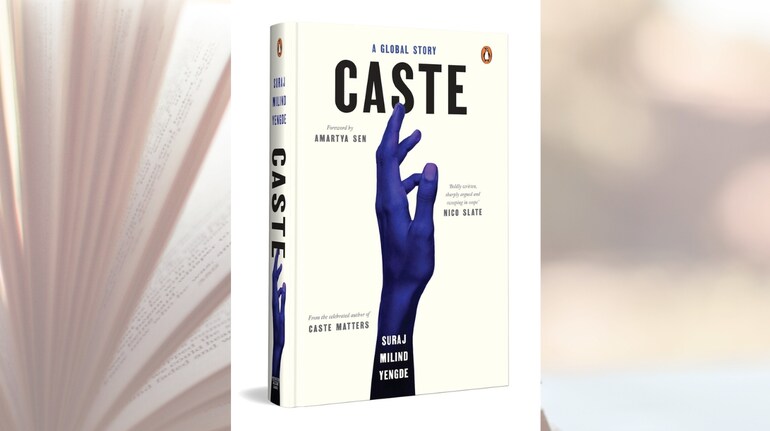
Excerpted with permission from the publisher Caste: A Global Story | A Powerful Account of Dalit Rights, Caste Discrimination, and Social Justice Movements Around the World Suraj Milind Yengde, published by Penguin Allen Lane / Random House India.
***
The tendency in this moment, as in many others, is to speak of India as a unitary society. Of course it is not, and the largest share of those writing, posting, and reading about Black Lives Matter represent a very specific part of it. That part is fluent in English, digitally savvy, and well-versed in US politics to understand the issues at hand—a combination of characteristics almost wholly exclusive to the country’s social and economic elite. And that elite is almost wholly drawn from a narrow set of “twice-born” savarna castes that form the three highest tiers of the four-tiered Hindu varna system—the brahmans, kshatriyas, and vaishyas. These castes constitute a minority of the country’s population, yet in all the institutions of social, cultural, political, and economic power, they are the dominant majority. They are the people who run the country.
It was a strange sight for me, a Dalit—a person outcasted by society—to see the dominant castes decry “Indian” racism, casteism, and religious prejudice. The country is not innocent of any of these things, but the problems, especially when it comes to these castes, are not so “Indian” after all.
Consider the example of the United States. It is easy to speak of racism as an American problem, but framing it this way obscures a more specific story. In the United States, racism is a white instrument that holds down Black people: what is involved here is a matter of colour castes. Colour castes draw on the power attached to the lineage of one’s birth and to societal beliefs: one is born into an unbreakable, rigid caste structure. In America, an individual’s status is largely defined by two main factors: their birth into a certain caste rank and their class. This dual recognition becomes a means of determining a person’s status.
Often, those in the dominant caste do not appear to be the power-holders, as they conceal their presence through state structures and societal institutions. Conversely, oppressed castes are made visibly apparent, engaging constantly with the state either to demand their rights or claim their share in state operations. In this context, colour castes are regarded as organizing principles necessary for any normal society to function. This normalization downplays the significant influence caste has on society’s mindset and functioning. Every significant shift in the history of American stratification, although imperfect and incomplete, has necessitated a change in white caste beliefs and behaviours, both voluntary and through state enforcement.
The nation, founded by men of the white caste, was never meant to be universally democratic and equal—the continuation of slavery was taken for granted. While Black people never needed to be convinced of the evils of slavery, white people did. The American Civil War was their moral reckoning with it. Even after slaves were freed, the white elite found ways to strip Black people of their rights, their intelligence, and their character. Decades of Black activism forced white America to reconsider legalized segregation and secured the Civil Rights Act of 1964, which prohibited discrimination in terms of race, colour, religion, sex, or national origin. Yet the exclusion and marginalization of Black people continued. More than half a century since the Civil Rights Act, Black people remain in an economic stranglehold that maintains a yawning gap in wealth and opportunity between them and whites. Redlining policies pushed masses of Black people into ghettoes, and biased police officers and courts pack Black people into prison at a rate five times higher than for white people. Black Lives Matter has forced another moment of truth upon the white-dominated country. This is why the movement holds real promise—though it is essential to remember Khalil Gibran Muhammad’s caution that “Americans have short memories and long appetites when it comes to racism”.
In India, sweeping talk of “Indian” prejudice advantageously shields the real architects of the social order from responsibility. The forces that give life to caste are apparent. The brahmanical-Hindu “holy” books, which enshrine the varna system, have been preserved, ameliorated, and propagated for millennia by the brahmans, who exercise monopoly over the priesthood and vast power over social thought. The other dominant castes have surrendered their minds to brahmanical beliefs and have joined the project of translating these into reality. While the equations between the dominant castes have seen various configurations over time, as have their relations with changing political rulers across historical periods, their collaboration in shaping the present state of affairs is indisputable.
Religious and social hatred is deeply enmeshed with caste belief. According to the rules of caste, all those not born into the varnas are subhuman, and their mere proximity or touch is a source of spiritual pollution. This explains the ostracization of many of the country’s ethnically stratified minorities—most notably the indigenous Adivasis, who are ranked alongside Dalits in the brahmanical hierarchy. Huge numbers of Indian Muslims, Christians, Buddhists, and Sikhs come from these outcaste groups, having converted to try to shake off the stigma they carry in Hindu eyes. But the dominant castes do not forget that stigma so easily and brand them with an added mark for the supposed sin of abandoning the Hindu religion. Even in their new faiths, which espouse human equality in the eyes of God, Dalit and Adivasi converts find that a narrow elite, often converts from higher castes, continue to shun them.
Colour comes into the picture too, even if skin tone does not set oppressors and oppressed as neatly apart in India as it does in the West. A common belief, though not always true, associates darker skin with lower caste. Slurs of caste and colour overlap and are paired together in Indians’ vocabularies. Darker groups—South Indians, Siddis, Africans, and others—face rampant discrimination. Generally, people with the privilege to determine their treatment—police and government officials, landlords, employers—come from the dominant castes. So do those in the media, film, advertising, and other cultural industries with the greatest power to shape physical and cosmetic ideals.
While it can be argued that the local fetish for fair skin owes a good deal to the complexes left behind by colonial rule, this cannot be used to deflect attention from indigenous prejudice; varna literally translates as “colour-based hierarchy”. The Indian elite make much of the fact that they have been subjected to racism by white people, whether in the past or the present, and on this basis claim solidarity with Black people. But, whether in India itself or in the Indian diaspora, this is the only form of discrimination they are willing to critique.
Casteism, colourism, and religious hatred in India are brahmanical instruments of the dominant castes for holding down Dalits, Adivasis, Muslims, Christians, and many others. The refusal by the dominant castes to acknowledge this is what keeps movements like Black Lives Matter from having any real impact here, and prevents any national introspection on how this society debases the lives of its oppressed ethnicities and castes and religious minorities.
The evil genius of the caste system lies in what Dr Ambedkar described as its “graded inequality”. The brahmanical order thrives on a seemingly infinite fragmentation of castes and subcastes, the position of each being dependent on its discrimination and violence against those it claims superiority over in the endless quest to defend and improve its rank. It is a near-perfect guarantor of hierarchy—self-enforcing, self-expanding, and self-perpetuating, with a built-in mechanism against the unity of the oppressed. The system has survived for thousands of years without any major change to its essential structure. It is impervious to political revolutions and ideological challenges and is able to transplant into new religions and lands.
If the elite castes ever care to confront religious hatred, racism, and casteism, they will very likely have to find the political morality to attack the foundations of caste. The foundation stone itself, as Ambedkar pointed out, is the brahmanical Hindu religion, Hinduism, which is so centred on the varna system that it cannot survive without caste—or, put another way, the annihilation of caste would depend on the dismantling of the shastras (holy books) upon which Hinduism stands. To vainly wonder when Dalit, Muslim, Adivasi, and so many other Indian lives will matter, while glossing over this reality, is an obfuscation of the Hindu religion and of Indian history.
India’s caste-oppressed communities have taken inspiration from the anti-racism struggle in the United States for over a century, seeing parallels between the evils of caste and of race, yet dominant-caste thinkers have usually tried to undermine claims to solidarity and shared experience—with the notable exception of Vijay Prashad, who authored a few articles along these lines. Before and since the creation of an independent India in 1947, the oppressed castes have repeatedly asked the dominant castes to recognize their plight, acknowledge their part in it, and redress the injustice. Yet at every step the dominant castes have refused them empathy and undermined their efforts at change. In the United States, in the wake of George Floyd’s killing, Black people asked white people to hold themselves accountable, and they are being heard through institutions and organizations by the white power-brokers. In India, the Dalits have been asking the same thing of the dominant castes for a long time. The response they get in return is dismissal or silence.
Suraj Milind Yengde, Caste: A Global Story | A Powerful Account of Dalit Rights, Caste Discrimination, and Social Justice Movements Around the World, by Penguin Allen Lane / Penguin Random House India, 2025. Hb. Pp.384
Caste, and caste-based discrimination, are not just Indian issues. They are experienced throughout the world, from Britain to Bahrain, Canada to South Africa. This is a global phenomenon, demanding global solutions.
Leading scholar Suraj Milind Yengde shines a light on the Dalit experience internationally, from indentured labourers in the nineteenth-century Caribbean to present-day migrant workers in the Middle East. Combining history, ethnography and archival research, he offers a compelling, comparative approach to caste and race from ancient times to today. What have been the impacts of colonialism, religion and nationalism on caste-based hierarchies worldwide? What can we learn from caste-related movements in India and internationally? Why hasn’t the South Asian diaspora embraced the anti-caste struggles of the homeland? And what are the limits of Dalit–Black solidarity?
Exploring the global footprint of the anti-caste struggle—from its links with Black Lives Matter to the work of international Ambedkarite organisations—this is a powerful analysis of world politics from the perspective of one of the most oppressed communities on Earth. Asking probing questions about the nature of inequality, Yengde issues an energetic call for a cosmopolitan Dalit universalism, as a vital part of today’s fight for social justice and equality.
The book extract published here is from a thought-provoking chapter entitled “Race and Caste: In the age of Dalit-Black Lives Matter”. Yengde explains in the opening lines that:
This chapter deals with the complexities of the Dalit and Black movements in India and the United States respectively, and the possibilities of their similarities and solidarities as framed in both academic literature and the popular media. Though appealing, such a comparison exaggerates what both movements stood for. To begin with, the positions of the Dalit and Black movements, generally speaking were divergent. In America, from the 1960s there were radical uprisings among the educated Black youth, who were unfair targets of police harassment and brutality. For the Dalits in India, whose status was that of a subordinate minority and untouchables, any demands they made were met with localized violence, either committed against individuals or the Dalit ghettoes. Dalit women were a particular vulnerable target.
Suraj Milind Yengde is Assistant Professor of History and Africana Studies and a Ford Foundation Presidential Fellow at the University of Pennsylvania. His second doctorate at the University of Oxford explored the intellectual histories of caste and race from the Middle Ages to the present, examining theories of W.E.B. Du Bois, B.R. Ambedkar, Frantz Fanon and Steve Biko. He is the bestselling author of Caste Matters.
Discover the latest Business News, Sensex, and Nifty updates. Obtain Personal Finance insights, tax queries, and expert opinions on Moneycontrol or download the Moneycontrol App to stay updated!
Find the best of Al News in one place, specially curated for you every weekend.
Stay on top of the latest tech trends and biggest startup news.