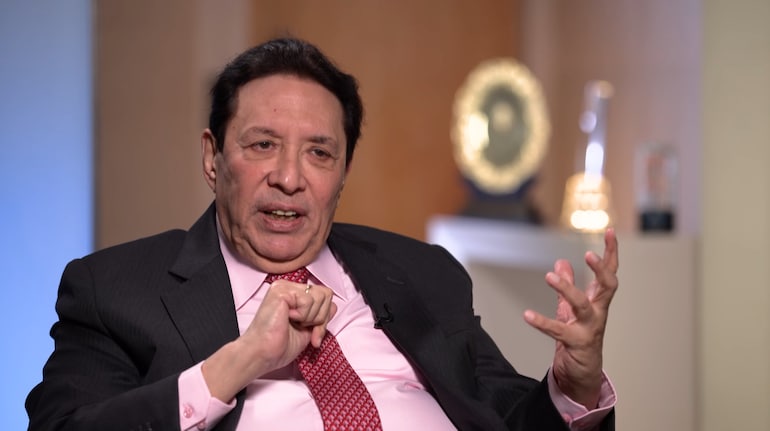
HDFC Ltd is built on the trust and confidence of customers and it is difficult to replicate its model, Keki Mistry, former vice chairman and CEO, said in an interview to Moneycontrol on December 22.
He believes the current cost structure in which most lenders in the housing space operate is expensive and they should build scale. Mistry remained optimistic about the housing sector and he is hopeful of a reduction in personal income tax slabs in 2026. A little more consumer confidence may go a long way in further sprucing demand.
Do you see the promise of 2025 getting carried forward to the next year?
I think so. We've seen a pickup in demand for most products, particularly two wheelers and consumer durables, post the GST (goods and services tax) cut. Inflation may continue to remain extremely benign unless something like oil prices shoot up. Interest rates should also not see an upward trend at least in the first half of the year.
Also watch: Veteran banker Keki Mistry speaks on demand in housing sector, why rate cuts were needed and more
What are the major takeaways for you, as a financial services expert, in 2025?
I would say low interest rates. Liquidity, which was very tight in 2023 and a fair part of 2024, has eased up significantly. Banks have started getting deposits again. Inflation is benign and GDP growth is strong.
As we look forward to 2026, what’s your budget wish list?
When we reduced the corporate tax rate to 25 percent, we saw massive investments happening. Tax rates for individuals is at a peak maximum marginal rate of 40 percent. If one can bring it down in line with the corporate rate, say to 25-30 percent, I think it will bring in a lot of investments. The money that the government will lose for a short while will be more than offset within two years by the additional jobs created.
Did this recent 25 basis point cut surprise you?
I thought initially there could be a rate cut to give a further momentum to the economy. Then, when the rupee came under pressure, I thought the RBI may hold back. But a rate cut is a good, because it will further drive economic momentum.
It's also after a very long time that India is seeing its repo rate decline by 125 bps in a year…
We were seeing a bit of sluggishness initially. So it needed a little momentum. The 125 basis points cut rate will hopefully boost consumption. But housing may be very different from car loans and consumer loans. It is historically not just a function of interest rates. It's a function of the mindset, the confidence level of that individual and the feel- good factor.
What do we do to get the housing demand back?
It is ultimately a question of confidence. If you look at Mumbai, for example, there is so much construction happening --obviously because there is a demand to absorb that construction. Demand may not be even across the country. In the smaller towns, we hear that demand has been relatively weak, but in large towns and cities, demand has been fairly good. With agriculture doing well this year, I think even in these smaller towns, you should see a pickup in demand.
What we are also seeing in Mumbai is that there is huge demand for luxury apartments and we see a lot of growth in the affordable market. The mid- market is pretty much vacant. What are your thoughts on this?
The base might be a little higher and hence the percentage growth may not look very high, but even in that mid-market segment, properties in the Rs 10 – 15 crore range is seeing reasonable demand in Mumbai. Luxury apartments have done well, but if you see an absolute value, it’s really nothing to talk about. It just gets a lot of media attention because the price is high. It's the mid-market segment and affordable housing segment which is important and there is demand.
Three years post the HDFC – HDFC Bank merger, and we don’t have an HFC equivalent to erstwhile HDFC’s size. What's stopping the housing finance market?
In HDFC, we used to do individual lending, which was the bulk of our lending. We used to do a certain amount of commercial lending and construction finance. Lending to individuals is being done by every bank in the country. Many NBFCs are also in the business. There’s no shortage there. The only place where there might be a void is construction finance, which was about 7 percent of our balance sheet. That void is now being filled up by real estate funds. But the cost of funding for real estate would be always higher than the cost of funding that we (HDFC) could have provided.
But no HFC still comes close to HDFC Ltd…
It's not easy to replicate the HDFC model. Our strength emanated from the trust we had with the common man. We got deposits at reasonable rates. We got funding from banks and institutions at reasonable rates. We could raise international funding and swap it through various structures -- again, at reasonable rates. So, our cost of funding was not as high as the cost of funding of other housing finance companies. The biggest advantage we got was that our operational cost was extremely low. Our cost income ratio was under 8 percent, whereas for most other housing finance companies, it would be upwards of 20 – 30 percent.
I find it extremely difficult to understand why it should be so. So if your cost structure is going to be so high, you can't price your housing loans the way HDFC used to. With due respects to all the housing finance companies, I think it will be very difficult to grow their balance sheet to a very substantial sense with this cost structure.
What's your view on AI? Can it sweep India like it’s being said in the US?
I think it's too early. AI will be a big thing for sure. But in financial services, I don't think it’s going to sweep the sector. Even when people could take housing loans digitally, not even 1 percent of our (HDFC Limited’s) customers took advantage of that. If you use apps to apps to sell, your cost of operation and cost of getting the loan will be lesser. But the appraisal (of the loan) will not be as good. It may increase the NPAs (non-performing assets). I still believe that, even today, most people will still visit a branch to take a loan, while applications can be submitted online.
Are you concerned about how long the tariff situation has stretched?
When the US imposed tariffs a few months ago, stock markets reacted very negatively. At that time, I was of the view that it won’t have more than the a 15 - 25 bps impact on GDP. We have taken measures within India to increase domestic consumption, and, by and large, domestic consumption has played out. GST cut has helped significantly. Our GDP growth is faster. I'm not very worried about tariffs, per se. The relationship between India and the US is more important.
In the last 1-2 years, we have seen a lot of money pouring into wealth and asset management. Do you see this trend continuing?
Historically, in India, our investments have been bank deposits and insurance. Very little money came into equity because it was not understood in the smaller towns. Now, with the emergence of social media and with the way markets have turned around in the last four years, people who had never thought of investing in stock markets are now investing. SIP, or system investment plan, has been a huge success. When Milind Barve was the HDFC AMC CEO, he started the product. Penetration levels of Indians investing in equity, by global standards, is low.
Are bank depositors moving out in search of lucrative products?
It’s a complete misnomer. When I buy a share, I'm paying from my bank account into another bank account. The money remains within the banking system. It's not that bank deposits are getting depleted because people are investing in the stock market. The nature of the deposit could theoretically shift from a savings account to a current account, but it will still remain within the banking system. I don't think the fight for deposits has much to do with equity. It was more because the real bulk of the deposits come from the mass market, and not the HNIs (high net worth individuals). Also, there was a period of high food inflation. For a middle income or a lower middle income person, food is the single biggest item of consumption. If your cost of food goes up a lot, the ability to save money shrinks. I would give it more importance than stock markets doing well.

Discover the latest Business News, Sensex, and Nifty updates. Obtain Personal Finance insights, tax queries, and expert opinions on Moneycontrol or download the Moneycontrol App to stay updated!
Find the best of Al News in one place, specially curated for you every weekend.
Stay on top of the latest tech trends and biggest startup news.