The Insurance Regulatory and Development Authority of India (IRDAI) is likely drawing up a framework to cap commissions paid to insurance agents, brokers and digital intermediaries. The move follows recent amendments to the Insurance Act that empower the regulator to intervene in distributor compensation, sources told Moneycontrol.
According to industry executives, IRDAI is likely to release draft regulations latest by four months after which stakeholder consultations will follow. The new regime is expected to be implemented in a phased manner over six to twelve months, allowing insurers and distribution networks time to recalibrate commission structures across life, health and general insurance, sources said.
Moneycontrol’s emails seeking IRDAI’s response remained unanswered at the time of publishing. The report will be updated when the reply comes in.
Why high commissions are under the scanner
In FY25, life insurers paid a record Rs 60,800 crore in commissions, up 18 percent from the previous year, even as overall premium growth was just 6.7 percent, indicating that commission growth significantly outpaced core business expansion.
Commission expenses alone accounted for nearly 6.9 percent of premiums, a rise from around 6.2 percent the previous year, the IRDAI annual report, which was recently released, showed.
In the non-life space, gross commission costs also remained sizeable, absorbing around Rs 47,266 crore of insurer outgo in FY25, with private general insurers accounting for the bulk of this spend.
The Reserve Bank of India has also flagged concerns around high commissions and misaligned incentives in the insurance sector.
In its Financial Stability Report (FSR), the central bank cautioned that elevated commission payouts can weaken underwriting discipline, increase expense ratios and pose conduct risks, particularly where insurers rely heavily on intermediaries for growth. It highlighted that such incentive structures could encourage short-term volume chasing at the cost of long-term solvency and consumer protection.
IRDAI also flagged commission ratios in segments such as motor insurance, where intermediaries’ payouts can range as high as 25-57 percent of premium, inflating costs for consumers and prompting discussions with industry executives on the need to moderate such practices.
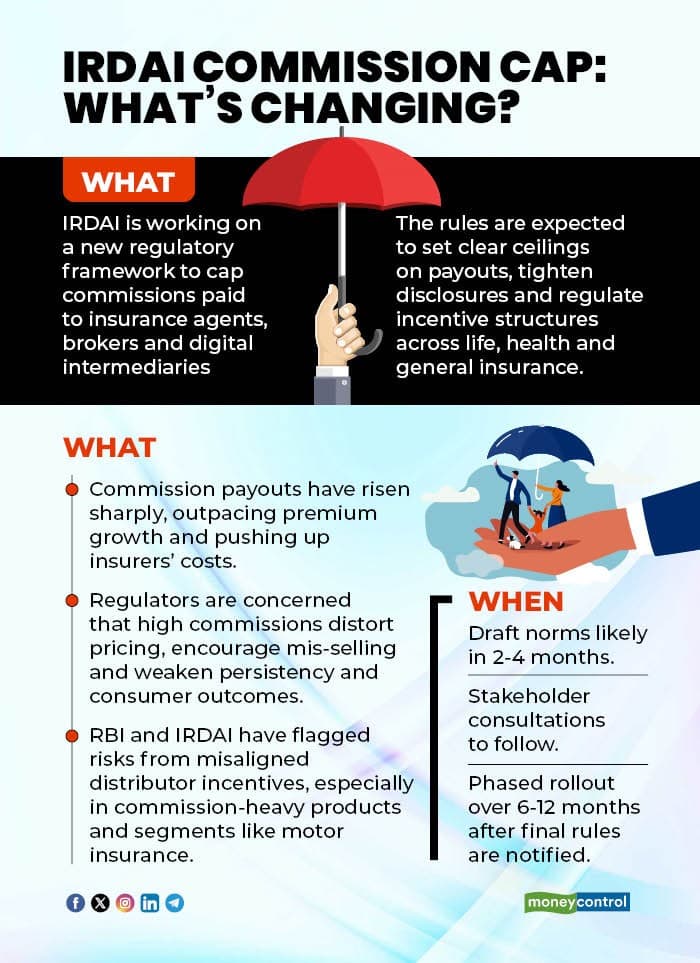 IRDAI commission cap: What’s changing?
Earlier attempts
This is not IRDAI’s first attempt to rein in commissions.
In 2023, the insurance sector regulator relaxed commission rules, allowing insurers more flexibility to design payout structures as long as they stayed within overall expense limits.
The regulator also asked insurers to improve disclosures around commissions and distribution costs.
However, the framework did not set hard commission caps and largely relied on internal controls and board oversight.
Officials believe this may have led to uneven outcomes across the industry, prompting IRDAI to move towards a more uniform and enforceable commission regime.
Regulatory powers strengthened
The amendments to the Insurance Act, 1938, and the IRDAI Act, passed during the recently concluded winter session, significantly enhance the regulator’s authority over distributor remuneration.
Under the revised law, IRDAI can specify commission ceilings and remuneration norms through enforceable regulations, replacing its earlier reliance on broad expense limits or insurer discretion.
The regulator can now not only determine how much distributors are paid but also how commissions are structured, disclosed, reported and audited. This includes oversight of upfront commissions, trail commissions, volume-linked incentives and non-monetary rewards.
Crucially, commission-related provisions have been removed from the statute and vested with the regulator, giving IRDAI flexibility to revise limits as market conditions evolve. This opens the door for product-specific and channel-specific caps across agents, corporate agents, brokers and web aggregators.
GST, ITC pressures add urgency
The regulatory push comes amid mounting margin pressures following changes in GST treatment, particularly restrictions on input tax credit (ITC) for commissions, marketing and outsourcing expenses.
Moneycontrol has reported that several private insurers have responded by reworking distributor compensation such as cutting payouts, tightening incentive slabs or shifting costs onto intermediaries to offset the ITC impact.
Public sector insurers, however, have largely refrained from passing on the burden, choosing to absorb higher costs amid concerns over agent morale and distribution stability. Industry executives are of the view that this divergence may have widened cost and margin dynamics across the sector.
Discover the latest Business News, Sensex, and Nifty updates. Obtain Personal Finance insights, tax queries, and expert opinions on Moneycontrol or download the Moneycontrol App to stay updated!
Find the best of Al News in one place, specially curated for you every weekend.
Stay on top of the latest tech trends and biggest startup news.