






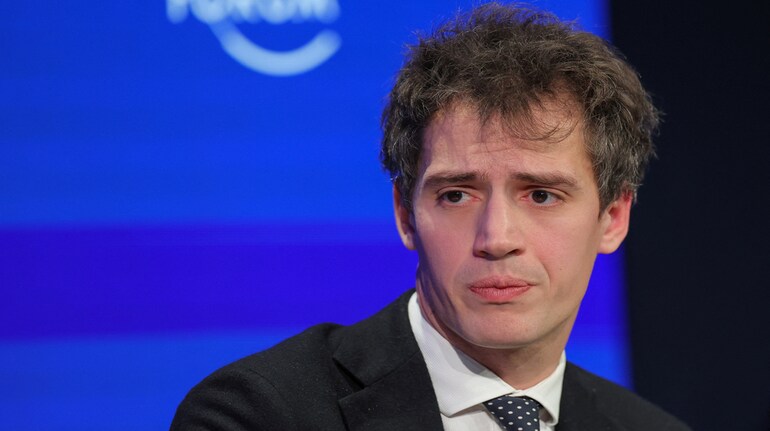

French artificial intelligence startup Mistral AI’s co-founder and CEO Arthur Mensch on February 19 said India holds a significant advantage in shaping the next wave of artificial intelligence, pointing to the country’s talent base, market scale, and cultural diversity as critical enablers.
Speaking on the fourth day of the India AI Impact Summit, Mensch said, “We believe the India opportunity is extremely large… its talent — a quarter of our researchers are Indian — its diversity of culture, its ambition, and the size of its market give it immense leverage in building differentiated artificial intelligence.”
His remarks come amid a global push by governments to reduce dependence on a small set of technology providers dominating the AI stack.
Warning against AI concentration
Mensch cautioned that the rapid rise of generative AI risks concentrating technological and economic power in the hands of a few companies unless countries actively invest in their own capabilities.
“There is a real risk today of excessive concentration of power in artificial intelligence,” he said. “We should not live in a world where three or four enormous companies control the deployment of AI and access to information — because AI is increasingly how we access information itself.”
He argued that nations must retain ownership of critical parts of the AI value chain — from models to infrastructure — to avoid strategic dependency.
“Every country and economic community must have a strategy to own part of this stack — not all of it, but enough to prevent excessive leverage and maintain global stability,” he said.
Call for sovereign AI infrastructure
Mensch urged governments to treat AI as foundational infrastructure, akin to energy or telecommunications, and invest accordingly.
“To governments, I would say: invest in AI infrastructure that you own and make sure to distribute it to local and regional providers,” he said, adding that developing domestic talent and datasets would be essential to ensure cultural and linguistic representation in AI systems.
He emphasised that open-source models and local partnerships can help countries avoid widening the digital divide while enabling broader participation in AI-led growth.
India positioned to lead
Highlighting India’s role, Mensch said the country could emerge as a global AI innovation hub if it builds and controls its own AI ecosystem.
“By controlling its own AI, India can become a global hub for innovation and help lead the way for the rest of the world,” he said.
India’s scale, multilingual environment, and developer base provide the ingredients needed to create differentiated AI solutions that can also become exportable technologies, he added.
From novelty to economic engine
Mensch described the past two years as an inflection point for AI adoption, moving from experimental chatbots to systems capable of executing complex, multi-step tasks.
“We need to seize the moment… we’ve gone from chatbots that were amusing two years ago to systems where we can delegate tasks over multiple hours and have an army of AI delegates working on our behalf,” he said.
That shift, he noted, would fundamentally reshape productivity, entrepreneurship, and software development, lowering barriers for startups while forcing enterprises to build customised AI systems around their own proprietary knowledge.
Discover the latest Business News, Sensex, and Nifty updates. Obtain Personal Finance insights, tax queries, and expert opinions on Moneycontrol or download the Moneycontrol App to stay updated!
Find the best of Al News in one place, specially curated for you every weekend.
Stay on top of the latest tech trends and biggest startup news.





