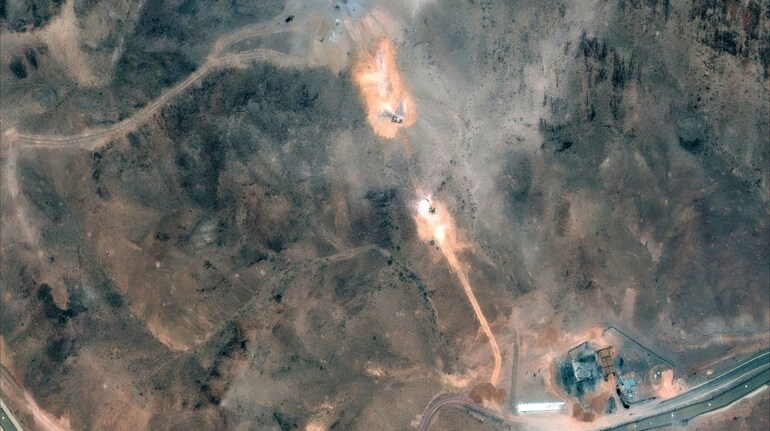
On June 22, the United States made a rare assault on Fordo, Iran's secret nuclear enrichment facility buried beneath a mountain. With the GBU-57 — a 30,000-pound "bunker buster" — American bombers blasted Fordo's air shafts with showers of explosives. The aim was not so much to reach all the way to the centrifuge rooms but to knock the plant out of operation with shock waves and roof damage, the New York Times reported.
Why Fordo is impossible to hitFordo was designed to withstand such attacks. Built more than 260 feet underground, and as deep as 360 feet, the complex rests below volcanic rock known as ignimbrite, which is extremely porous and good at soaking up energy. That geology, together with reinforced concrete and a set of underground levels, disperses the force of blasts. Experts describe how even the most advanced bombs might possibly not topple the facility.
The role of ventilation shaftsBecause the main chambers were out of reach by direct penetration, US planners focused on Fordo's ventilation shafts. The entrances represented a potential path for bombs to reroute destructive energy toward the heart of the complex. Six GBU-57s were aimed at each shaft — the first to blast through protective caps, others to cascade deeper into fractured rock. Computer simulations project shock waves cascading down the shafts could have caused high-level disturbance even without landing on centrifuges directly.
Limitations of the GBU-57The GBU-57 is the United States' deepest-penetrating conventional bomb, capable of blowing through 30 or more feet of hard rock on the initial strike. Successive bombs penetrate deeper by exploiting fissures opened up by earlier blows. Fordo's depth made complete penetration improbable. Tunnels were destabilized at best, support structures destroyed, and delicate equipment obliterated. Pentagon officials believe centrifuges might have been destroyed but cannot be certain.
Protective design of the bunkerFordo's structure also complicates assessment. The plant reportedly has several underground floors, heavily walled rooms, and sturdy blast-resistant doors. Iran also produces high-end concrete in high quantities, like steel fibre-reinforced mixes, that most likely have been utilized to increase tensile strength and inhibit cracking. The protective aspects, along with possible steel linings, make it harder for shock waves to cause cataclysmic failure of the structure, even if equipment inside is damaged.
What experts say about the damageExperts caution that it is effectively impossible to measure the true extent of success for the attack short of observation. Experts guess the explosions probably inflicted "very significant damage," especially if detonations were close to main chambers. Some argue Fordo's geology and construction might have taken the brunt of the impact, with parts of the plant being salvageable. The range of possibilities ranges from great upset of centrifuges right through to impact contained largely within peripheral systems.
Why uncertainty persistsWithout on-site inspection, foreigners must rely on simulations and geologic surveys. Iran has made no announcement regarding the site's status, nor has the International Atomic Energy Agency confirmed the magnitude of damage. Officials in the United States have grown more confident that Fordo was severely damaged, but independent corroboration is scarce. Those very same conditions that make Fordo a strategic nuclear plant — depth, geology, and fortified construction — also render it essentially impossible to verify its true condition.
Consequences for Iran's nuclear programmeHow far back Fordo was set back is a matter of whether centrifuges were destroyed or just disrupted. If shock waves knocked out sensitive equipment, Iran could take years or months to recover it. But if the force was largely dissipated by porous rock or armoured concrete, operations might be underway sooner. This makes it harder to estimate Iran's nuclear timeline and illustrates the challenge of military solutions to heavily buried facilities.
The US strike on Fordo is a highlight reel of the possibilities and the limits of high-tech warfare. America's bunker-buster bombs might have grievously damaged Iran's most fortified nuclear site, but the geology, engineering, and secrecy of Fordo guarantee that certainty may always remain out of reach. For the moment, however, it is a reminder of a bigger truth: in the shadow war over Iran's nuclear programme, what cannot be seen is as important as what can be hit.
Discover the latest Business News, Sensex, and Nifty updates. Obtain Personal Finance insights, tax queries, and expert opinions on Moneycontrol or download the Moneycontrol App to stay updated!
Find the best of Al News in one place, specially curated for you every weekend.
Stay on top of the latest tech trends and biggest startup news.