






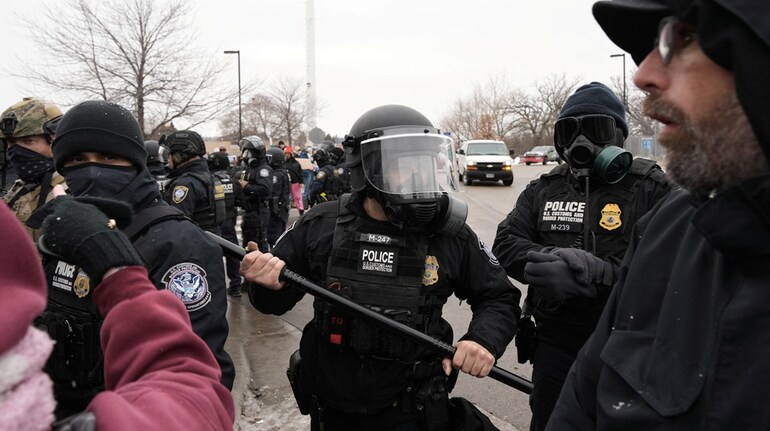

In mid-January, as Minnesota was grappling with public anger after the killing of a civilian by federal immigration agents, the state received an unexpected demand from Washington.
In a letter to Governor Tim Walz, Attorney General Pam Bondi outlined what she called three “simple steps” to restore law and order. One of them had little to do with immigration or public safety.
The US Justice Department wanted access to Minnesota’s full voter rolls.
The request was swiftly rejected by Minnesota’s secretary of state, who described it as an attempt to force the state into handing over private data belonging to millions of voters — information protected under both state and federal law.
That clash is now part of a much broader national fight over who controls voter data and how it can be used, the New York Times reported.
What voter rolls actually contain
Most states already make a limited version of their voter rolls public. These typically include names and, in some cases, addresses. Political parties, researchers and journalists routinely access these records.
But the complete voter file is something else entirely. It includes sensitive personal information such as driver’s licence numbers and, in some cases, partial or full Social Security numbers. These databases are tightly guarded by state election officials and are not available through public records requests — including requests from the federal government.
Until recently, that boundary was rarely challenged.
Why the Justice Department says it wants the data
Attorney General Bondi has said the administration’s goal is election integrity. The Justice Department argues that reviewing full voter files is necessary to ensure states are complying with federal election law.
But voting-rights advocates say the context matters.
President Trump and many of his allies continue to deny the legitimacy of the 2020 election, despite repeated court rulings and audits. For years, they have promoted claims — unsupported by evidence — that undocumented immigrants vote in large numbers.
Against that backdrop, critics worry that the administration is trying to assemble a national voter database that could later be used to challenge election outcomes or justify tighter voting restrictions.
Is this kind of request normal?
Not really. The US federal government has investigated voter fraud before, including during Republican and Democratic administrations. But historically, those investigations relied on targeted inquiries, not blanket access to every voter’s private information.
Under the US Constitution, the administration of elections is largely left to the states. Congress can set national rules, but the executive branch has limited authority to intervene directly.
Legal experts say the Justice Department’s approach marks a sharp break from precedent.
How states are responding
So far, the country is split. According to data compiled by voting-rights groups, about a dozen states — mostly Republican-led — have complied, at least in part. Some others have shared voter information with a related Department of Homeland Security programme.
But roughly half the states, including Minnesota, have refused outright. The Justice Department has responded by filing lawsuits against more than two dozen states and territories to force compliance.
Minnesota is among those being sued.
Why states say no
The objections fall into three broad categories. First, legality. Some states say their laws explicitly prohibit sharing private voter data with the federal government.
Second, security. Election officials worry about how such massive datasets would be stored and protected, especially given recent breaches across both public and private institutions.
Third, trust. Many officials say they are uncomfortable handing sensitive data to an administration that has repeatedly questioned the legitimacy of past elections.
As one election official put it, the concern isn’t just misuse — it’s misinterpretation.
The courts step in
That concern has already found its way into court rulings. Earlier this month, a federal judge dismissed the Justice Department’s lawsuit against California, ruling that the executive branch could not compel the state to turn over its full voter file.
In his decision, the judge warned that democratic erosion often happens incrementally, through small but cumulative intrusions on privacy and voting rights.
The ruling does not bind other courts, but it has given fresh confidence to states resisting the administration’s demands.
A practical problem, even if access were granted
There is also a technical issue that election officials say is being overlooked. Voter rolls are constantly changing. People move, die, change names or register in new states. A national database, even if compiled in good faith, would quickly become outdated.
Comparing one state’s live voter file with another’s static snapshot could easily produce thousands of false positives — voters wrongly flagged as ineligible.
That, officials warn, could fuel confusion and mistrust rather than clarity.
What comes next
The legal fight is far from over. Courts will ultimately decide whether the Justice Department has the authority it claims.
But the dispute has already revived deeper questions about who controls elections in the United States — and how much power any administration should have over the machinery of voting.
For states like Minnesota, the issue is not just compliance. It is about drawing a line between oversight and overreach, at a moment when faith in democratic institutions is already under strain.
Discover the latest Business News, Sensex, and Nifty updates. Obtain Personal Finance insights, tax queries, and expert opinions on Moneycontrol or download the Moneycontrol App to stay updated!
Find the best of Al News in one place, specially curated for you every weekend.
Stay on top of the latest tech trends and biggest startup news.





