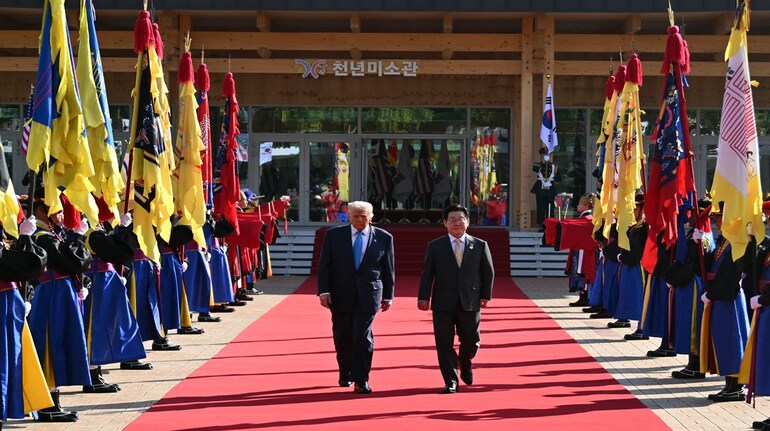
When Chinese President Xi Jinping landed in South Korea for the first time in 11 years, President Lee Jae Myung made sure to welcome him with the full diplomatic pageantry — honour guards, ceremonies, and warm language about “inseparable partners.” But just days earlier, Lee had hosted US President Donald Trump at the Asia-Pacific Economic Cooperation summit in Gyeongju, sealing a new trade deal and a surprise defence announcement that startled even his own officials, the New York Times reported.
Trump’s submarine surprise
Trump used the summit to unveil a major shift in US–Korea defence cooperation, announcing that Washington would allow Seoul to build nuclear-powered submarines. Lee had quietly lobbied for such technology, calling it essential to patrol the seas near China and North Korea. But Trump’s announcement — reportedly made without warning — tied South Korea even closer to America’s security structure and risked further irritating Beijing.
In return, South Korea agreed to invest $350 billion in the United States, much of it in shipbuilding, in exchange for a reduction in tariffs from 25% to 15%. Trump touted it as another win for “America First.”
Beijing’s balancing act grows tense
For Xi, the timing could not have been worse. He had hoped to use his visit to repair a decade of strained ties and pitch a renewed partnership built on trade. China remains South Korea’s largest trading partner, critical to its electronics, automotive, and manufacturing exports. But Xi also warned against “American-led efforts to suppress trade,” urging Seoul to uphold multilateralism — a diplomatic way of saying: don’t take sides.
Beijing’s foreign ministry later issued a pointed reminder that the US and South Korea should “do what is conducive to regional peace,” signalling unease at Seoul’s deepening defence links with Washington.
The end of strategic ambiguity
South Korea has long tried to maintain what analysts call “strategic ambiguity” — relying on the US for security while depending on China for economic growth. That balance may now be cracking. “South Korea’s equilibrium between its security dependence on the US and its economic interdependence with China has effectively ended,” said Seong-Hyon Lee of the George H.W. Bush Foundation for US–China Relations. “The submarine deal marks Seoul’s shift from a balancing actor to a fully embedded partner in the US framework.”
For Lee Jae Myung, the diplomatic tightrope is getting thinner. He has sought China’s help in calming tensions with North Korea while leaning on Washington for military backing — a dual strategy that is becoming harder to sustain.
An uneasy summit
Inside the APEC meetings, the divide was palpable. Trump championed tariffs as a tool of foreign policy and warned Asian economies not to depend too heavily on Chinese supply chains. Xi, for his part, cautioned leaders against joining the US in reducing reliance on Chinese manufacturing. South Korea, caught in the middle, struggled to bridge the gap. “Consensus is difficult in an era of norm-breaking tariffs and export controls,” said Leif-Eric Easley, a professor at Ewha Womans University.
Little room left to manoeuvre
Despite the awkward optics, Lee managed small wins — a revived trade agreement with the US and Xi’s verbal commitment to cooperation. But those victories underscored his dilemma more than they resolved it. A decade ago, Xi’s visit to Seoul came before his first trip to Pyongyang. This time, Kim Jong-un stood in his place at a Chinese military parade, a reminder of how the regional map has shifted.
For South Korea, that change means more pressure, fewer options, and a narrower path between two superpowers that expect loyalty, not balance.
Discover the latest Business News, Sensex, and Nifty updates. Obtain Personal Finance insights, tax queries, and expert opinions on Moneycontrol or download the Moneycontrol App to stay updated!





Find the best of Al News in one place, specially curated for you every weekend.
Stay on top of the latest tech trends and biggest startup news.