






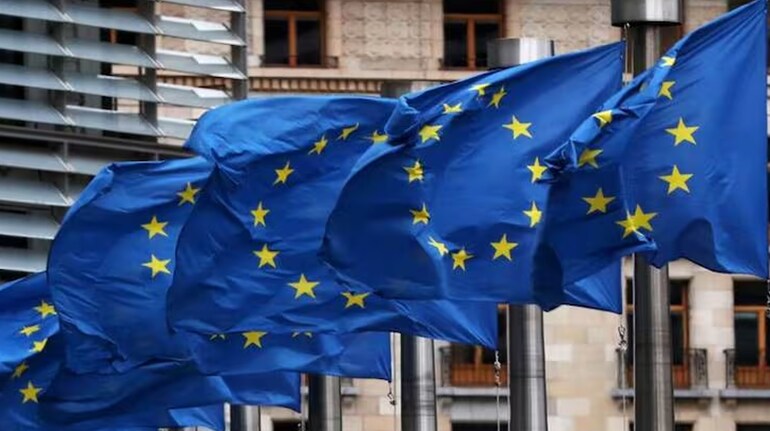
The European Union is approaching a pivotal decision on whether to use frozen Russian state assets to bankroll further support for Ukraine — a move without precedent that has exposed deep divisions within the bloc. EU leaders are set to debate the proposal at a high-stakes summit on Thursday and Friday, with the outcome likely to shape Europe’s financial, legal and geopolitical posture in the war, CNN reported.
At the heart of the dispute is whether billions of euros belonging to Russia’s central bank — immobilised in Europe since Moscow’s 2022 invasion of Ukraine — can be used more aggressively to support Kyiv. While many EU member states back the idea, Belgium, where most of the assets are held, has emerged as a key sceptic, warning of legal risks and possible retaliation from Moscow.
The decision comes at a sensitive moment. Europe faces mounting pressure from the United States, internal war fatigue, and growing strain on public finances. Although the EU has already pledged to support Ukraine financially through 2027 regardless of the outcome, failure to approve the proposal would force governments to find alternative funding sources at a politically difficult time.
Compounding the urgency are increasingly sharp warnings from Russia, which has made clear that any move to appropriate its assets would trigger consequences.
What assets are involved?
Following Russia’s invasion of Ukraine, the EU froze the European-based assets of the Russian central bank as part of its sanctions regime. These assets — largely government bonds — are worth around €210 billion ($246 billion), according to EU officials.
So far, Europe has limited itself to using the interest generated by those assets to help finance Ukraine. But on December 3, the European Commission proposed going much further: using not just the income but also the principal value of the assets to extend large-scale loans to Kyiv.
As the bonds mature, they are converted into cash. The Commission has labelled this pool of funds “cash balances,” arguing that because EU sanctions prohibit returning the money to Russia, those balances are no longer the property of the Russian central bank.
“We’re taking the cash balances, we’re providing them to Ukraine as a loan, and Ukraine has to pay back this loan if and when Russia is paying reparations,” European Commission President Ursula von der Leyen told reporters.
Valdis Dombrovskis, the Commission’s senior official for economic policy, said the total value of the assets defines the upper limit of the plan. “This is therefore the maximum loan amount we could propose,” he said.
Under the proposal, the EU would lend Ukraine €90 billion ($105 billion) over the next two years, covering roughly two-thirds of what the International Monetary Fund estimates Kyiv will need in 2026 and 2027 for civilian and military spending.
Approval would require a “qualified majority,” meaning support from more than half of EU member states representing at least 65% of the bloc’s population.
Why does Belgium object?
Belgium’s opposition is central to the standoff because Euroclear — the Belgian-based financial services company — holds the majority of the frozen Russian assets. Estimates suggest around €176 billion has already been converted into cash.
Belgian officials argue that using the principal of the assets crosses a dangerous legal line and could expose the country to lawsuits or retaliation.
“We have repeatedly said that we consider the option of the reparations loan the worst of all, as it is risky – it has never been done before,” Belgium’s Foreign Minister and Deputy Prime Minister Maxime Prévot said on December 3. “We keep on pleading for an alternative – namely, the EU borrowing the amounts needed on the markets.”
To address these concerns, the European Commission has proposed guarantees from EU member states to protect Belgium if Russia seeks compensation. Dombrovskis said these guarantees would cover “any member state if it is forced to pay the claim from Russia.”
But Belgian authorities say the safeguards fall short. According to Peter Van Elsuwege, a professor of EU law at Ghent University, the guarantees do not cover the full range of potential liabilities.
“The problem for Belgium is that – under the current proposal – only the repayment of the loan may be guaranteed but those additional costs are not (yet) covered, which exposes Belgium to a risk of bearing those additional costs,” he told CNN.
Belgium has also sought assurances against Russian countermeasures targeting Euroclear’s assets abroad.
Russia’s response and wider EU unease
Russia has already taken legal action. Its central bank has filed a lawsuit seeking billions of euros in damages from Euroclear, describing it as a pre-emptive response to the EU plan. Kremlin officials have sharply criticised the proposal.
“Panicked EU bureaucrats keep blundering,” Kremlin economic envoy Kirill Dmitriev wrote on X. “They know using Russian reserves without CBR consent is illegal.”
In a recent interview with CNN, Kremlin-linked banker Andrey Kostin was even blunter, calling the plan “a robbery.”
Other EU countries have voiced reservations. Italy and the Czech Republic have raised concerns, while the Czech prime minister has said his government will not provide guarantees, arguing national funds must be reserved for domestic needs.
There is also a broader fear that seizing or repurposing sovereign assets could deter foreign investment in Europe. Critics argue that countries such as China might hesitate to hold reserves in the EU if they fear sanctions could one day put their assets at risk.
How does the US fit in?
The debate is unfolding alongside competing US ambitions for Russia’s frozen assets. A leaked, US-backed peace plan earlier this year proposed investing $100 billion of frozen Russian funds worldwide into “US-led efforts to rebuild and invest in Ukraine,” with Washington receiving a share of the profits.
Because most of Russia’s immobilised assets are held in Europe, the EU’s proposal clashes with those US plans. American officials confirmed they discussed the issue with Ukrainian and European counterparts earlier this week.
However, the EU’s decision last week to indefinitely freeze the assets has strengthened its negotiating position. “The future of these assets cannot be decided by the United States or Russia alone but requires the involvement of the EU,” Van Elsuwege said.
The issue has become more pressing as US financial support for Ukraine has sharply declined this year under the Trump administration. Since January 2022, European allies have committed $221 billion in aid, compared with $134 billion from the United States, according to the Kiel Institute.
For Kyiv, the stakes are existential. “The frozen assets could balance certain declines in certain countries’ support,” Ukrainian President Volodymyr Zelensky said Tuesday. “Without such support, I don’t see the possibility for Ukraine to hold on, or to stand tall economically.”
As EU leaders gather, the decision before them is not only about funding Ukraine — but about how far Europe is willing to go in reshaping international financial norms in a world increasingly defined by geopolitical conflict.
Discover the latest Business News, Sensex, and Nifty updates. Obtain Personal Finance insights, tax queries, and expert opinions on Moneycontrol or download the Moneycontrol App to stay updated!
Find the best of Al News in one place, specially curated for you every weekend.
Stay on top of the latest tech trends and biggest startup news.




