






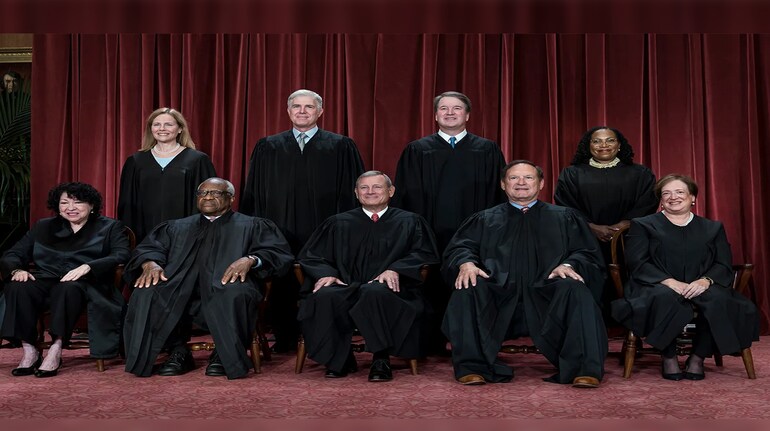

In a landmark 6-3 decision, the US Supreme Court struck down former President Donald Trump’s sweeping global tariffs, and six of the nine justices who voted in the case were nominated by Republican presidents.
The ruling, which curbs how far a president can stretch emergency powers to reshape trade policy, was not a simple liberal-versus-conservative split. It produced a cross-ideological majority that included three Republican-appointed justices siding against Trump’s claim of authority.
Here’s who voted, and what their alignment signals.
The six-justice majority
Chief Justice John Roberts, a nominee of President George W. Bush, wrote the majority opinion. Roberts concluded that the International Emergency Economic Powers Act (IEEPA) “does not authorise the President to impose tariffs,” stressing that Congress holds constitutional authority over taxation and trade unless it clearly delegates that power.
Joining him were:
Justice Neil Gorsuch – Nominated by Trump, Gorsuch has consistently supported a stricter reading of statutory authority. He sided with the majority in applying limits to executive power under IEEPA.
Justice Amy Coney Barrett – Also a Trump nominee, Barrett joined Roberts in rejecting the claim that emergency law permits sweeping import duties without explicit congressional backing.
Justice Sonia Sotomayor – A nominee of President Barack Obama, she joined the majority in holding that the statute did not grant the broad authority claimed by the executive branch.
Justice Elena Kagan – Another Obama appointee, Kagan voted with the majority, emphasising statutory interpretation and congressional intent.
Justice Ketanji Brown Jackson – Nominated by President Joe Biden, Jackson joined the bloc rejecting the administration’s expansive reading of emergency trade powers.
Three of these six justices, Roberts, Gorsuch and Barrettm, were nominated by Republican presidents. All three voted against Trump’s position.
The three dissenters
The dissenting justices would have upheld the president’s authority to impose the tariffs.
Justice Clarence Thomas – Nominated by President George H.W. Bush, Thomas argued that neither the Constitution nor statutory text justified invalidating the president’s actions.
Justice Samuel Alito – A George W. Bush appointee, Alito joined the dissent, rejecting the majority’s interpretation of executive power limits.
Justice Brett Kavanaugh – A Trump nominee, Kavanaugh also dissented, maintaining that the president’s interpretation of IEEPA should stand.
Six of the nine justices in the case were nominated by Republican presidents. Yet the majority that blocked Trump’s tariffs included three of those Republican appointees.
The decision struck down the broadest tariffs imposed under IEEPA, including 'reciprocal' duties affecting multiple countries, while leaving intact sector-specific tariffs enacted under separate statutes.
Discover the latest Business News, Sensex, and Nifty updates. Obtain Personal Finance insights, tax queries, and expert opinions on Moneycontrol or download the Moneycontrol App to stay updated!
Find the best of Al News in one place, specially curated for you every weekend.
Stay on top of the latest tech trends and biggest startup news.





