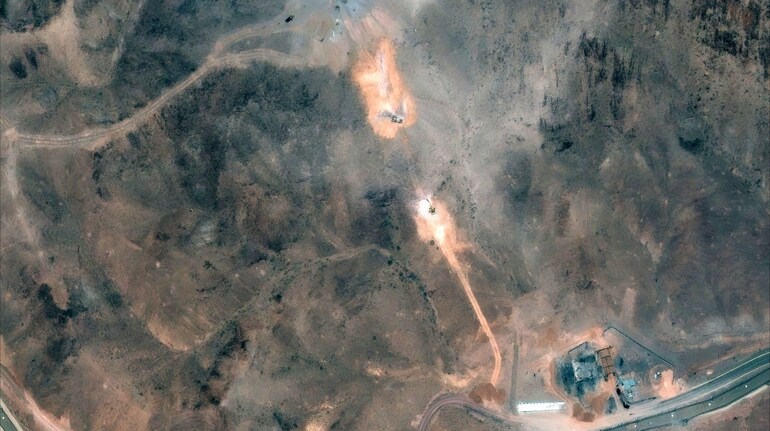
Israel has concluded that a portion of Iran’s stockpile of 60% enriched uranium—just shy of weapons-grade—survived the massive American and Israeli strikes in June, according to a senior Israeli official. Though buried beneath rubble at sites like Isfahan, Israeli and Western intelligence believe the material could still be accessible to Iranian engineers if they attempt to retrieve it. Such a move, officials warn, would almost certainly trigger renewed attacks, the New York Times reported.
While U.S. officials initially believed Iran had not yet moved toward weaponization, Israel claims to have detected covert activity shortly after the killing of Hezbollah leader Hassan Nasrallah last year—activity it says is consistent with preparations to build a bomb. That assessment, the official said, helped prompt Israeli Prime Minister Benjamin Netanyahu to begin planning military action, even without U.S. cooperation.
A difference in assessments: how much was moved?A key point of contention remains whether Iran had relocated parts of its stockpile ahead of the strikes. Rafael Grossi, head of the International Atomic Energy Agency (IAEA), said much of the uranium at Isfahan had likely been moved before the bombs hit. But Israeli officials dispute that, arguing the storage facility was too deep for American bunker-busters to fully destroy, and that no material was relocated.
Regardless, the attack crippled the facilities that turn enriched uranium into weapons-ready metal, even if the fuel itself wasn’t fully eliminated. Defense Secretary Pete Hegseth and President Trump have claimed the program was “obliterated,” with Trump calling the strikes “Operation Midnight Hammer” and insisting that Iran’s nuclear threat has been neutralized for years to come.
Centrifuge capacity destroyed, but could Iran rebuild?By most Western estimates, the airstrikes destroyed or disabled some 18,000 centrifuges at Natanz and Fordo, effectively shutting down Iran’s enrichment capability. However, intelligence officials are now closely watching whether Iran might attempt to rebuild at dispersed sites across the country. “Even something you put in a mountain can be bombed,” said Iran analyst Ray Takeyh, noting that Tehran may now decentralize its nuclear efforts into small, harder-to-detect workshops.
Satellite surveillance and intelligence-sharing between allies like Israel, the U.S., and Britain will be critical in monitoring whether Iran attempts such a strategy. But the West is largely “blinded” for now: Iran has expelled IAEA inspectors and shut off many of the organization’s monitoring devices, cutting off a key source of real-time visibility into its nuclear activity.
Why the surviving uranium mattersIran’s stockpile of uranium enriched to 60% remains a central concern. That level of enrichment means Iran has already completed the most difficult part of the fuel cycle. Going from 60% to the 90% typically used in weapons is a relatively quick technical step, particularly if the material can be recovered from damaged storage sites.
Some Israeli officials say fuel remains not only at Isfahan, but also at Fordo and Natanz—though these locations were bombed heavily, and Israel believes recovering that material would be too difficult or dangerous. However, any attempt by Iran to dig out the material from the rubble is likely to be detected by satellites or ground-level intelligence.
In the months and years before the June 22 attacks, Iran had been building two new underground nuclear sites—one near Isfahan and another at Natanz. These deeper facilities were not targeted by the airstrikes and could serve as future enrichment centers. But turning them into operational replacements would require thousands of new centrifuges and months—if not years—of reconstruction.
Intelligence agencies are now working to assess how many centrifuges may still be under construction elsewhere in Iran, and how quickly they could be deployed. With Iran’s program likely to go underground and off the radar, Western powers may be entering a new phase: a slow, secretive game of cat and mouse.
As Trump and Israeli leaders continue to emphasize military readiness, analysts say the current pause may only be temporary. The future of Iran’s nuclear program may now depend on whether it can quietly rebuild without being caught—or whether another round of attacks is already being prepared.
Discover the latest Business News, Sensex, and Nifty updates. Obtain Personal Finance insights, tax queries, and expert opinions on Moneycontrol or download the Moneycontrol App to stay updated!
Find the best of Al News in one place, specially curated for you every weekend.
Stay on top of the latest tech trends and biggest startup news.