






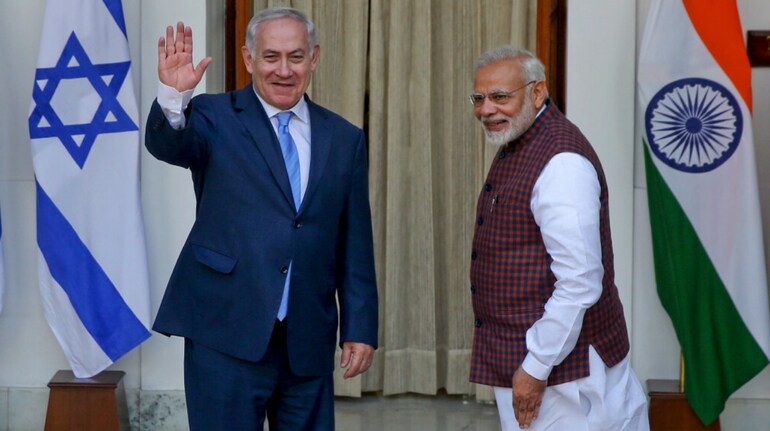

Israel Prime Minister Benjamin Netanyahu has outlined an ambitious new diplomatic architecture ahead of Prime Minister Narendra Modi’s February 25–26 visit: a 'hexagon of alliances' linking India with Arab states, African nations, Greece, Cyprus and select Asian partners.
The proposal is more than symbolism. It signals Israel’s attempt to formalise a broad economic, diplomatic and security bloc to counter what Netanyahu called the 'radical Shia axis' led by Iran, and an 'emerging radical Sunni axis.' India sits at the heart of that design.
What is the ‘hexagon of alliances’?
Netanyahu described a six-sided alliance system “around or within the Middle East.” The proposed members include:
The intent, according to Netanyahu, is to create an “axis of nations that see eye-to-eye on the reality, challenges, and goals” facing the region.
In practical terms, the hexagon would coordinate across three pillars:
The framework is explicitly positioned as a counterweight to Iran and its network of regional proxies, which Israel frequently describes as a “radical Shia axis.” Netanyahu also flagged concerns about what he termed an “emerging radical Sunni axis,” suggesting the bloc would serve as a stabilising counter-structure in a fragmented regional landscape.
Why India is central to the plan
Netanyahu was unusually personal in framing India’s role, calling Modi a “personal friend” and highlighting their frequent calls and past visits. He underscored India’s status as a “global power,” signalling that New Delhi is not a peripheral player but a strategic anchor.
India and Israel already share deep defence ties. Bilateral trade stood at about $10 billion last year, and India is among the largest buyers of Israeli defence equipment. The two countries cooperate closely on counterterrorism, intelligence sharing and advanced military technologies.
Netanyahu also emphasised technology cooperation as a key agenda item during Modi’s visit. He specifically mentioned artificial intelligence and quantum computing, arguing that these are not distant goals but present-day strategic domains.
Israel has positioned itself as a global innovation hub, particularly in defence tech and cybersecurity. India, with its vast digital ecosystem and policy push into semiconductors and AI, offers scale, talent and market depth.
What happens during Modi’s visit
Modi is scheduled to address the Knesset and visit Yad Vashem, Israel’s Holocaust memorial. Netanyahu will personally receive him at the airport, underscoring the political weight attached to the trip.
Behind the optics, both sides are expected to discuss decisions to strengthen government-to-government cooperation across defence, trade and high technology.
Netanyahu framed the visit as an opportunity to “tighten” an already growing relationship. The broader diplomatic play, however, is the formal articulation of a multi-country alliance system in which India features prominently.
Discover the latest Business News, Sensex, and Nifty updates. Obtain Personal Finance insights, tax queries, and expert opinions on Moneycontrol or download the Moneycontrol App to stay updated!
Find the best of Al News in one place, specially curated for you every weekend.
Stay on top of the latest tech trends and biggest startup news.





