






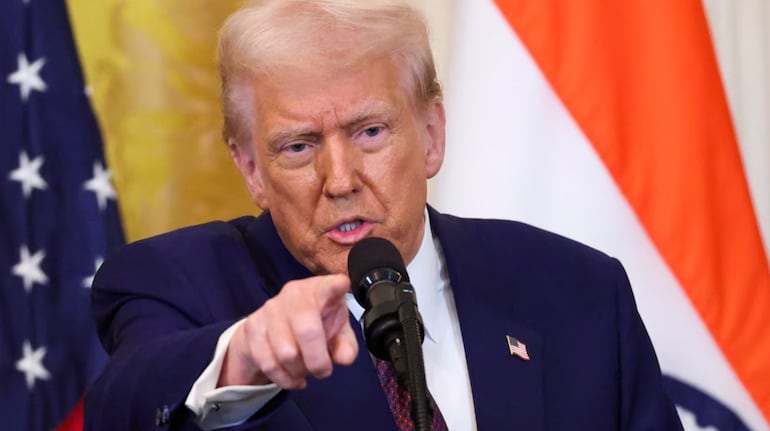

The US Supreme Court on Friday delivered a historic blow to President Donald Trump, declaring his across-the-board global tariffs issued under the International Emergency Economic Powers Act (IEEPA) invalid.
While delivering the judgment on Friday, Chief Justice of the US Supreme Court John Roberts said "IEEPA contains no reference to tariffs or duties."
Following the setback, Trump signed an executive order for a 10% global tariff under Section 122 of the Trade Act of 1974
According to a Reuters report, the tariffs collected under Donald Trump's use of IEEP, which was struck down by the Supreme Court, have come to account for more than half of all tariff revenues.
What is IEEPA?
Enacted in 1977, IEEPA is a US federal law that gives only the President of the United States broad authority to regulate commerce after declaring a national emergency in response to an unusual and extraordinary foreign threat.
Signed by 39th US President Jimmy Carter, it was designed to limit and clarify presidential emergency economic powers after concerns about executive overreach during earlier decades. Historically, it has been used to impose sanctions, freeze foreign assets and restrict financial transactions - not as a conventional tariff mechanism.
It is typically administered by the US Department of the Treasury, particularly through its Office of Foreign Assets Control.
How IEEPA is different from Sections 122, 232 and 301?
IEEPA was primarily designed for imposing sanctions, and not for raising revenue by imposing tariffs. Regular tariffs and customs duties are typically imposed under U.S. Congress constitutional authority over trade, Section 122 and 301 of the Trade Act of 1974 and Section 232 (national security tariffs).
Section 122, Trade Act of 1974
Within hours of the Supreme Court ruling, Trump invoked Section 122 of the Trade Act of 1974, imposing a 10 tariff for all of US trading partners. This authorises the US president to impose temporary tariffs of up to 15% for a maximum of 150 days to address what the law describes as "large and serious" US balance-of-payments deficits - situations where imports significantly exceed exports.
Unlike several other trade laws, Section 122 does not require a formal investigation before tariffs are imposed, allowing rapid action. Tariffs imposed under Section 122 automatically expire after 150 days unless Congress votes to extend them. Section 122 explicitly permits temporary import surcharges, though within strict limits on duration and rate.
Section 301, Trade Act of 1974
Section 301 of the Trade Act of 1974 makes provisions to investigate and retaliate against foreign trade practices deemed unfair, unreasonable, or discriminatory. It is a key tool used by the US Trade Representative (USTR) to undertake investigations.
Section 301 has been designed to counter intellectual property theft, forced technology transfer and discriminatory trade practices. It was extensively used by the Trump administration to impose tariffs on Chinese goods.
Section 232, Trade Expansion Act of 1962
Section 232 of the Trade Expansion Act of 1962 allows the US President to impose tariffs or quotas on imports that threaten national security, based on the findings of the Department of Commerce. It was designed to protect national security industries such as steel and aluminum.
While Sections 232 and 301 are structured statutes catering to specific trade problems, IEEPA gives broader economic control, not limited to ordinary trade disputes.
Both Sections 232 and 301 are imposed after investigations by the concerned departments. IEEPA is an emergency sanctions power that can reach trade, but wasn’t designed primarily for tariffs.
Discover the latest Business News, Sensex, and Nifty updates. Obtain Personal Finance insights, tax queries, and expert opinions on Moneycontrol or download the Moneycontrol App to stay updated!
Find the best of Al News in one place, specially curated for you every weekend.
Stay on top of the latest tech trends and biggest startup news.





