






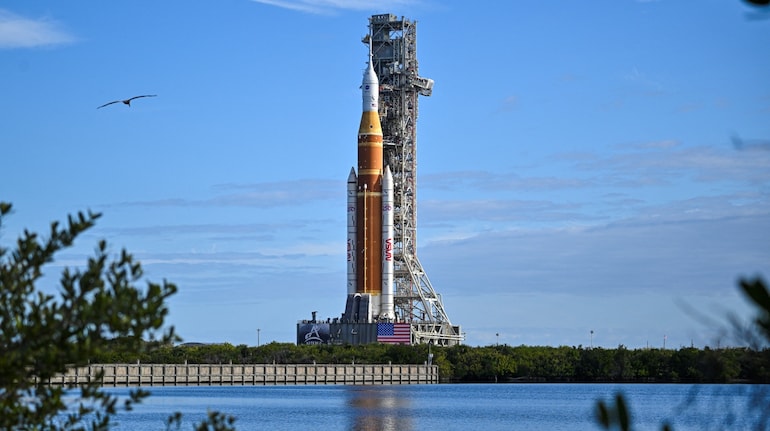

When NASA’s Artemis II mission begins its 10-day journey around the moon, the four astronauts on board could see parts of the lunar surface that no human has ever observed directly.
As Orion swings behind the moon, the crew will pass over the lunar far side, a region that permanently faces away from Earth. Apollo astronauts never had a clear view of this terrain because of the orbits their spacecraft followed. Artemis II will change that, marking the first time in more than 50 years that humans travel into the moon’s neighbourhood and opening a new phase of lunar exploration.
Scientists say the mission matters not because it lands on the moon, but because it offers fresh human observation of a place that still holds basic unanswered questions, CNN reported.
Why scientists still don’t fully understand the moon
Decades of study, including the Apollo missions of the late 1960s and early 1970s, built the foundation of what we know about the moon. Rock and soil samples helped scientists piece together its origin and composition. More recent analysis of old Apollo samples and robotic missions even revealed traces of water in rocks once believed to be completely dry.
But there is a major limitation. Apollo missions visited similar locations on the moon’s near side, mostly near the equator, where the ground was flatter and communication with Earth was easier. Over time, researchers have realised that those samples represent only a narrow slice of a much more complex body.
The near and far sides of the moon look and behave very differently, and scientists still do not fully understand why.
What makes the far side so different
The moon is uneven in ways that remain puzzling. The near side has a thinner crust, lower elevations and large dark plains formed by ancient lava flows. It also contains a concentration of heat-producing elements left behind as the moon’s early magma ocean cooled.
The far side, by contrast, has a thicker crust, higher terrain and far fewer signs of volcanic activity. This global imbalance affects how the moon formed, cooled and evolved, yet its cause remains unclear.
The far side is also home to some of the moon’s most dramatic features, including vast impact basins that record the violent early history of the solar system. Unlike Earth, where erosion has erased much of that record, the moon preserves it almost intact.
What Artemis II could reveal
Artemis II will not land, but during the flyby the astronauts will be able to see the entire lunar disk at once, including regions near the poles that are often shadowed. At closest approach, Orion will pass thousands of miles above the surface, giving the crew a broad, uninterrupted view.
During roughly three hours behind the moon, the astronauts will photograph craters, lava flows and basin structures and describe what they see to scientists on the ground in real time. Human observers can notice subtle features, lighting effects and surface textures that instruments alone may miss.
Depending on the exact flight path, the crew may glimpse regions such as the Orientale Basin, a massive crater that marks a transition between the near and far sides. They may also observe flashes from meteoroid impacts or faint dust glows near the lunar horizon, phenomena that are still not fully understood.
Why this matters for future missions
Artemis II is designed to inform what comes next. Later missions aim to return astronauts to the lunar surface, particularly near the south pole, where scientists hope to study ancient material from deep inside the moon and determine how much water ice is trapped in permanently shadowed craters.
Only a small fraction of the moon has ever been sampled. By adding human observation of unexplored regions, Artemis II helps narrow down where future landings and experiments could answer the moon’s biggest remaining questions.
The mission is a reminder that even after decades of study, Earth’s closest neighbour still has a lot left to reveal.
Discover the latest Business News, Sensex, and Nifty updates. Obtain Personal Finance insights, tax queries, and expert opinions on Moneycontrol or download the Moneycontrol App to stay updated!
Find the best of Al News in one place, specially curated for you every weekend.
Stay on top of the latest tech trends and biggest startup news.





