






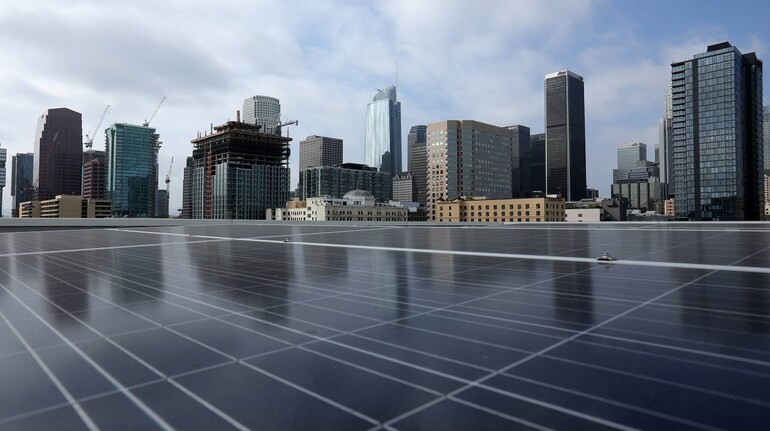
The Donald Trump administration on Tuesday imposed preliminary duties of 126% on solar imports from India and some other countries, citing unfair government subsidies that disadvantage American manufacturers, according to the US Department of Commerce.
Along with India, tariffs are imposed on exporters from Indonesia, ranging from 86% to 143%, while exporters of Laos will face duties of about 81%, marking a significant escalation in trade action targeting renewable energy supply chains.
Why US impose these tariffs
US authorities concluded that state-backed incentives in India, Indonesia, and Laos enabled producers to price modules below fair market value, harming domestic solar manufacturers. The decision followed a petition by the Alliance for American Solar Manufacturing and Trade urging Washington to investigate subsidy practices.
“Today’s finding is an important step toward restoring fair competition in the US solar market,” said Tim Brightbill, co-chair of Wiley Rein’s International Trade Practice and lead attorney for the Alliance.
“American manufacturers are investing billions of dollars to rebuild domestic capacity and create good-paying jobs. Those investments cannot succeed if unfairly traded imports are allowed to distort the market,” he added, according to a Bloomberg report.
How will it impact India?
India, Indonesia, and Laos accounted for 57% of US solar-module imports in the first half of 2025, according to BloombergNEF. Following earlier US tariffs on four Southeast Asian countries, developers increasingly sourced panels from these three nations.
US imports of Indian solar panels in 2024 were valued at $792.6 million, more than nine times the 2022 level. Citi analyst Vikram Bagri told Bloomberg that the high duty structure could effectively lock Indian manufacturers out of the US market in the near term.
However, the countervailing duties are applicable only to solar cells made in India and not the panels assembled in the country using imported cells.
In an interview with Zee Business, Waaree Energies Chairman and Managing Director Hitesh Doshi clarified that the US had imposed duties based on the country of origin of solar cells, not the country where solar panels are assembled.
He said most Indian manufacturers import solar cells from countries where import duties are relatively low and then manufacture panels in India for export, limiting the impact of the US decision.
Moreover, Doshi said that as per available data, just about 4 percent of US solar imports were panels made using India-manufactured solar cells. This will impact roughly 600–1,000 megawatts of exports from India.
Broader trade context
The new duties are separate from the global tariffs introduced by the Trump administration that the US Supreme Court struck down last week. In response, Trump announced fresh 10% tariffs, which have already come into effect. He later increased it to 15%, but that is yet to take effect.
Earlier this month, the US and India had also reached a bilateral trade understanding aimed at easing economic tensions, making the recent duties particularly notable.
What’s next
The Commerce Department is expected to issue a final decision on the subsidy investigation by July 6. At the same time, an anti-dumping probe into solar cell imports from India, Indonesia, and Laos is underway, which could further reshape trade flows.
The Trump administration’s move signals a tightening grip on the global solar supply chain and could raise costs for American consumers and developers, even as it seeks to strengthen domestic manufacturing.
Discover the latest Business News, Sensex, and Nifty updates. Obtain Personal Finance insights, tax queries, and expert opinions on Moneycontrol or download the Moneycontrol App to stay updated!
Find the best of Al News in one place, specially curated for you every weekend.
Stay on top of the latest tech trends and biggest startup news.




