






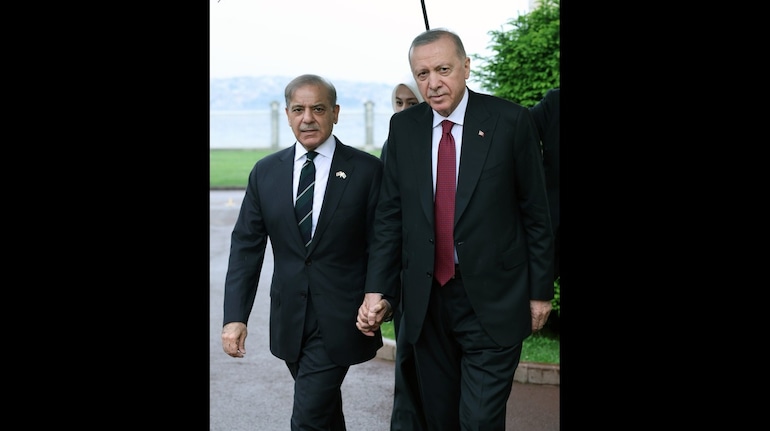

Turkey is in advanced talks to join a defence alliance between Saudi Arabia and nuclear-armed Pakistan, reports Bloomberg. The move may not only reshape regional security dynamics across West Asia and South Asia, but also carry serious implications for India.
Negotiations to be inducted in Ankara into the framework have progressed significantly, and an agreement is considered likely, the report stated, citing people familiar with the matter.
All about the Saudi Arabia-Pakistan defence pact
Pakistan and Saudi Arabia signed the Strategic Mutual Defence Agreement in September 2025. The pact includes a collective defence clause under which any aggression against one signatory would be treated as an attack on all, mirroring NATO’s Article 5.
While the full text of the agreement has not been made public, reports suggest it allows Pakistan’s military capabilities, including its nuclear deterrent, to factor into Saudi Arabia’s defence planning if required.
The idea propagated is that this alliance is a NATO-style military alliance for Muslim-majority states.
For now, the “Arab-Islamic NATO” remains largely a slogan aimed at Israel. Major players like Saudi Arabia, the UAE, and Egypt maintain friendly ties with India and are unlikely to allow Pakistan to dominate the agenda. Internal rivalries among the proposed members could also make coordination difficult.
Still, Pakistan’s role as a vocal advocate of the alliance cannot be ignored. By portraying itself as the military vanguard of the Muslim world, Islamabad is seeking to gain strategic depth and legitimacy at a time of economic crisis and political instability at home.
Why Turkey’s inclusion matters
Turkey’s entry would elevate the pact from a bilateral arrangement into a trilateral security bloc, combining:
Nihat Ali Ozcan, a strategist at Ankara-based think tank TEPAV, told Bloomberg that the proposed alignment brings together complementary strengths, including Turkey's operational experience and defence industry, Pakistan's nuclear capability, and Saudi Arabia's financial resources.
Despite being a key member of the US-led NATO and possessing the alliance’s second-largest military after the United States, Ankara appears to be exploring parallel security frameworks amid shifting US priorities and uncertainty over Washington’s long-term commitment to NATO.
“As the US increasingly focuses on its own interests and those of Israel, regional actors are reassessing alliances and developing new mechanisms to identify partners and rivals,” Ozcan said.
Islamabad and Ankara deepening ties
Turkey has consistently backed Pakistan on the Kashmir issue and played a direct role in supporting Islamabad during the four-day military confrontation with India in Operation Sindoor in May 2025.
According to reports, Ankara supplied Pakistan with hundreds of drones, including Bayraktar TB2 and YIHA, along with trained personnel. Beyond drones, Turkey-Pakistan defence cooperation has expanded across multiple domains:
Ahead of Operation Sindoor, Turkey also sent a naval warship to Karachi and dispatched a C-130 military transport aircraft to Pakistan. Ankara, however, back then clarified that the aircraft had nothing to do with the border standoff between India and Pakistan.
Strategic implications for India
Indian Air Force Air Marshal Anil Chopra (Retd) has warned that Turkey’s potential entry into the Pakistan–Saudi framework could complicate India’s security environment, even if it does not pose an immediate military threat.
Writing in The Eurasian Times, Chopra said, “If finalised, the alliance could seriously challenge and even threaten countries like India, Israel, Armenia, and Cyprus, among others.”
He added that the emerging nexus must be assessed alongside India’s growing defence cooperation with Israel. "Turkey and Pakistan have been working very closely. India, too, is concerned about this nexus. India has also been working more closely with Greece and Cyprus. India and Israel could coordinate more closely in the Mediterranean,” he wrote.
Beyond South Asia, analysts say the trilateral alignment could alter power equations across West Asia and adjoining regions where India has major energy, trade, and strategic interests.
A broader geopolitical reset?
Turkey’s interest in the pact is also linked to the evolving relationship between Ankara and Riyadh, which has historically been marked by rivalry over leadership of the Sunni Muslim world. Despite years of tension, both countries are now expanding economic and defence cooperation and share concerns over Iran, Syria, and Palestine.
Should Turkey formally join the alliance, it would underscore a reset in ties between the two regional powers. Turkey’s Defence Ministry declined to comment on the talks, while Pakistan’s Information Ministry and Saudi authorities did not immediately respond to requests for comment, according to Bloomberg.
If finalised, the trilateral bloc could draw closer scrutiny from India, the United States, NATO, and Iran, potentially reshaping security dynamics across West and South Asia and beyond
Discover the latest Business News, Sensex, and Nifty updates. Obtain Personal Finance insights, tax queries, and expert opinions on Moneycontrol or download the Moneycontrol App to stay updated!
Find the best of Al News in one place, specially curated for you every weekend.
Stay on top of the latest tech trends and biggest startup news.





