






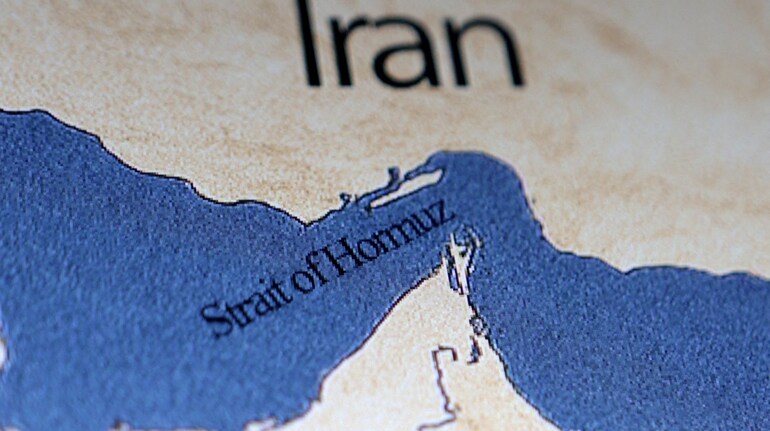

The escalating conflict in West Asia has pushed the Strait of Hormuz to the centre of a global geopolitical and energy crisis. After Iranian forces declared the crucial waterway effectively closed to commercial traffic, US President Donald Trump has openly threatened to take control of the strait if Tehran continues to disrupt oil shipments.
Trump’s warning marks one of the strongest signals yet that Washington may consider direct military measures to secure the world’s most critical energy route. The threat follows a dramatic collapse in maritime traffic through the narrow passage, which normally carries a large share of global oil and gas shipments.
But can the United States actually “take over” the Strait of Hormuz? The answer involves a complex mix of geography, international law and military power.
Why the Strait of Hormuz matters
The Strait of Hormuz is one of the most strategically important waterways on the planet. It serves as the only sea passage linking the Persian Gulf to the open ocean through the Gulf of Oman and the Arabian Sea.
The strait lies between Iran on its northern coast and the Musandam Peninsula of Oman on the southern side, with the United Arab Emirates also located nearby.
At its narrowest point, the waterway is only about 21 to 33 miles wide, or roughly 33 to 54 kilometres. Because of its limited width, shipping traffic operates through tightly defined lanes that are about two miles wide in each direction with a buffer zone separating them.
Several islands inside the strait or near its approaches are controlled by Iran. These include Qeshm, Hormuz, Larak and Hengam, which give Tehran strategic positions overlooking the shipping lanes.
The importance of the strait is enormous. About 20 percent of global oil consumption, or roughly 20 million barrels per day, passes through this corridor. It also carries 20 to 25 percent of the world’s liquefied natural gas exports, mainly from Qatar.
More than 80 percent of the oil transported through the strait is destined for Asian markets, particularly China, India, Japan and South Korea.
Because of this concentration of energy flows, even temporary disruption can send global oil prices sharply higher.
Iran’s declaration of control
Following recent military strikes and rising tensions, Iran’s Islamic Revolutionary Guard Corps declared that it had taken full control of the strait.
On March 4, the IRGC said it had achieved “complete control” over the waterway and warned that it would “set ablaze” any vessel attempting to pass through the area.
The announcement effectively halted most commercial shipping activity.
Maritime traffic through the strait has reportedly dropped by 90 to 95 percent since the conflict began on February 28. Major shipping companies such as Maersk and Hapag-Lloyd have suspended transits through the region because of the security risks.
Iran has also suggested that vessels from countries it considers friendly may still be allowed to pass.
Trump threatens military action
In response, President Trump has threatened strong military retaliation if Iran continues to block oil shipments.
In an interview with CBS News on March 9, Trump said the United States could consider “taking over” the waterway to secure global energy supplies.
He suggested that the US Navy could begin escorting commercial oil tankers through the strait if necessary and that Washington might provide “political risk insurance” to encourage shipping companies to resume operations.
Trump also warned Iran that if it stops the flow of oil, the United States will strike back “TWENTY TIMES HARDER” than Iran has already been hit.
He went further by threatening devastating military action against Iranian infrastructure.
Trump said the US could destroy targets that would make it “virtually impossible for Iran to ever be built back” as a nation, using the phrase “Death, Fire, and Fury.”
Who actually controls the strait?
Despite its global importance, the Strait of Hormuz is not controlled by any single country.
Under international maritime law, authority over the waterway is divided between the surrounding coastal states.
Iran controls the northern shoreline and several key islands that overlook the shipping lanes. Its territorial waters extend about 12 nautical miles from its coastline.
Oman controls the southern side through the Musandam Peninsula. Most of the primary shipping lanes used by international tankers pass through Omani territorial waters.
The United Arab Emirates also borders parts of the southern approaches to the strait and maintains a strong maritime security presence in the region.
International law also plays a critical role. Under the United Nations Convention on the Law of the Sea, ships from all nations are guaranteed the right of “transit passage” through international straits used for global navigation.
In theory, this means that neither Iran nor Oman can legally block the strait for international shipping during peacetime.
However, legal protections do not necessarily guarantee safe passage during active military conflict.
Global powers move into the region
The strategic importance of the waterway has drawn multiple countries into the region.
China has deployed a naval fleet, including the missile destroyer Tangshan, to help protect its energy supply routes.
Pakistan launched Operation Muhafiz-ul-Bahr on March 9 to escort its merchant vessels through the disrupted corridor.
Meanwhile, Russia has been conducting joint naval exercises with Iran and China in nearby waters, according to reports in international media and Al Jazeera.
The growing military presence from several global powers reflects the enormous stakes involved in keeping the waterway open.
Trump’s mixed signals on the war
Trump’s rhetoric about the conflict has combined both escalation and optimism.
On March 9 and March 10, the president repeatedly said the war could end quickly. He described the conflict as a “short-term excursion” intended to “get rid of some evil.”
He also said US military operations were “very complete” and “ahead of our initial timeline.”
At the same time, Trump indicated that some major targets in Iran had deliberately been left untouched for potential future strikes.
Speaking to Republican leaders, he said, “We’ve already won in many ways, but we haven’t won enough.”
Among the potential targets still on the table, Trump mentioned Iran’s electrical grid.
A battle over the world’s energy lifeline
For now, the Strait of Hormuz remains the central flashpoint in the widening conflict.
While the United States possesses overwhelming naval power in the region, physically “taking over” the strait would involve confronting Iranian forces operating from nearby islands, coastal missile batteries and naval units.
Such a move could dramatically escalate the conflict and risk turning the world’s most important oil chokepoint into a direct battlefield.
As long as the crisis continues, the fate of the narrow waterway will remain closely tied to the stability of global energy markets.
Discover the latest Business News, Sensex, and Nifty updates. Obtain Personal Finance insights, tax queries, and expert opinions on Moneycontrol or download the Moneycontrol App to stay updated!
Find the best of Al News in one place, specially curated for you every weekend.
Stay on top of the latest tech trends and biggest startup news.





