






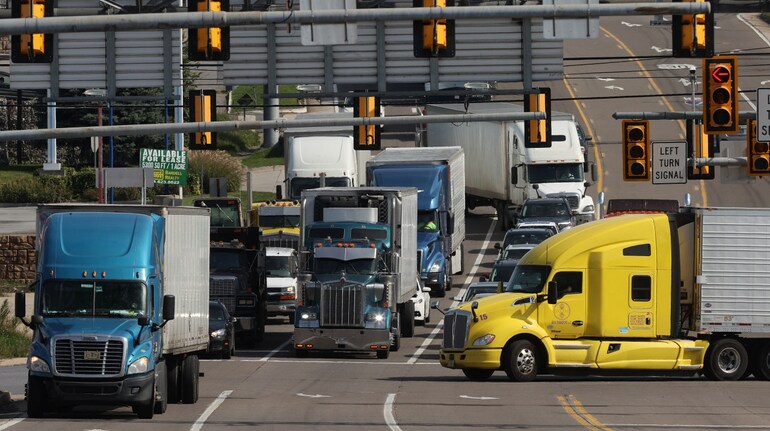

US President Donald Trump on Wednesday proposed a new law that would bar illegal immigrants from obtaining commercial driving licences, linking road safety with his administration’s broader immigration enforcement agenda.
Speaking during his annual State of the Union address, Trump urged the US Congress to pass what he called the “Dalilah Law,” a measure he said was aimed at protecting American citizens from unsafe commercial driving practices.
What Trump said in his State of the Union address
Trump framed the proposal as a public safety measure and a matter of national responsibility.
“It is the duty of my administration to protect American citizens, not illegal aliens,” the US president said.
“Many, if not most, illegal aliens do not speak English and cannot read even the most basic road signs,” he added.
“That’s why I am calling on Congress to pass what we will call the Dalilah law, barring any state from granting commercial driver’s licences to illegal aliens.”
Who is Dalilah Coleman?
Trump named the proposed law after Dalilah Coleman, who was present in the chamber with her father during the speech.
Dalilah was five years old when she suffered life-altering injuries in a multi-vehicle crash in 2024 involving an 18-wheeler driven by Partap Singh, an Indian national who had entered the US illegally.
According to details cited by the Trump administration, the accident left Dalilah unable to speak and required her to relearn how to walk. She suffered a broken femur, skull fractures, spent three weeks in a coma and remained hospitalised for six months.
Investigators later found that Singh had been issued a commercial driver’s licence by the state of California despite lacking legal immigration status.
Singh had entered the US illegally in October 2022 and was later arrested by Immigration and Customs Enforcement under the Trump administration to face deportation proceedings.
What the Delilah law proposes
If passed, the Dalilah Law would prohibit US states from issuing commercial driver’s licences to individuals without legal immigration status.
The proposal also reinforces stricter English language proficiency standards for commercial drivers, an area that the Trump administration has increasingly linked to road safety.
The proposal builds on recent regulatory changes that allow inspectors to remove drivers from service if they fail English proficiency checks.
Why Indian-origin drivers are in focus
Indian-origin truck drivers form a significant part of the US trucking workforce.
Estimates suggest that more than 1.5 lakh Indian-origin drivers, primarily from Punjab and Haryana, are employed in the US trucking industry. They make up roughly 20 percent of the country’s truck drivers, with strong representation in states such as Texas and California.
Members of the Sikh community, in particular, have helped address driver shortages across the US over the past decade.
The Trump administration’s focus is not on nationality but on immigration status and licensing practices. However, the visibility of Indian-origin drivers in the sector means they are more exposed to the policy shift.
Tighter checks already underway
The Dalilah Law would add to a series of steps already taken by the Trump administration.
Authorities have begun aggressive audits of non-domiciled commercial driver’s licences, which allow non-citizens or non-permanent residents to operate commercial vehicles.
English proficiency enforcement has also been tightened. A 2016 memo issued during the presidency of Barack Obama, which discouraged sidelining drivers solely for poor English skills, has been rescinded.
As a result, more than 7,000 commercial drivers have reportedly been taken off the road across the US in 2025. A majority of them are Indian-origin drivers, according to industry estimates.
California has also announced plans to revoke around 17,000 commercial driver’s licences issued to foreign nationals.
In December, the US further tightened the rules by stopping the issuance of visas for foreign truck drivers.
What this means for the US trucking industry
While the proposed law aims to enhance safety and compliance, industry experts warn of unintended consequences.
The US trucking industry has faced a chronic driver shortage for years. Indian-origin and other immigrant drivers have played a key role in keeping supply chains moving.
Any large-scale removal of drivers from the workforce could worsen existing shortages and raise costs for logistics and transportation.
The bigger picture
The Dalilah Law reflects Trump’s broader attempt to link immigration enforcement with public safety and economic nationalism.
For Indian-origin drivers who are legally present and properly licensed, the proposal does not directly target them. However, it underscores the importance of compliance with immigration status, licensing rules, and language standards in an increasingly regulated environment.
Whether Congress passes the Dalilah Law remains to be seen. Its progress will determine not just the future of thousands of drivers, but also how the US balances road safety, immigration enforcement, and the practical needs of its trucking industry.
Discover the latest Business News, Sensex, and Nifty updates. Obtain Personal Finance insights, tax queries, and expert opinions on Moneycontrol or download the Moneycontrol App to stay updated!
Find the best of Al News in one place, specially curated for you every weekend.
Stay on top of the latest tech trends and biggest startup news.





