






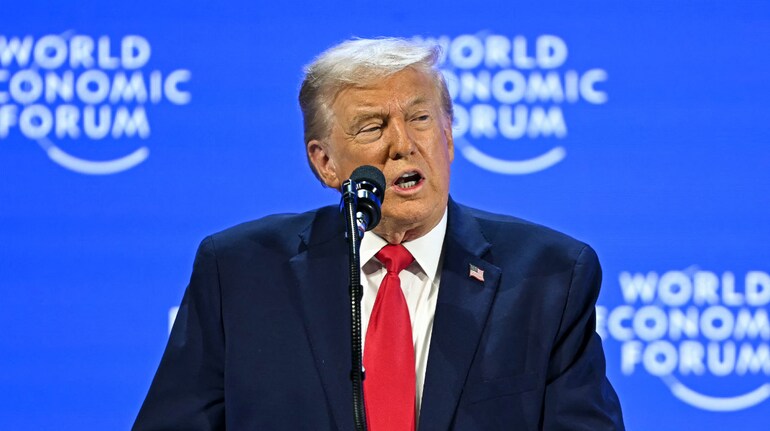

US President Donald Trump said on Wednesday that Washington had agreed to cut tariffs on Swiss imports from 39% to 15%, bowing to pressure from Swiss companies, including luxury watchmaker Rolex, while warning that the rate could still be raised again.
“I reduced it because I don't want to hurt people. I don't want to hurt them. And we brought it down to a lower level; it doesn't mean it's not going up,” Trump told world leaders and business executives at the World Economic Forum in Davos.
Trump’s remarks came after days of trade tensions with major European economies, including France, Britain, and Germany, as well as neighbouring Canada. During his Davos address, his criticism also extended to Switzerland, the event’s host country.
Recalling earlier tariff talks, Trump appeared unable to remember whether he had spoken to Switzerland’s president or prime minister, repeatedly referring instead to a “woman,” a reference to former Swiss President Karin Keller-Sutter.
“I guess the prime minister I don't know, the president the prime minister called, a woman. And she was very repetitive. She said, 'No, no, no, you can't do that, 30%. We are a small, small country.’ But I said, 'You may be small, but you have a big deficit,’” Trump said.
Describing the former Swiss leader as “so aggressive,” Trump said she had urged him not to impose tariffs on Swiss goods.
“I said, alright thank you maam, she kept on saying do not do this and I made it 39% and then all hell did break loose,” he added.
Trump said he had initially planned a 30% tariff on Swiss imports but raised it to 39% after the meeting with then-Swiss President Karin Keller-Sutter, saying she “just rubbed me the wrong way, I'll be honest with you.”
Speaking on Wednesday at the World Economic Forum in Davos, Switzerland, Trump seemed to confirm what European officials had long suspected: The rate increase was personal.
Switzerland does not operate under a presidential or prime ministerial system. Executive authority rests with a seven-member Federal Council, which collectively serves as both head of state and government. The role of Federal President rotates annually among council members. Keller-Sutter, who held the post when the tariffs were imposed last year, has since been replaced by Guy Parmelin.
Trump said the tariff decision was driven by what he described as a large US trade deficit with Switzerland, which he claimed stood at $41 billion.
“Without the US, they wouldn't make anything. Imagine, Switzerland made $41 billion off us. And she said it's a small place,” he said.
He cited Swiss luxury exports, particularly Rolex watches, accusing Switzerland of benefiting disproportionately from access to the US market while paying little in return.
“A majority of the money they make is because of us, because we never charge them anything,” Trump said. Despite the criticism, Trump confirmed that the tariff rate had been lowered after lobbying by Swiss companies.
The tariff reduction follows a preliminary trade agreement reached between the US and Switzerland, under which tariffs on many Swiss goods, including watches, were cut to 15%. In return, companies from Switzerland and Liechtenstein committed to investing $200 billion in the United States over five years, including $67 billion in 2026, according to a White House fact sheet.
Swiss businesses have welcomed the lower tariff rate, which places them on par with competitors from the European Union. However, negotiations to finalise the agreement are ongoing and are expected to conclude by the first quarter of 2026. Trump reiterated that while tariffs had been reduced for now, future increases remain possible.
(With agency inputs)
Discover the latest Business News, Sensex, and Nifty updates. Obtain Personal Finance insights, tax queries, and expert opinions on Moneycontrol or download the Moneycontrol App to stay updated!
Find the best of Al News in one place, specially curated for you every weekend.
Stay on top of the latest tech trends and biggest startup news.





