






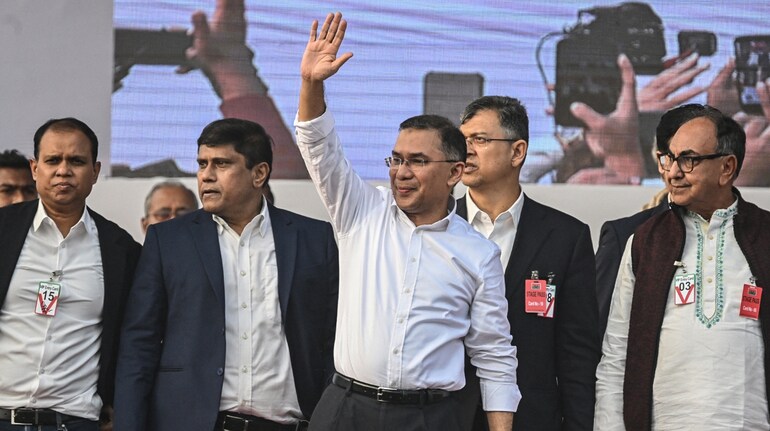
Tarique Rahman’s return to Bangladesh after 17 years in exile was no routine development — it signals a seismic shift in the South Asian country's political landscape.
Rahman, the acting chairman of the Bangladesh Nationalist Party (BNP), is widely seen as the front-runner to become Bangladesh’s next Prime Minister.
The BNP scion, who is the son of former prime minister Khaleda Zia, returned to a charged atmosphere on Thursday with violent protests gripping the country following the death of Sharif Osman Hadi, prominent leader of the youth movement that ousted Sheikh Hasina.
A symbolic homecoming
Rahman, 60, landed at Hazrat Shahjalal International Airport in Dhaka alongside his wife Zubaida and daughter Zaima, stepping barefoot onto Bangladeshi soil amid tight security.
Thousands of BNP workers and supporters gathered to welcome him, underlining his central role in the party’s election plans.
His return comes just months before landmark general elections (scheduled in February 2026), with the BNP positioning itself for a comeback after the fall of Sheikh Hasina’s Awami League government last year.
Hasina is currently living in exile in India, and her party is unlikely to be permitted to contest the polls, making the elections among the most consequential in Bangladesh’s recent history.
Bangladesh's PM-in-waiting
Rahman's mother Zia, 80, is hospitalised in a critical condition since November 23. This means that Rahman is expected to become the country’s new leader if the BNP emerges as the largest party. Experts view his homecoming as a major inflection point in Bangladeshi politics, especially for the post-Yunus era.
South Asia analyst Michael Kugelman called Rahman’s return a defining moment.
"Tarique Rahman, possibly Bangladesh’s next prime minister, has returned home after 17 years in exile. His return marks one of Bangladesh’s biggest political moments in years. It’s also a test of his ability to reconnect w/his base & navigate the powder keg that is BD politics," he said on X.
Kugelman also noted that the BNP, which appeared politically sidelined for years, is now poised for a return.
"But there are often second chances in politics. The BNP, left for dead during the end of the Hasina era, is poised to return to power. One signpost to watch: Will Rahman signal a readiness to end the retributive politics that have been so destabilizing for BD? Color me skeptical," Kugelman added.
Jon Danilowicz, a former US diplomat, told Al Jazeera that that Rahman’s return was the final piece of the puzzle in Bangladesh’s preparations for elections. He added the elections will only be BNP's to lose, noting that the party has shown great resilience over the past 17 years while being away from power.
Decoding Rahman’s messaging on his return, Kugelman suggested that the BNP leader adopted a softer stance and ticked all the right boxes as the country remains on the edge. He even quoted Martin Luther King, saying "I have a plan" for Bangladesh, quoting from the American civil rights activist's iconic "I have a dream" speech.
"Tarique Rahman’s speech today called for unity, invoked MLK Jr, and essentially said all the right things. But that will be a hard sell, given deep divisions within Bangladesh’s polity-and within his own party-and given the BNP’s poor record on rights and democracy when in power."
What it means for India
Rahman’s ties with India are strained by past BNP baggage and Hasina’s asylum, but shifting political equations and recent goodwill signals suggest scope for a pragmatic reset if he comes to power.
Tarique’s ascent may still mean that India can no longer bank on a government that prioritised Delhi on security, transit and connectivity, especially against Northeast insurgents and Islamist networks. Even a friendly Tarique government would likely be less reflexively aligned with New Delhi compared to Sheikh Hasina's Awami League.
New Delhi has already witnessed a shift in Bangladesh's priorities since Yunus assumed power, with Dhaka fostering closer ties with both Beijing and Islamabad. This foreign policy shift is expected to continue even as Rahman laid bare his "Bangladesh First" agenda.
For Pakistan, Rahman’s return is a mixed opportunity: a BNP resurgence could revive Dhaka–Islamabad warmth given the party’s historical affinity with Pakistan and past tolerance for Jamaat-linked networks.
But Rahman’s “Not Dilli, not Pindi… Bangladesh first” posture and his public distancing from Islamists signal a more nationalist, balanced foreign policy that could limit Rawalpindi’s leverage.
During a rally at Dhaka, he said that Bangladesh will not align itself closely with either India or Pakistan. "Not Dilli, not Pindi (Rawalpindi), Bangladesh before everything," he said.
Moreover, with Jamaat now a key rival rather than ally, Pakistan is likely to keep courting Rahman while keeping ties with Islamist proxies as an insurance policy if BNP’s moderation hardens into a more independent line.
Who is Tarique Rahman?
Discover the latest Business News, Sensex, and Nifty updates. Obtain Personal Finance insights, tax queries, and expert opinions on Moneycontrol or download the Moneycontrol App to stay updated!
Find the best of Al News in one place, specially curated for you every weekend.
Stay on top of the latest tech trends and biggest startup news.




