






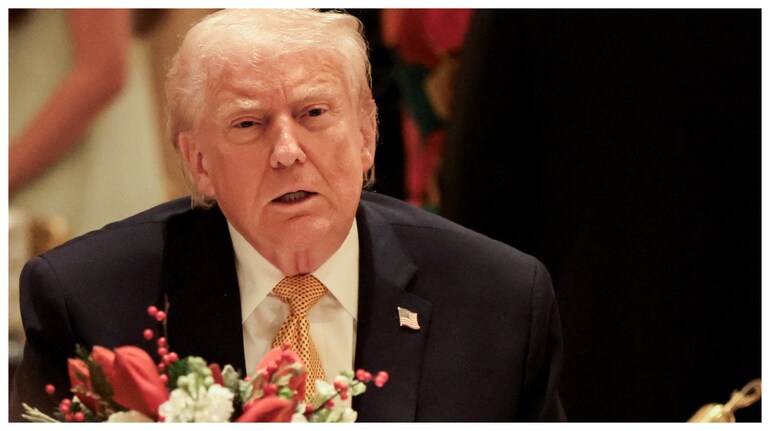
Donald Trump took oath as US President for a second term on January 20, 2025, and the months since have been marked by a wave of surprises that have sent ripples across the globe. From slapping tariffs on goods reaching US from countries around the world to projecting himself as a peacemaker in several global conflicts, Trump has made headlines throughout 2025.
Upon his historic White House return, Trump's second term began with a rush of executive orders, from an immigration crackdown and rollbacks on climate-friendly policies to pardoning people convicted for the 2021 Capitol riot. Soon after in his speech, the Republican President promised a new 'golden age of America' and even accused his predecessor Joe Biden of a 'horrible betrayal of America'.
"We're going to have ... I say it's the golden age of America. We have an age that's coming up, the likes of which ... this country has never seen. And I just look so forward to the results. You're going to see results in six months to a year," he said in his address.
Here's how the US President jolted the world -Trump Tariffs
Donald Trump imposed tariffs in ways the world had never seen. In the first 100 days of his presidency, he imposed tariffs on multiple countries — primarily targeting China, Mexico, and Canada - triggering swift retaliatory measures in response.
On April 2, 2025, Trump made 'Liberation Day' tariff announcement that sent shockwaves through financial markets across the globe. The US president imposed tariffs on imports from more than 90 countries. The nations worst hit were Brazil, India, Canada and Switzerland among others.
Trump imposed a 25% 'reciprocal' tariff on Indian imports, citing India's high duties on US goods. It was followed by an additional 25% penalty tariff, effective August 27, accusing India of funding Russia's war on Ukraine through discounted oil purchases. Total duties reached 50% on many goods, which was one of the highest rates globally.
India is currently in advanced discussions with the US on a trade agreement, Commerce and Industry Minister Piyush Goyal said on December 22, as a breakthrough is awaited in long-drawn negotiations even as New Delhi has sealed FTAs with other nations.
Peacemaker in global conflicts
Trump has made tall claims about playing a peacemaker in global conflicts including the war between Ukraine and Russia as well as India-Pakistan clash. According to the US President, he helped prevent a potential 'nuclear conflict' between India and Pakistan. "We stopped a potential nuclear war between Pakistan and India. The Prime Minister of Pakistan said that President Trump saved 10 million lives, maybe more," he said.
He was referring to the four-day military confrontation between India and Pakistan that followed Operation Sindoor, launched by New Delhi in response to the Pahalgam terror attack that claimed 26 lives. Trump has repeatedly claimed that he used trade tariffs as leverage to defuse the crisis. India, however, has consistently dismissed this narrative.
After taking office again in January 2025, Donald Trump placed resolving the Russia–Ukraine conflict at the centre of his foreign policy agenda, frequently asserting that strong U.S. leadership and direct diplomatic engagement could quickly bring the war to an end.
The Trump administration worked on a peace plan with about 20 points addressing ceasefire terms, territorial arrangements, security guarantees, and NATO membership issues, though key disagreements persist with Russia continuing military attacks. Trump has also threatened sanctions on Russia and pressured allies diplomatically to support peace efforts. However, significant breakthroughs have not been achieved.
H1-B visa fees & lottery
In September 2025, US President Donald Trump issued a proclamation introducing a $100,000 charge on fresh H-1B visa applications for skilled foreign professionals. The steep hike, from earlier fees that were only a few thousand dollars, is intended to crack down on perceived misuse of the visa system, deter firms from substituting American employees with cheaper overseas talent, and reinforce the administration’s push to put US workers first in high-skilled sectors.
Indians have long been the largest beneficiaries of the H-1B visa system. Now, beyond the added financial burden Indian IT firms face for employing thousands of workers on these visas, there is growing uncertainty that has scarred many Indian professionals working in US tech, finance, health care and other industries, especially after the recent mass postponement of work-visa appointments.
The US scrapped its decades-old lottery system, replacing it with a wage-weighted model that fundamentally changes who gets a shot. Starting in 2026, the H-1B visa system will move away from a random lottery. Applications that propose higher salaries will have a greater likelihood of being selected, marking a clear change in how the US plans to draw skilled foreign workers.
Travel ban on 30+ nations
US President Donald Trump signed a proclamation expanding the list of countries with full or partial travel restrictions to 39. As per a White House fact sheet, the latest proclamation introduced travel restrictions on five countries—Burkina Faso, Mali, Niger, South Sudan and Syria—and also added holders of travel documents issued by the Palestinian Authority to the banned list. In addition, Laos and Sierra Leone, which had earlier faced only limited entry curbs, are now subject to a full travel ban.
The expanded ban and restrictions are set to take effect on January 1, 2026.
The White House cited terrorist activity, internal conflict and high visa overstay rates as major factors behind the latest decision. Countries such as Burkina Faso, Mali, Niger and Nigeria were flagged for active terrorist threats, while others were highlighted for high rates of B-1/B-2 and student visa overstays, according to the Department of Homeland Security reports.
Golden Dome missile defense system
In May, Trump announced plans for a $175 billgion missile defence system 'Golden Dome', designed to safeguard the country against potential threats from China and Russia. "Golden Dome will protect our homeland," the US President said.
The Golden Dome is a next-generation missile defence plan designed to shield the US homeland from increasingly advanced and rapidly evolving aerial threats. Moving beyond traditional systems that primarily target ballistic missiles, Golden Dome will deal with Hypersonic Glide Vehicles (HGVs), cruise missiles, and large swarms of AI-equipped drones.
The Golden Dome is envisioned as an integrated ground-and space-based missile shield system capable of identifying, monitoring and neutralising missiles at various phases of their flight, including striking them before launch or intercepting them while airborne.
The ambitious initiative, projected to cost around $175 billion, is expected to take several years to roll out and faces uncertainty over funding and political clearance. However, Trump said the project should be finished by January 2029, before the end of his term if re-elected.
Discover the latest Business News, Sensex, and Nifty updates. Obtain Personal Finance insights, tax queries, and expert opinions on Moneycontrol or download the Moneycontrol App to stay updated!
Find the best of Al News in one place, specially curated for you every weekend.
Stay on top of the latest tech trends and biggest startup news.




