






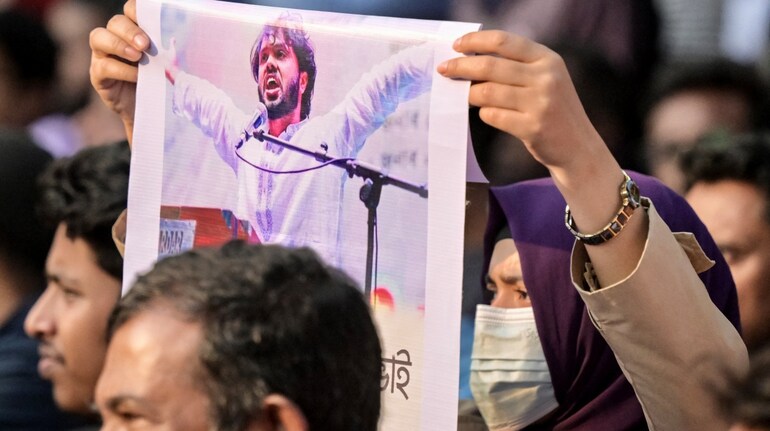
Bangladesh has been pushed into widespread violence and disorder following the death of radical anti-India leader Sharif Osman Hadi, exposing deep political instability just months before crucial national elections scheduled for February 2026.
Nationwide protests erupted on Thursday night after news emerged that Hadi had died in Singapore, where he was undergoing treatment for gunshot wounds. The unrest quickly spiralled into chaos. Media houses, cultural centres and even the residence of Sheikh Mujibur Rahman were torched. A Hindu man was lynched and burnt alive following blasphemy allegations, underlining the breakdown of law and order.
Who was Sharif Osman Hadi
Sharif Osman Hadi was a vocal and controversial figure in Bangladeshi politics. Known for his radical anti-India stance, he served as the spokesperson of the Anti Sheikh Hasina Inqilab Mancha. He was also an independent political candidate from the Dhaka 8 constituency.
Hadi was shot in broad daylight in Dhaka last week by masked assailants riding a motorcycle. A bullet entered one ear and exited through the other, leaving him critically injured. After days in intensive care, he was flown to Singapore by air ambulance under the supervision of the Yunus administration. He died there after prolonged treatment.
A chilling warning before the shooting
Bangladeshi investigators say the night before the attack holds crucial clues and points to clear pre-planning.
According to law enforcement agencies, the main accused, Faisal Karim, had ominously hinted at a major incident even before the shooting took place. While staying at a resort in Savar, on the outskirts of Dhaka, Faisal allegedly spoke to his girlfriend and close associate, Maria Akhtar Lima.
"It would be something that would shake the entire country," Faisal told Maria, while he showed her a video clip of Hadi, reported Jamuna Television.
"Something will happen tomorrow (on Friday), that the whole country will tremble," newspaper Daily Jugantor quoted Faisal as saying.
Investigators say these statements, revealed during interrogations, show prior knowledge and deliberate planning. Authorities believe the attack was not an isolated act but part of a coordinated conspiracy involving dozens of people.
How investigators say the attack was planned
Bangladesh police and the Rapid Action Battalion believe the shooting was carefully organised and well funded. A former councillor is suspected to be the main planner behind the attempted assassination.
Officials say at least 20 people were involved, with roles ranging from financing and weapons procurement to executing the shooting and arranging escape routes. So far, nine people have been arrested in joint RAB and police operations, according to Prothom Alo.
Raids have uncovered firearms, bullets, magazines and cheques worth several crore taka, Jamuna Television reported. Investigators also believe more shooter teams were on standby.
An investigating officer said preliminary findings suggest that a significant amount of money was invested with the clear intention of killing Hadi.
Weapons used in the attack have been recovered from multiple locations. Two magazines and 11 rounds of ammunition were found under the residence of Faisal’s sister. Two foreign pistols, two magazines, a toy pistol and 41 rounds of ammunition were later recovered from a pond in the Narsingdi district, which police say were used in the shooting.
The motorcycle used in the attack carried a fake number plate. Police also allege that Faisal’s father changed number plates to help the shooters evade detection.
Arrests made but shooters still missing
Several people linked to the attack have been arrested, including Faisal Karim’s parents, his wife Saheda Parvin Samia, his brother-in-law Wahid Ahmed Shipu, his girlfriend Maria Akhtar Lima, alleged motorcycle owner Abdul Hannan and close aide Md Kabir.
Some of the accused are on remand, while others remain under surveillance. However, Faisal Karim and the main shooters remain at large, highlighting serious gaps in Bangladesh’s security apparatus.
Bangladeshi media initially claimed that Faisal and his aides had fled to India. However, the Dhaka Metropolitan Police stated that "there was no verified evidence that the attackers crossed into India," reported Jagonews24 on December 14.
Despite this, the Yunus-led interim administration urged India to arrest and hand over the attackers, even as Bangladeshi police admitted they had no proof of cross-border escape.
Jamuna Television later reported that one of the shooters had travelled from Guwahati to Maharashtra and was using a Reliance Jio SIM card. These claims remain unverified, and Dhaka police have provided no confirmation.
A country on edge ahead of elections
The aftermath of Hadi’s death has plunged Bangladesh into a dangerous phase of instability. Mob violence, targeted attacks and political unrest have exposed the fragility of governance under the interim administration.
With elections barely a year away, Bangladesh now faces a volatile environment where fear, radicalisation and lawlessness threaten to derail the democratic process that the Yunus government promised to uphold.
Instead of restoring calm, the handling of the crisis has deepened mistrust, raised regional tensions and reinforced concerns that Bangladesh is sliding further into chaos rather than stability.
Discover the latest Business News, Sensex, and Nifty updates. Obtain Personal Finance insights, tax queries, and expert opinions on Moneycontrol or download the Moneycontrol App to stay updated!
Find the best of Al News in one place, specially curated for you every weekend.
Stay on top of the latest tech trends and biggest startup news.




