






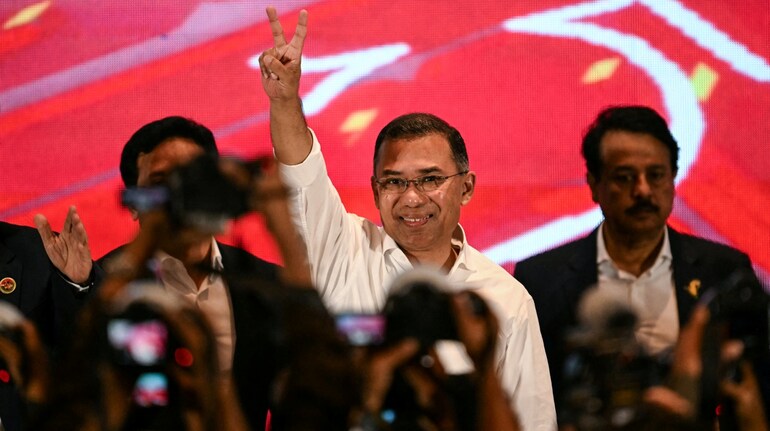

Bangladesh’s latest election has delivered a decisive verdict, but it has also reopened old anxieties in New Delhi. With the Bangladesh Nationalist Party returning to power under Tarique Rahman, the political order shaped by Sheikh Hasina has come to an abrupt end.
For India, this is not just a change of government in a neighbouring country. It is a strategic reset with uncertain consequences. The BNP’s sweeping mandate, coupled with the strongest parliamentary showing ever by Jamaat-e-Islami, has placed India-Bangladesh relations at a delicate crossroads. The challenge for New Delhi is to engage a new leadership without ignoring the lessons of the past.
India’s message: Engagement without illusions
Prime Minister Narendra Modi moved quickly to signal diplomatic continuity, congratulating Tarique Rahman and emphasising India’s willingness to work with the new government.
“This victory shows the trust of the people of Bangladesh in your leadership. India will continue to stand in support of a democratic, progressive and inclusive Bangladesh,” Modi said.
The message was deliberate. India wants dialogue, but it is not blind to history. During the 2001 to 2006 BNP-Jamaat rule, relations deteriorated sharply. Indian security agencies repeatedly flagged Dhaka’s failure to act against insurgent groups targeting India’s Northeast. According to The Indian Express, militant outfits found sanctuary and logistical support during that period, leaving a deep scar on India’s strategic thinking.
Hasina in India: A diplomatic fault line
The most immediate flashpoint is Sheikh Hasina’s presence in India. After her removal in 2024, she took refuge in New Delhi. Since then, a special tribunal in Dhaka has sentenced her to death in absentia for “crimes against humanity” linked to the uprising.
The new BNP government has made extradition an official demand. For India, this is a diplomatic minefield. Handing over a long-time strategic partner risks reputational damage. Refusing could poison ties with Dhaka at the very start of engagement.
The problem is compounded by Jamaat’s pressure within the ruling coalition to pursue Hasina’s return aggressively. Any political activity or statements by Hasina from Indian soil are likely to be framed by Dhaka as interference, ensuring the issue remains a constant irritant in bilateral relations.
Security anxieties return to the forefront
India’s core concern remains security. Hasina’s government dismantled militant networks and deepened counter-terrorism cooperation with India after 2008. That cooperation came at a cost to democratic space in Bangladesh, but it delivered tangible security outcomes for India.
With the BNP and Jamaat back in power, New Delhi fears a rollback. Intelligence agencies are closely watching border regions, particularly areas near the Siliguri Corridor, the narrow strip linking India’s Northeast to the mainland. Any revival of militant infrastructure would fundamentally alter India’s security posture.
Border management remains another sensitive issue. Dhaka has criticised the use of force by Indian border guards, while India insists on curbing smuggling and irregular crossings. Without trust at the top, these operational frictions could escalate quickly.
Minority safety as a barometer
India is also watching how the new government handles violence against religious minorities. Since the 2024 upheaval, attacks on Hindu communities have increased. For New Delhi, minority safety is not just a moral concern but a measure of political radicalisation.
Failure to rein in extremist elements would raise serious questions about Dhaka’s ability or willingness to govern inclusively. While India raises the issue diplomatically, responsibility rests squarely with Bangladesh’s leadership.
Water and trade pressure points
Structural disputes have not disappeared. The Teesta river remains unresolved, and Tarique Rahman has pledged to secure what he calls a fair share for Bangladesh. At the same time, the 1996 Ganga Water Sharing Treaty expires in December 2026.
Renegotiation will require trust that is currently fragile. Water-sharing is politically explosive in both countries, with direct implications for farmers and state governments.
Trade and connectivity offer a counterweight. Bangladesh is India’s largest trading partner in South Asia. Connectivity projects linking India’s Northeast to Bangladeshi ports benefit both sides. But public suspicion in Bangladesh about India’s regional influence means these projects remain politically sensitive.
China and Pakistan loom large
Rahman has described China as a “development friend,” signalling continuity in Dhaka’s engagement with Beijing. China already dominates Bangladesh’s defence imports and infrastructure financing. For India, Beijing’s expanding footprint in the Bay of Bengal is a strategic concern, not an abstract fear.
Even more troubling is Bangladesh’s renewed outreach to Pakistan. Since Hasina’s removal, Dhaka has moved towards restoring maritime links and discussing defence cooperation. Any revival of Pakistan’s influence is viewed in New Delhi through the prism of regional rivalry and past hostility.
India’s balancing act
India’s response is calibrated realism. Engage the new government, keep communication channels open, and defend core interests without confrontation. New Delhi knows Bangladesh will diversify its partnerships. The task is to ensure that diversification does not come at India’s strategic expense.
Bangladesh’s election has ended one chapter, but it has opened another filled with unresolved tensions. For India, the test is not whether relations continue, but whether they can be stabilised without repeating the mistakes of the past.
Discover the latest Business News, Sensex, and Nifty updates. Obtain Personal Finance insights, tax queries, and expert opinions on Moneycontrol or download the Moneycontrol App to stay updated!
Find the best of Al News in one place, specially curated for you every weekend.
Stay on top of the latest tech trends and biggest startup news.





