






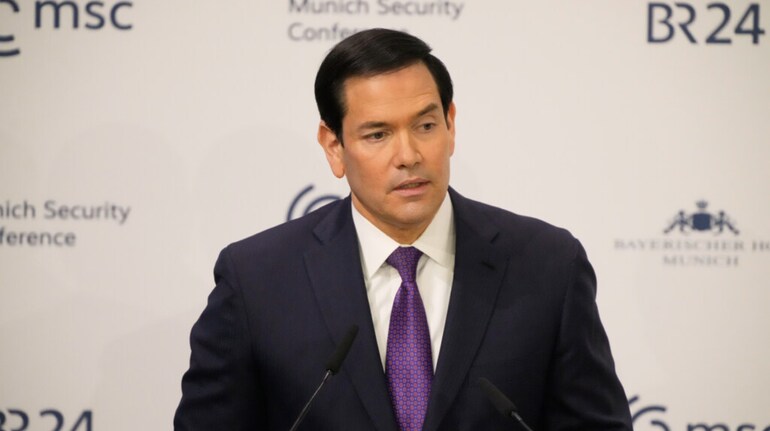

The United States launched strikes on Iran only after concluding that Israel was set to attack and that Tehran would swiftly retaliate against American forces, Secretary of State Marco Rubio said Monday, offering the administration’s clearest justification yet for entering the conflict.
"We knew that there was going to be an Israeli action. We knew that that would precipitate an attack against American forces, and we knew that if we didn't preemptively go after them before they launched those attacks, we would suffer higher casualties," Rubio told reporters at the Capitol ahead of a classified briefing for lawmakers.
Rubio said Iranian commanders had been instructed to automatically target US forces if Iran came under attack.
"If we stood and waited for that attack to come first before we hit them, we would suffer much higher casualties. And so the president made the very wise decision" to strike alongside Israel, he said.
Pressed on whether the United States faced an imminent threat — a key legal threshold as Congress holds the constitutional authority to declare war — Rubio again cited Israel’s plans.
"There absolutely was an imminent threat, and the imminent threat was that we knew that if Iran was attacked -- and we believed they would be attacked -- that they would immediately come after us," Rubio said.
"We were not going to sit there and absorb a blow," he added, warning that if Iran had struck first, "we would all be here answering questions about why we knew that and didn't act."
The briefing to lawmakers came as Congress prepares to consider a war powers resolution that could force President Donald Trump to end hostilities. Republicans control both chambers, making passage unlikely.
Democrats sharply questioned the administration’s rationale. Representative Joaquin Castro said Rubio’s comments suggested that Israel’s decision to attack had placed American troops at risk.
"This is unacceptable of the President, and unacceptable of a country that calls itself our ally," Castro wrote on X.
Senate Democratic leader Chuck Schumer described the conflict as a “war of choice” and said the briefing left him with more questions than answers. Senator Mark Warner warned that equating a threat to Israel with an imminent threat to the United States set a troubling precedent.
Vice President JD Vance, speaking to Fox News, framed the objective as preventing Iran from acquiring a nuclear weapon, saying the president would not relent until that goal was achieved. Iran denies seeking such a weapon.
Since hostilities began, US and Israeli forces have conducted extensive airstrikes across Iran, targeting military infrastructure. Tehran has responded with drone and missile attacks against US-aligned countries in the region. The fighting has resulted in significant casualties on both sides, including senior Iranian leaders and US service members.
Rubio stressed that regime change was not the formal objective of the operation.
"We hope that the Iranian people can overthrow this government and establish a new future for that country. We would love for that to be possible," Rubio said.
"But the objective of this mission is the destruction of their ballistic missile capabilities and of their naval capabilities."
House Speaker Mike Johnson defended the president’s actions as a defensive measure, arguing that Israel faced what it viewed as an existential threat and would have acted with or without US backing.
The House is expected to vote later this week on the war powers resolution. Even if it passes, Trump could veto the measure, requiring a two-thirds majority in both chambers to override it.
Discover the latest Business News, Sensex, and Nifty updates. Obtain Personal Finance insights, tax queries, and expert opinions on Moneycontrol or download the Moneycontrol App to stay updated!
Find the best of Al News in one place, specially curated for you every weekend.
Stay on top of the latest tech trends and biggest startup news.





