






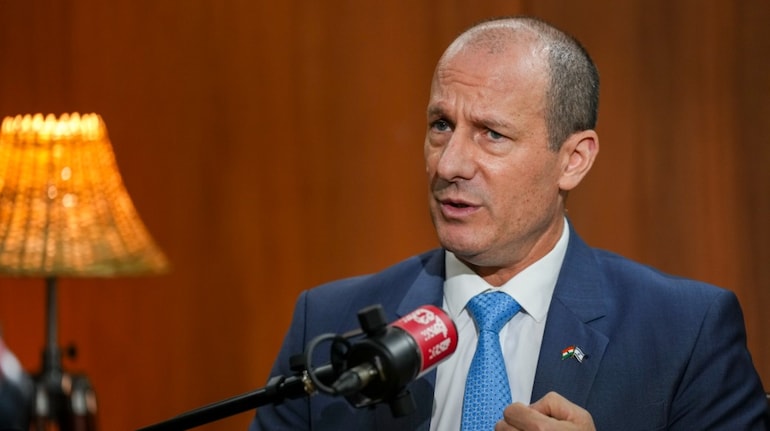

Israel’s ambassador to India, Reuven Azar, has said that the timing of the recent military action against Iran was dictated not by prior scheduling, but by a sudden and actionable intelligence window that emerged only after Prime Minister Narendra Modi concluded his visit.
According to him, the decision followed years of preparation, but the final trigger came unexpectedly.
“It was basically, let’s say, an operational opportunity that we utilised as a result of the intelligence that came in real time,” Azar said, emphasising that the development unfolded after PM Modi had already departed.
He clarified that there had been no prior knowledge during the diplomatic engagements. “It was an operational opportunity that came up only after Prime Minister Modi left.”
During PM Modi’s visit, discussions between Indian and Israeli leadership were focused on broader regional cooperation and long-term strategic alignment. The two countries had recently upgraded their relationship to a “Special Strategic Partnership” and concluded 17 agreements following talks between PM Modi and Israeli PM Benjamin Netanyahu on February 26.
However, Azar underlined that the possibility of imminent strikes was not part of those conversations. “Of course, during the conversations with Prime Minister Modi during the visit, we talked about regional development, but we couldn’t have actually shared something that we didn’t know.”
He explained that Israel’s preparedness for such an operation had been built over decades, driven by what it perceives as a sustained threat from Iran.
According to him, billions of dollars have been invested into intelligence gathering, surveillance, and military readiness.
The aim, he said, has been to deeply understand Iran’s leadership structure, military infrastructure, and operational capabilities. This includes identifying decision-makers, mapping their locations, and tracking evolving threats.
“So, only towards that effort, we have invested billions of dollars throughout the years because of the nature of the threat,” Azar noted. He added that Israel had simultaneously worked on advancing military technologies capable of penetrating Iranian air defence systems and countering missile attacks.
A key part of that defensive architecture includes multiple layers of missile interception systems. While declining to provide exact figures about incoming projectiles, Azar indicated that a significant portion had been successfully neutralised.
“Fortunately, most of them are intercepted. Unfortunately, some of them managed to penetrate,” he said, referencing a recent incident in which a civilian shelter was struck by a ballistic missile, resulting in nine fatalities.
Israel’s defence network, he said, integrates a range of systems including Arrow 3 and David’s Sling for ballistic threats, alongside Iron Dome and the newer Iron Beam for drones and shorter-range projectiles.
“We have developed new systems, including Iron Beam, a laser defence system that now has helped us a great deal to deal with drone threats and also with the missiles and rocket threat,” he stated, though he acknowledged that this system does not yet address ballistic missiles.
The complexity of modern air defence, according to Azar, lies in synchronising multiple technologies in real time. “At the end of the day, the challenge is to integrate all the systems in real time and decide in real time what is the tool that you are going to use,” he said.
This process relies heavily on artificial intelligence, rapid data processing, and trained personnel coordinating from command centres.
He further described how Israel’s air force contributes to interception efforts, with fighter aircraft playing a role in neutralising certain threats mid-air.
The offensive operations against Iran also involved a mix of aircraft. “We have procured F-35s… and we also have F-16s, and we have been using a combination of them for the attacks that we conducted over the skies of Iran,” he said.
Coordination with international partners has also been a significant factor. Azar highlighted ongoing collaboration with the United States, both in terms of planning and execution.
He pointed to the role of US Central Command and the broader framework established under the Abraham Accords, which has enabled regional surveillance and operational coordination. “And now, before this operation, we’ve been coordinating with the United States for a long time and been waiting for the right moment… which we didn’t know when was going to happen.”
He added that American military presence in the region has amplified operational capabilities, particularly in striking hardened targets. According to him, US assets allow for attacks on missile launchers, production facilities, and underground storage sites using heavy munitions. This includes capabilities that Israel alone does not possess.
Despite the scale of the operation, Azar maintained that Israel’s objective was limited to neutralising threats rather than influencing Iran’s political future.
“We are not going to determine who is going to rule Iran in the future. It’s up to the Iranian people to decide,” he said. He framed the strikes as defensive, aimed at both protecting Israel and weakening structures that, in his view, oppress Iranian citizens.
“What we have done is that we engage in a military operation to neutralise the threats that were against the existence of our country and also against the Iranian people,” he stated. He suggested that responsibility for the country’s future now lies with its population and opposition groups.
Azar also acknowledged that Israel’s ability to support internal unrest in Iran has been limited. “Unfortunately, we didn’t have enough energy to help the Iranians more than we did,” he said.
Nonetheless, he expressed hope that current developments could lead to change within the country.
“I think that the Iranian people deserve freedom,” he said, adding that greater international support could strengthen their position. “Because the Iranian people deserve freedom. They deserve liberty. They deserve to free themselves from this terrible oppression…”
He concluded by reiterating that Israel’s immediate focus remains on its own security concerns. “Our resources are limited, so we are concentrating first and foremost on our right of self-defence and the usage of military capabilities to neutralise the threats that are coming from Iran.”
Discover the latest Business News, Sensex, and Nifty updates. Obtain Personal Finance insights, tax queries, and expert opinions on Moneycontrol or download the Moneycontrol App to stay updated!
Find the best of Al News in one place, specially curated for you every weekend.
Stay on top of the latest tech trends and biggest startup news.





