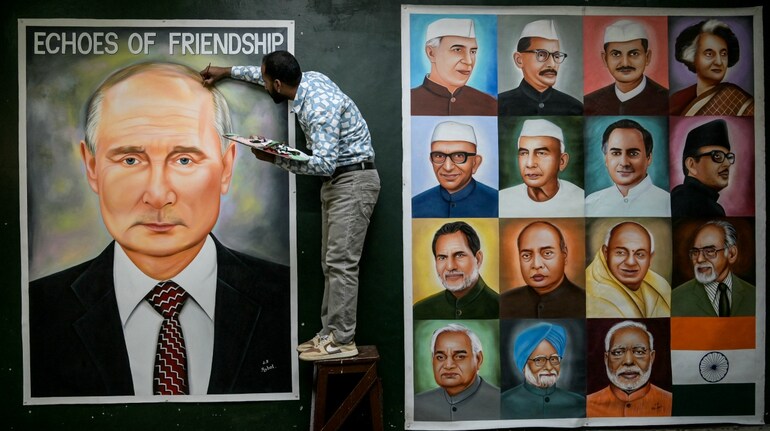
Russian President Vladimir Putin will land in New Delhi on Thursday for the 23rd India–Russia Annual Summit with Prime Minister Narendra Modi, a visit drawing global scrutiny as it marks one of his most significant foreign engagements since the International Criminal Court issued an arrest warrant for him in March 2023. His arrival has reignited a key question: is India legally bound to detain the Russian leader while he is on its territory?
The answer, grounded in India’s legal framework and long-standing diplomatic choices, is no. New Delhi is under no obligation to act on the ICC warrant because it has neither signed nor ratified the treaty that grants the court its jurisdiction.
Why the ICC issued a warrant against Putin
The ICC’s Pre-Trial Chamber II issued arrest warrants on March 17, 2023 for President Vladimir Putin and for Maria Lvova-Belova, Russia’s Commissioner for Children’s Rights. The Court said it had evidence that both individuals carried individual criminal responsibility for the war crime of unlawfully deporting Ukrainian children from territories occupied by Russia.
ICC Prosecutor Karim AA Khan said there were “reasonable grounds” to believe these actions took place after February 24, 2022. According to the ICC, thousands of children were taken from orphanages and care homes in Ukraine. The Court argues that certain presidential decrees issued by Putin helped speed up the process of granting Russian citizenship to these children and placing them with Russian families.
The ICC says this amounts to an attempt to remove the children permanently from their home country and violates the Fourth Geneva Convention. Russia, however, rejects the authority of the ICC. Since Russia is not a party to the Rome Statute, and since Ukraine only accepted the Court’s jurisdiction for crimes on its territory, the ICC can enforce the warrant only in the 125 countries that are treaty members.
Why India does not fall under ICC rules
India’s ability to host Putin without arresting him comes from a basic rule of international law. A country is bound only by treaties it has signed and adopted. Since India is not a member of the Rome Statute, none of the ICC’s obligations apply.
India chose not to join the ICC after raising several concerns during the drafting of the Rome Statute in 1998. One major objection was the power given to the United Nations Security Council to refer or suspend cases. New Delhi argued that this could politicise a judicial institution because the permanent members of the Security Council could influence which cases moved forward and which were blocked.
Another concern was the ICC’s limited definition of international crimes. India wanted terrorism and the use of nuclear weapons and other weapons of mass destruction to be included under the Court’s jurisdiction because these were issues of national priority. Since the final statute excluded these crimes, India believed the Court’s framework did not meet its security needs.
India also insisted that its own judicial system is strong enough to handle trials involving serious international crimes. Joining the ICC, in India’s view, could weaken national sovereignty and reduce the authority of domestic courts.
Most importantly, India never passed a law to recognise the Rome Statute within its own legal system. Without this step, an ICC arrest warrant has no legal effect inside the country. It is simply a document issued by a court whose jurisdiction India does not recognise.
What history tells us about similar situations
This is not the first time India has faced such a situation. In 2015, Sudan’s then president Omar al-Bashir visited New Delhi for the India-Africa Forum Summit. He was already facing an ICC arrest warrant for genocide and war crimes in Darfur. Civil society groups demanded his arrest, but India made clear that it had no legal obligation to act because it was not an ICC member.
A similar crisis emerged in 2023 during the BRICS Summit in South Africa. Since South Africa is a member of the ICC, it would have been required to arrest Putin. The issue was avoided when Putin chose to participate virtually and sent his foreign minister to attend in person.
The limited reach of ICC arrest warrants continues today. The Court has recently issued warrants against Israeli Prime Minister Benjamin Netanyahu, former Israeli Defence Minister Yoav Gallant, and senior Hamas leaders. The lack of uniform enforcement has reinforced the position of countries like India, China, and the United States, all of which remain outside the ICC system.
Why India will not act against Putin
India and Russia share a long-standing partnership that plays a key role in India’s defence and energy security. Russia supplies a large share of India’s military equipment, including fighter jets, submarines, tanks and the S-400 air defence system. India relies on Russian support for maintenance, spare parts and upgrades for this equipment.
India has also increased imports of Russian crude oil since the Ukraine conflict began, benefiting from discounted rates that help stabilise domestic fuel prices.
Given this strategic relationship, India is unlikely to take any step that would harm its ties with Moscow, especially when it has no legal duty to enforce the ICC warrant. New Delhi has consistently maintained that dialogue and diplomacy are the only way forward in the Ukraine conflict and has avoided joining Western sanctions.
Putin’s visit shows that despite international pressure, India will continue to follow an independent foreign policy shaped by national interest rather than external legal expectations.
Discover the latest Business News, Sensex, and Nifty updates. Obtain Personal Finance insights, tax queries, and expert opinions on Moneycontrol or download the Moneycontrol App to stay updated!
Find the best of Al News in one place, specially curated for you every weekend.
Stay on top of the latest tech trends and biggest startup news.