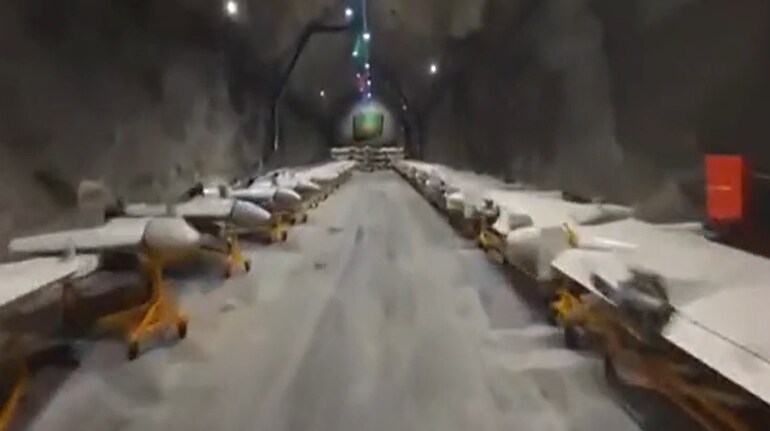

A modern air-defence commander today faces a dilemma that would have seemed implausible a decade ago.
A radar picks up a slow, low-flying drone. It is not stealthy. It is not fast. It is not technologically sophisticated.
But intercepting it may require firing a missile worth hundreds of thousands, sometimes millions, of dollars.
Individually, that decision is straightforward. Intercept.
Repeated at scale, it becomes a strategic liability.
This is the logic at the heart of Iran’s drone doctrine, a model of warfare built not on technological superiority, but on forcing adversaries into economically unsustainable defence. Estimates cited by Reuters and defence analysts put the cost of a Shahed-136 drone at roughly $20,000–$50,000, compared with around $4 million for a Patriot interceptor.
Do Not Miss | US claims Iran missile power is crippled: How is Tehran still raining down fire in the Gulf?
Iran’s real innovation: Turning affordability into strategy
Deprived of access to advanced Western systems due to decades of sanctions, Iran designed platforms that could be assembled from commercially available, dual-use components and produced at scale. Investigations by research groups such as C4ADS have documented how global supply chains were leveraged to build these systems despite export controls.
The result is a family of drones optimised not for performance, but for reliability, affordability and mass production.
The Shahed-136, widely used by Russia in Ukraine, is emblematic. It is slow, noisy and relatively simple. But it can travel long distances and be launched in large numbers.
Iran did not set out to build the most advanced drone but just enough of them.
From platform to doctrine: The rise of 'precise mass'
Iran’s doctrine relies on volume, sequencing and saturation:
This approach was visible in April 2024, when Iran launched around 170 drones along with cruise and ballistic missiles toward Israel, a coordinated salvo designed as much to test and saturate defences as to inflict damage.
The Council on Foreign Relations has described this model as 'precise mass,' the use of large numbers of relatively inexpensive systems to generate strategic effects traditionally associated with high-end platforms.
The implication is clear: air power is no longer defined only by sophistication, but by the ability to deploy at scale.
Must Read | Iran’s missile stockpile shrinking but conflict still far from over
The economics problem air defence cannot ignore
Modern air-defence systems are highly capable. They can intercept drones like the Shahed.
The problem is not capability. It is sustainability.
Each interception:
Meanwhile, the attacker can produce and launch replacements far more cheaply and quickly.
Even high interception rates do not resolve this.
If hundreds of drones are launched, a small percentage getting through can still cause damage. At the same time, the defender incurs disproportionately high costs for each successful intercept.
In Case You Missed It | Pentagon seeks $200 billion for Iran war after burning $11.3 billion in just one week
Lockheed Martin’s push to scale Patriot interceptor production from roughly 600 annually to about 2,000 by 2027 reflects growing concern over stockpile pressures.
This is the core of the problem: air defence systems were designed for scarcity. Drone warfare introduces abundance.
What Iran’s drone doctrine means for Indian air defences
For India, this is not a distant trend.
It is already visible.
The June 2021 drone attack on the Jammu Air Force Station, described by Reuters as a suspected first use of drones to strike an Indian military installation, demonstrated how low-cost systems can bypass traditional defences and target sensitive assets.
Since then:
The central lesson: Stop fighting cheap with expensive
The most important takeaway from Iran’s doctrine is economic.
Defending against low-cost drones using high-cost interceptors is not sustainable over prolonged periods.
India’s response will need to shift toward systems that are:
This includes:
The objective is not just to intercept threats, but to do so without exhausting resources.
Scale will define the next phase of warfare
Iran’s experience highlights another critical point: production capacity matters.
Future conflicts may not be determined solely by who has the most advanced platforms, but by who can:
India’s domestic drone ecosystem is expanding, but production volumes remain limited relative to potential conflict scenarios involving large-scale drone use.
Bridging that gap will require not just technology development, but industrial scaling and procurement reform.
Mass launches, multi-axis attacks, infrastructure targeting and sustained pressure campaigns are now part of modern conflict.
India has begun adapting, through military exercises, counter-drone systems and increased integration of UAVs in operations.
But the shift required is broader. Because the threat is not a single strike. It is a sustained campaign designed to stretch systems, budgets and response capacity.
Discover the latest Business News, Sensex, and Nifty updates. Obtain Personal Finance insights, tax queries, and expert opinions on Moneycontrol or download the Moneycontrol App to stay updated!





Find the best of Al News in one place, specially curated for you every weekend.
Stay on top of the latest tech trends and biggest startup news.