






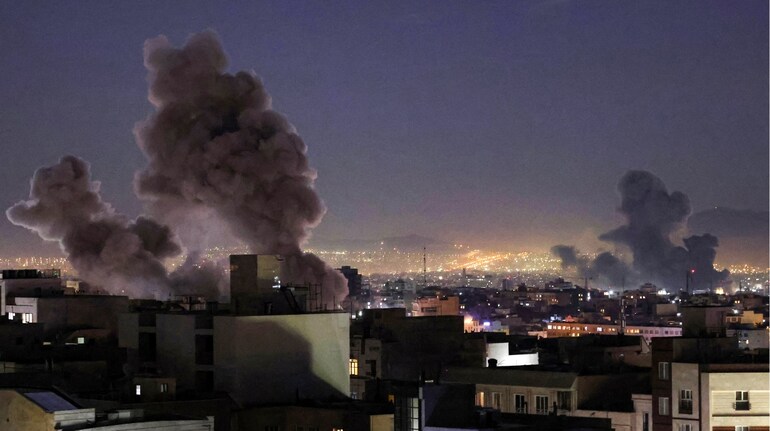

With its top military leaders killed and US forces pressing in, Iran appears to be fighting a battle for survival as it enters a deadly conflict in West Asia again.
After last year’s 12-day conflict with Israel — when large Iranian barrages were heavily intercepted and missile launchers destroyed — Tehran has recalibrated its missile doctrine.
According to a report in The Financial Times, Iran appears to have moved to a steadier, sustained campaign designed to stretch air defence systems over time instead of firing headline-grabbing salvos.
Western officials told the Financial Times that since US and Israel began striking Iran on Saturday, the Islamic Republic has retaliated with ballistic missiles and drones “in over 25 waves” targeting Israel, Bahrain, Qatar, the United Arab Emirates, Kuwait and Iraq.
Israeli officials say the country is being hit with smaller salvos than in the previous war — but at a more consistent rate.
A former Israeli security official described it as a deliberate strategy of attrition, which Israel often refers to as a “drizzle”.
“Who said the Iranians will play by our rules?” We don’t know where the Iranians will take it . . . but this [war] will likely not be measured in hours or days," the former security official said.
The vast majority of the incoming missiles and drones have been intercepted by sophisticated defence systems across Israel and the Gulf. But several projectiles have either evaded interception or were not deemed dangerous enough to justify expending costly interceptor missiles.
Live Updates: West Asia conflict
On Sunday, the death toll from Iranian attacks was rising. However, it was overshadowed by casualties inside Iran, where Supreme Leader Ayatollah Ali Khamenei, top military commanders and the defence minister were killed.
On the other hand, two direct Iranian missile strikes in Tel Aviv and Beit Shemesh killed 10 people in total, according to Israeli emergency services. UAE reported three deaths and 58 injuries after being hit by more than 150 ballistic missiles, over 500 drones and two cruise missiles.
Damage and casualties were also reported in Manama, Doha and Kuwait City, including strikes on a hotel and a port facility.
That marks a stark contrast with last year’s 12-day war, when Tehran launched heavily telegraphed strikes against a single US military base in the Gulf.
Analysts say the new approach reflects both political and military calculations, the report said.
Behnam Ben Taleblu of the Washington-based Foundation for the Defense of Democracies told the Financial Times that Iran may be escalating “hard, fast and early” against Gulf states.
“If they create enough of a crisis, they believe that they can get US partners in the region to help pull the plug on any kind of Israeli or American operation against Iran,” he said.
At the same time, Iran appears to be using its least advanced missiles first to deplete US and Israeli interceptor stocks, potentially saving more advanced systems for later.
“They are aware that the interceptors such as Thaad, Arrow and David’s Sling are exceptionally expensive and take years to accumulate,” said Robert Campbell, a former major and aerial weapons specialist in the UK military.
“They appear to be throwing older liquid-fuel missiles at Israel and the Gulf states to deplete these stocks and husband the newer solid-fuel missiles for later strikes.”
However, Campbell cautioned: “This relies on their launchers surviving.”
Eyewitness footage from Bahrain appeared to show a Shahed-136 drone striking a US naval facility in the Juffair district of Manama, home to the US Navy’s Fifth Fleet.
Lynette Nusbacher, a former adviser to the UK cabinet on intelligence matters, said Iran may be seeking symbolic hits.
“Iran would really like to ‘count coup’ — to get a warhead detonation on an Israeli or US military target. The lesson the Iranians appear to have learned is that they can’t keep from being hit,” she told FT.
“They anticipated the loss of command and control, and authorised regimental commanders or even lower to fire on pre-set targets. The people shooting are just shooting at co-ordinates off a spreadsheet.”
Israeli estimates put Iran’s arsenal at around 2,500 ballistic missiles. “I think they are calculating that it’s going to be a lengthy war,” Danny Citrinowicz of the Institute for National Security Studies in Tel Aviv told FT.
The sustained strikes are also meant to strain civilians, with Citrinowicz saying they create a constant need to stay near shelters, underscoring Tehran’s shift to a war of endurance rather than shock.
Discover the latest Business News, Sensex, and Nifty updates. Obtain Personal Finance insights, tax queries, and expert opinions on Moneycontrol or download the Moneycontrol App to stay updated!
Find the best of Al News in one place, specially curated for you every weekend.
Stay on top of the latest tech trends and biggest startup news.





