






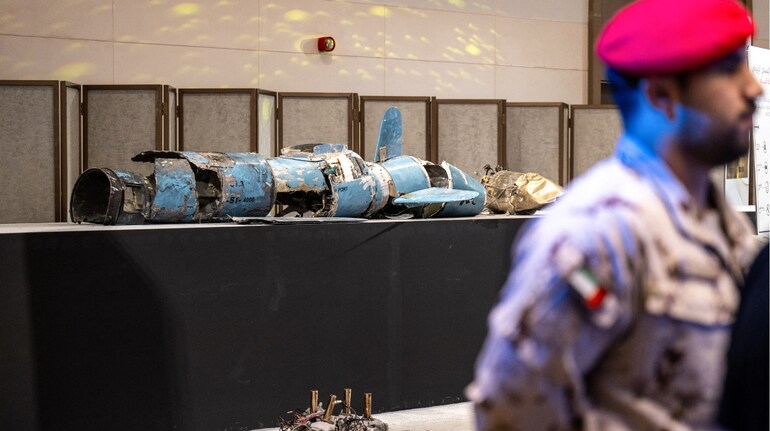

Missiles, drones, submarines, fighter jets, interceptors: the war in West Asia is on an escalation ladder with each day witnessing intense damage on all fronts as Iran hits back at Israel and US.
But how much firepower does Iran actually have in its arsenal to sustain resistance before it is forced to accept American terms — or does it have enough to turn the conflict into a prolonged war of attrition?
So far, the pace of the conflict has been unusually escalatory, with both sides burning through weapons at a rapid pace — faster than they can be replenished.
Iran war with US and Israel: Live updates
According to the Tel Aviv-based Institute for National Security Studies (INSS), US and Israel have already carried out more than 2,000 strikes, each involving multiple munitions, since the conflict escalated.
Iran, meanwhile, has launched 571 missiles and 1,391 drones, many of which have been intercepted by air defence systems.
For both sides, sustaining this level of combat could become increasingly difficult if the war drags on.
Iranian missile launches already dropping
Western officials say there are early signs that Iran may already be slowing its pace of attacks.
Before the war, Iran was estimated to possess more than 2,000 short-range ballistic missiles, though exact numbers remain classified, according to a BBC reports. Military powers rarely disclose precise stockpile figures to avoid revealing vulnerabilities.
According to US military officials, the number of Iranian missile launches has dropped sharply since the early days of the conflict.
America’s top commander Gen Dan Caine said Iran’s ballistic missile launches had fallen 86 percent from the first day of fighting. The US Central Command (Centcom) also reported a 23 percent drop in launches over the past 24 hours.
Iran’s drone activity has also slowed. Caine said launches of Iranian drones have declined 73 percent since the first day of the war, suggesting Tehran may be struggling to maintain the same tempo of operations.
The reduction may partly be an effort by Iran to conserve its remaining stockpiles for a longer conflict.
Drones remain Iran’s most abundant weapon
Despite the slowdown, Iran still has one major advantage — its large fleet of Shahed attack drones.
Before the war began, Iran was believed to have mass-produced tens of thousands of Shahed one-way attack drones, relatively cheap weapons designed to overwhelm air defences when launched in swarms.
The drone, which carries explosives in its nose and detonates on impact, can travel up to 2,500 km and costs an estimated $20,000–$30,000, making it far cheaper than most modern missiles.
The technology has already been exported to Russia, which has deployed modified versions extensively in Ukraine.
Key missile systems in Iran’s arsenal
Iran’s missile programme also includes a wide range of ballistic weapons capable of striking targets across the Middle East.
These include the hypersonic Fattah-1 and Fattah-2, which Iran claims can manoeuvre mid-flight and carry warheads of up to 450 kg.
Another key system is the Emad missile, which has a range of just over 1,000 miles and can carry a warhead weighing nearly 800 kg, according to defence analysts, according to a report in The Times.
Tehran also deploys missiles such as Kheibar Shekan and the newer Qassem Basir, which Iran says is equipped with defence-evasion capabilities.
Still, experts believe the total missile stockpile is limited and may not last too long.
Estimates suggest Iran had roughly 2,000 missiles before the war and the capacity to produce about 100 new missiles per month, according to US assessments, The Times report said.
Manufacturing sites now prime targets
One major objective of the US-Israel campaign is to cripple Iran’s ability to replenish those weapons.
Centcom said the next phase of the war involves targeting missile and drone launchers, weapons depots and manufacturing facilities.
If these production sites are destroyed, Iran’s ability to sustain attacks could decline sharply over time.
However, fully eliminating Iran’s stockpiles will be difficult.
Iran’s vast territory — roughly three times the size of France — allows weapons to be hidden or dispersed across multiple locations, BBC reported.
War from the air has limits
Military history also suggests that aerial bombardment alone rarely destroys an adversary’s military capacity entirely.
Despite years of intensive Israeli strikes, Hamas has not been fully eliminated in Gaza. Similarly, Houthi rebels in Yemen survived a year-long US bombing campaign and continued launching attacks.
Numbers may decide the conflict
Ultimately, the outcome may depend on a race between Iran’s missile stockpiles and the defensive systems used by US and its allies.
One Gulf source told The Times that uncertainty remains about the scale of remaining weapons.
“We don’t know how much supply is left, and how quickly the Americans and the Israelis are doing their job,” the source said.
“The issue is not just the launchers but the infrastructure: the manufacturing factories for the drones and missiles.”
For now, both sides appear capable of sustaining the conflict in the short term. However, as missile launches decline and production facilities come under attack, the durability of Iran’s arsenal could become one of the major factors shaping the war’s trajectory.
Discover the latest Business News, Sensex, and Nifty updates. Obtain Personal Finance insights, tax queries, and expert opinions on Moneycontrol or download the Moneycontrol App to stay updated!
Find the best of Al News in one place, specially curated for you every weekend.
Stay on top of the latest tech trends and biggest startup news.





