






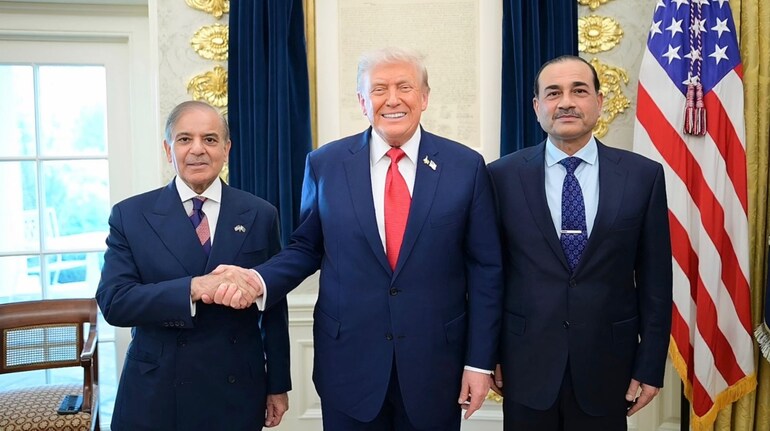

Pakistan’s top military leadership has begun an urgent review of its options as rising tensions between the United States and Iran threaten to drag Islamabad into a difficult geopolitical corner, senior security sources told CNN-News18.
Emergency huddle at GHQ
Field Marshal and Army Chief Asim Munir convened an emergency meeting of the country’s senior security leadership to assess the fallout from a possible US-Iran confrontation, CNN-News18 reported, citing sources.
Those present included ISI chief and National Security Adviser Asim Malik, the Southern Commander Lt Gen Rahat Naseem, the Director General of Military Intelligence, the Chief of General Staff to the COAS, the ISI’s Director General (Analysis), and other senior generals.
Border pressure compounds existing threats
According to the report, commanders warned that Pakistan cannot afford a new flashpoint along its long and sensitive border with Iran when the Durand Line with Afghanistan remains tense.
Any escalation involving Iran, officials said, would stretch security resources already deployed across multiple theatres and complicate border management, including the risk of refugee inflows if fighting intensifies.
The US factor and base access concern
A central concern raised at the meeting was Pakistan’s close strategic relationship with the United States, particularly under President Donald Trump.
Sources told CNN-News18 that military planners discussed the possibility of Washington seeking access to Pakistani airspace or military bases in the event of strikes on Iran, an ask that could carry heavy political and regional costs for Islamabad.
Domestic unrest risk flagged
Intelligence inputs reviewed by the leadership also pointed to internal stability risks. Pakistan’s sizeable Shia population, estimated by officials at nearly 30 per cent, could mobilise against any attack on Iran or a regime-change scenario, potentially triggering protests and adding pressure along the Pak–Iran border.
The cause-effect chain outlined by officials was clear: a US strike could inflame public sentiment, stress border controls through displacement, and force the military to divert resources inward.
Diplomatic channels activated
CNN-News18 sources said Field Marshal Munir directed commanders to remain on high alert and tasked the ISI chief with intensifying diplomatic and security-level contacts with counterparts in Iran, Turkey, Qatar, the United Arab Emirates, Saudi Arabia, and the United States to explore de-escalation.
Intelligence assessments shared at the meeting suggest Pakistan, alongside Saudi Arabia, Qatar and Turkey, has conveyed to Washington that a military strike on Iran risks destabilising the entire region.
Managing the home front narrative
As external pressure builds, the military is also moving to consolidate domestic messaging. Sources said the army recently hosted a delegation of religious scholars under the National PaighaPakistan’s generals met in emergency. What US “request” are they bracing for as the Iran crisis heats up?m-i-Aman Committee at its headquarters.
Participants, speaking on condition of anonymity, said the leadership emphasised the need for a coordinated national security narrative to counter what it described as psychological warfare by hostile forces, including India and militant groups operating along Pakistan’s borders.
Discover the latest Business News, Sensex, and Nifty updates. Obtain Personal Finance insights, tax queries, and expert opinions on Moneycontrol or download the Moneycontrol App to stay updated!
Find the best of Al News in one place, specially curated for you every weekend.
Stay on top of the latest tech trends and biggest startup news.





