






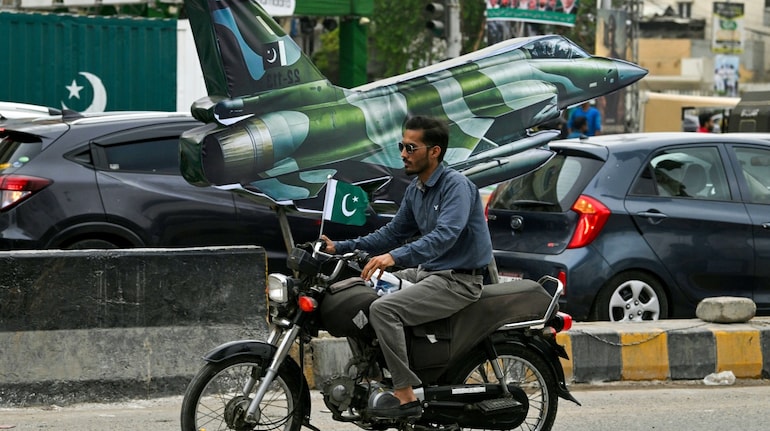

Pakistan is once again selling a story of strategic resurgence through the JF-17 Thunder. From Azerbaijan to Libya, from Southeast Asia to the Middle East, Islamabad has projected the fighter jet as proof that it is no longer just a defence importer but an emerging exporter. In reality, this narrative masks a far more uncomfortable truth.
Pakistan’s JF-17 push is less a sign of industrial maturity and more a symptom of economic desperation, diplomatic improvisation and an overreliance on rhetoric. Strip away the press releases and political claims, and what remains is a fragile defence industry trying to punch far above its weight.
The sales pitch versus the paperwork
Pakistan’s leadership has been vocal. Prime Minister Shehbaz Sharif has publicly claimed that “several countries” are in talks to acquire Pakistani fighter jets. Defence Production Minister Raza Hayat Haraj has echoed similar assertions. Yet most of what Islamabad calls momentum remains expressions of interest, memorandums and exploratory talks.
Azerbaijan’s induction of the JF-17 in late 2025 made headlines, but it followed earlier, limited orders from Myanmar and Nigeria. Even the much-publicised Libya announcement with the Libyan National Army remains opaque, with no clear timelines, numbers or financing details. Indonesia, Bangladesh and Iraq are frequently cited as potential buyers, but no firm contracts have emerged.
In defence aviation, intent means little without binding agreements, financing, training packages and long-term sustainment guarantees. On these counts, Pakistan’s record remains thin.
China’s shadow over Pakistan’s ambitions
The JF-17 is not a purely Pakistani product. It is co-developed with China, which means every export deal requires Beijing’s approval. That alone places structural limits on Islamabad’s freedom to negotiate.
More tellingly, the Chinese People’s Liberation Army Air Force does not operate the JF-17 itself. For a country pitching the aircraft as battle-tested and reliable, the absence of its co-developer as a user undercuts the credibility of Pakistan’s claims.
Pakistan’s defence industry also lacks depth. Its private sector participation is minimal, production rates are modest, and the ecosystem needed for sustained exports remains underdeveloped.
Selling jets to the vulnerable
Islamabad’s target market is revealing. Rather than competing with advanced Western or Chinese platforms, Pakistan is courting economically fragile and conflict-affected states. These countries often face sanctions, political conditions or supply disruptions from traditional suppliers.
Pakistan’s pitch is simple. The JF-17 is cheaper, comes with fewer political strings and avoids Western scrutiny. But affordability is only one part of the equation. Buyers still need assured spare parts, upgrades, training and decades of maintenance support. Pakistan’s own foreign exchange shortages and dependence on external bailouts raise doubts about its ability to honour such long-term commitments.
The idea of converting debt into fighter jets, reportedly discussed with Saudi Arabia, illustrates how unconventional and strained Pakistan’s approach has become.
Weaponising conflict narratives
Pakistan has also tried to leverage the May 2025 conflict with India as a marketing tool. Officials have claimed that JF-17s outperformed Indian platforms and even asserted dominance over Rafale fighters and S-400 systems. These claims remain unsubstantiated, with India declining to comment on losses.
For Islamabad, the objective is clear. Project parity with India to boost domestic morale and sell an image of technological competence abroad. For serious defence buyers, however, salesmanship built on disputed battlefield narratives is unlikely to substitute for proven capability and support infrastructure.
Why India should watch, not worry
From India’s perspective, there is little immediate cause for alarm. The countries engaging Pakistan are not capable of altering the regional military balance. Even potential defence talks with Bangladesh reflect political signalling more than transformative capability shifts.
The larger point is economic. Even if Pakistan secures a handful of JF-17 deals, the revenue will be marginal. It will not stabilise a debt-ridden economy or create a sustainable defence-industrial base.
Pakistan’s JF-17 campaign is best understood not as a breakthrough but as a stopgap. It is arms-for-cash diplomacy driven by financial stress and strategic insecurity. Until Pakistan demonstrates consistent production, reliable sustainment and independence from external patrons, its fighter jet hype will remain exactly that. A loud pitch, but little lift.
Discover the latest Business News, Sensex, and Nifty updates. Obtain Personal Finance insights, tax queries, and expert opinions on Moneycontrol or download the Moneycontrol App to stay updated!
Find the best of Al News in one place, specially curated for you every weekend.
Stay on top of the latest tech trends and biggest startup news.





