






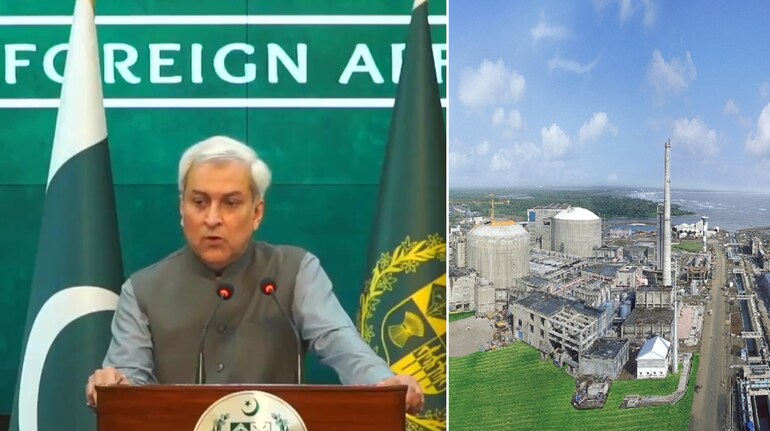
Pakistan on Thursday reacted after Lok Sabha cleared the SHANTI Bill earlier this week to allow private companies to operate nuclear reactors and plants.
In a media briefing, Pakistan’s foreign ministry spokesperson Tahir Andrabi expressed “concern” over the decision, adding that Islamabad is “monitoring the developments carefully”.
Despite Pakistan’s own nuclear safety record being repeatedly questioned by international observers, the Shehbaz Sharif government raised concerns that the bill would “pose challenges to global efforts to prevent access by private individuals.”
“We’ve seen these media reports. There were remarks by the Indian Prime Minister. We monitor these developments very carefully. Given India’s troubling history of nuclear security lapses, including incidents of radio-activity ... and unlawful sale of radioactive material reported since 1990s ... the involvement of private sector in handling of sensitive nuclear material and knowledge could be a matter of concern,” Andrabi said.
Andrabi was peddling claims by his own ministry last year following the seizure of alleged “radioactive” material in India. However, the Indian ministry of external affairs had clarified then that the relevant Indian authorities had investigated the matter and found "no radioactive substance".
The Pakistani spokesperson further alleged that the SHANTI Bill may pose a challenge to global efforts for countering access of private individuals to sensitive nuclear materials. “We hope that enough safeguards will be placed to prevent that eventuality.”
However, Union minister Jitendra Singh had categorically said that nuclear safety standards have not been relaxed in any way, adding that the foundational policy of “safety first, production next”, enshrined in the Atomic Energy Act, remains fully intact.
He also dismissed concerns around privatisation, clarifying that uranium mining above specified thresholds will remain the exclusive domain of the government. “Spent fuel management will always remain under strict government control, following a long-term storage protocol. All strategic materials, including fissile material, source material and heavy water, will continue to be governed solely by the State.”
Unravelling Hypocricy
Pakistan’s position on India’s nuclear energy bill only exposes its own double standards since Islamabad itself has maintained strategic ambiguity about its nuclear doctrine, especially regarding atomic weapons. India, on the other hand, has clearly spelt out its no-first use policy.
In an old report, US-based academic institution Combating Terrorism Center had flagged that the risk of the transfer of nuclear weapons to terrorists in Pakistan "is genuine".
Analysts have often raised concerns about the potential theft of nuclear weapons or materials and unauthorised use by non-state actors.
In 2022, then US President Joe Biden described Pakistan as "one of the most dangerous nations in the world" due to its possession of nuclear weapons without apparent cohesion.
Moreover, Pakistan’s nuclear programme was alsi directly linked to the illicit transfer of nuclear technology to countries like Iran, North Korea and Libya.
And while both India and Pakistan are outside the Non-Proliferation of Nuclear (NPT), India’s clean non-proliferation record, civil–military separation of nuclear facilities and international safeguards have allowed it access to civilian nuclear cooperation (including a Nuclear Suppliers Group waiver in 2008) — privileges Pakistan has not received due to proliferation history and security concerns.
What is SHANTI Bill
The Lok Sabha on Wednesday had passed the Sustainable Harnessing and Advancement of Nuclear Energy for Transforming India (SHANTI) Bill, 2025.
The bill is aimed at modernising India's nuclear energy laws and opening up the sector for private companies to operate nuclear reactors and plants.
The bill, which seeks to repeal the Atomic Energy Act, 1962 and the Civil Liability for Nuclear Damage Act, 2010, was passed as opposition staged a walkout, during the ongoing Winter Session.
Union minister Jitendra Singh said the Bill seeks to modernise India's nuclear framework in line with contemporary technological, economic and energy realities, while retaining and strengthening core safety, security and regulatory safeguards that have been in place since the Atomic Energy Act of 1962.
The SHANTI Bill also opens avenues for participation by public sector entities, government companies, joint ventures and other companies, subject to strict national security and safety safeguards.
Discover the latest Business News, Sensex, and Nifty updates. Obtain Personal Finance insights, tax queries, and expert opinions on Moneycontrol or download the Moneycontrol App to stay updated!
Find the best of Al News in one place, specially curated for you every weekend.
Stay on top of the latest tech trends and biggest startup news.




