






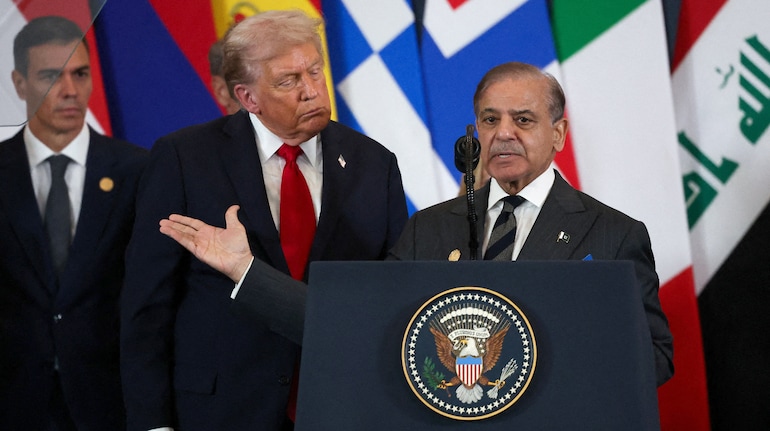

Pakistan Prime Minister Shehbaz Sharif is in Washington to attend the global summit of the proposed Board of Peace (BoP) hosted by US President Donald Trump, where deliberations are expected to centre on the Gaza crisis and a broader framework for post-conflict stability.
The immediate focus of the summit is likely to be consolidating a ceasefire in Gaza, mobilising financial pledges for the BoP and finalising the contours of a new global forum that the Trump administration hopes can achieve what the United Nations has struggled to deliver.
Washington has already announced an initial commitment of $5 billion towards the initiative.
For Sharif, however, the visit is not just about Pakistan’s prospective role in a new international stabilisation architecture but also about navigating a complex mix of domestic and external pressures.
Akbar Ahmed, Ibn Khaldun Chair of Islamic Studies at American University, as cited by Dawn, described the moment as unusually challenging.
“PM Shehbaz Sharif faces as sticky a wicket as can be imagined when he arrives in Washington for his meetings with President Trump,” Ahmed said, adding that the prime minister is dealing with “two sets of dilemmas: an internal one and an external one.”
Participants at the summit are also expected to discuss the creation of a proposed International Stabilisation Force tasked with securing reconstruction zones and supporting a post-conflict governance arrangement in Gaza.
For Pakistan, the question of contributing troops has taken on added significance after it reportedly surfaced in discussions between Pakistan Army Chief Asim Munir and US Secretary of State Marco Rubio on the sidelines of the Munich Security Conference.
Diplomatic sources cited by Dawn indicate that several Muslim-majority countries are open to participating in a stabilisation mechanism but remain reluctant to accept combat roles that could place their forces in direct confrontation with Hamas.
Many are also seeking a credible political pathway toward Palestinian statehood while opposing Israeli annexation moves in the West Bank.
On the domestic front, Ahmed noted that Sharif must manage a delicate civil-military balance amid security concerns and political sensitivities, including the continued incarceration and health of former prime minister Imran Khan.
Externally, the challenge is balancing a warming relationship with Washington against Pakistan’s long-standing strategic ties with China, particularly as tensions simmer along both the eastern and western borders.
“With both the western border with Afghanistan and the eastern border with India heating up, Shehbaz Sharif cannot ignore this balance between America and China,” Ahmed said. “His performance will be watched carefully and his words weighed. He will need all his legendary skills of survival.”
The Washington visit is as much a test of Pakistan’s evolving relationship with the United States as it is about Gaza.
How Sharif positions Islamabad between competing expectations from Washington, Beijing and regional partners is likely to shape both the immediate diplomatic outcome of the summit and Pakistan’s longer-term role in any emerging post-conflict framework.
Discover the latest Business News, Sensex, and Nifty updates. Obtain Personal Finance insights, tax queries, and expert opinions on Moneycontrol or download the Moneycontrol App to stay updated!
Find the best of Al News in one place, specially curated for you every weekend.
Stay on top of the latest tech trends and biggest startup news.





