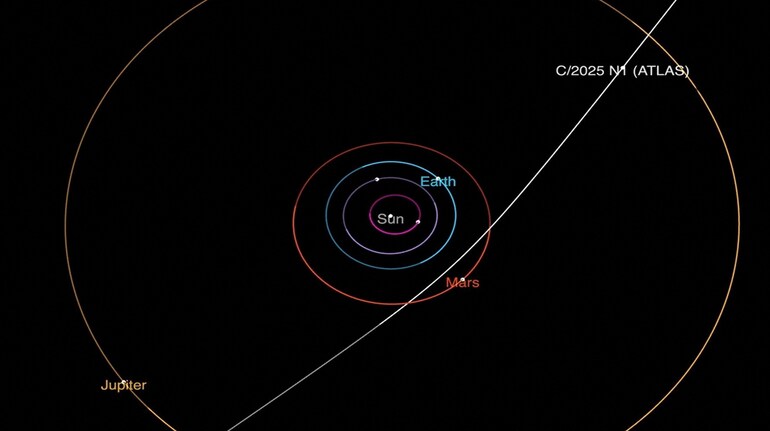
Fresh observations of interstellar object 3I/ATLAS have reopened a heated scientific argument about its true nature, as new photos show the visitor emerging intact after its close pass behind the sun. According to an article in the New York Post, the images have encouraged Harvard astrophysicist Avi Loeb to repeat his claim that the object may be artificial, even as most astronomers insist it continues to behave like a normal comet undergoing intense solar heating.
The latest photographs were captured on November 11 by the Nordic Optical Telescope in Spain’s Canary Islands. They show ATLAS as a single, active object with no signs of breaking apart after its perihelion, the closest point to the sun in its orbit. This is significant because Loeb had earlier suggested that if the object were natural, its extreme jet activity should have torn it into pieces during the solar encounter. Instead, it survived intact, prompting him to argue that the comet explanation is becoming harder to defend.
In comments to reporters, Loeb said the jets seen streaming from ATLAS appear far too powerful for a nucleus of its estimated size. He argued that solar energy alone could not produce such large-scale outflows without requiring a surface area larger than Manhattan. Since the object has not fragmented into smaller pieces that could collectively account for that area, he believes another explanation must be considered. In his view, the jets could represent directional thrusters designed to accelerate the object away from the sun, a manoeuvre he says would be consistent with an engineered spacecraft rather than an icy body.
Loeb also highlighted what he described as an unusual anti tail that appears to point toward the sun instead of away from it. Combined with the object’s resilience and jet behaviour, he believes the case for an artificial origin should not be dismissed.
Most experts remain unconvinced. Darryl Seligman, an astronomy professor at Michigan State University, said the survival of ATLAS is exactly what he expected. Based on estimates from Hubble observations, ATLAS likely has a nucleus up to a few kilometres in size, making it large enough to remain stable even under intense jetting. He calculated that its spin up time is roughly a century, meaning it would not rotate itself apart during this perihelion passage.
Additional evidence also supports natural comet activity. In late October, the MeerKAT radio telescope in South Africa detected hydroxyl absorption lines from ATLAS, a classic signal of water molecules breaking apart in sunlight. Scientists say this fits well with a highly active interstellar comet approaching a star for the first time.
For now, ATLAS remains a scientific mystery. While Loeb continues to argue for a non-natural explanation, most astronomers believe the interstellar visitor is behaving in line with physics rather than science fiction.
Discover the latest Business News, Sensex, and Nifty updates. Obtain Personal Finance insights, tax queries, and expert opinions on Moneycontrol or download the Moneycontrol App to stay updated!
Find the best of Al News in one place, specially curated for you every weekend.
Stay on top of the latest tech trends and biggest startup news.