






Japan’s airspace has become the region’s newest pressure cooker. Within 72 hours, Chinese jets allegedly locked radar onto Japanese fighters, a Chinese carrier drilled near southern Japan, China and Russia sent strategic bombers looping around the archipelago, and now the United States has stepped visibly into the frame with its own show of force.
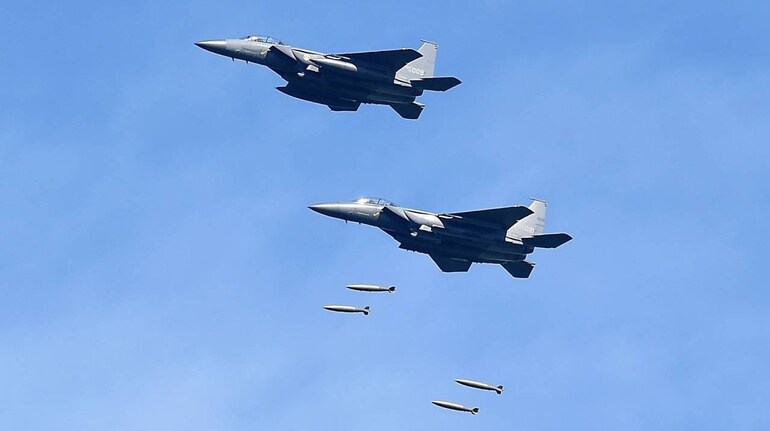
On Wednesday, two US B-52 strategic bombers flew alongside Japanese F-35 and F-15 fighter jets over waters between Japan and South Korea, in a drill meant to underscore joint readiness as “the security environment surrounding our country is becoming even severer,” Japan’s Joint Staff said.
What happened in the sky this week
The joint exercise took place a day after Chinese H-6 and Russian Tu-95 bombers conducted a long-range flight from the East China Sea to the Pacific, prompting Japan to scramble fighter jets though no airspace was breached.
It also followed a more fraught encounter: on Saturday, Japanese jets were reportedly targeted by repeated radar-locking from Chinese military aircraft, a move militaries worldwide view as preparation to fire. Beijing has denied the allegation, accusing Japan of interfering with its drills.
Why now: timing that is impossible to ignore
Tokyo insists the US-Japan drill was not a direct response to any single incident. But the timing lines up unmistakably with a rapid escalation of close calls and signalling moves by China and Russia in Japan’s near-airspace.
Washington, for its part, described its alliance with Japan as “unwavering,” warning that the radar-lock episode was not conducive to regional stability.
The players and their motives
Japan is signalling it will not allow sustained pressure around its airspace or in the waters around Okinawa and Miyako, areas where China has expanded its military presence.
China is testing boundaries while rejecting Japan’s complaints, especially after Prime Minister Sanae Takaichi said in November that Japan could get involved if China moves on Taiwan.
Russia, increasingly aligned with Beijing, joined the bomber patrol, a coordinated move that mirrors the broader geopolitical convergence between the two.
The US, by flying B-52s, nuclear-capable, long-range platforms, is showing that its commitment to Japan and regional deterrence remains operational, not just rhetorical.
How we got here
Japan has lodged multiple protests with China over radar-lock cases and close approaches this year. The region has been on edge since Beijing stepped up drills around Taiwan, and Tokyo began recalibrating its defence posture, boosting military spending to record levels.
Joint China–Russia bomber flights are no longer rare; they have occurred nearly every year since 2019. What makes this week different is the proximity of the incidents, and the political climate after Takaichi’s Taiwan comments.
(With inputs from Associated Press)
Discover the latest Business News, Sensex, and Nifty updates. Obtain Personal Finance insights, tax queries, and expert opinions on Moneycontrol or download the Moneycontrol App to stay updated!
Find the best of Al News in one place, specially curated for you every weekend.
Stay on top of the latest tech trends and biggest startup news.




