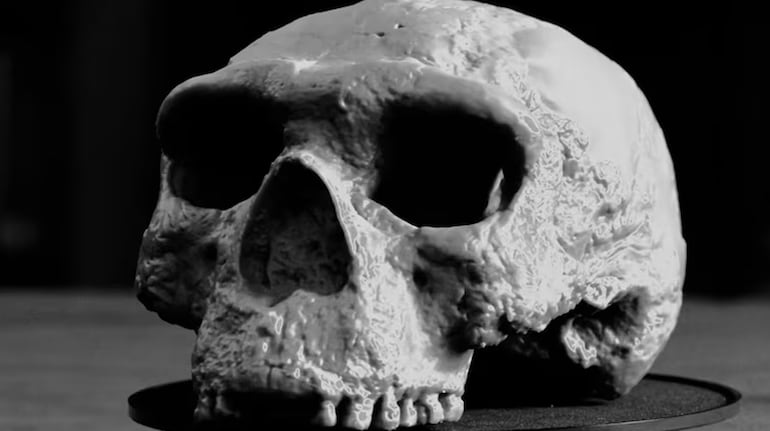
For decades, scientists thought that the large and protruding noses and faces of Homo Neanderthalensis had been evolutionary adaptations to the cold and dry climates of Ice Age Europe. In other words, large, wide nasal cavities served in the warming and moistening of cold air before reaching the lungs. A new study is based on a remarkably well-preserved skull that has dealt a serious blow to that idea.
This skull is of the so-called Altamura Man, found in a cave near Altamura, southern Italy. Scientists used endoscopic cameras and 3-D modelling to examine his internal nasal cavity; for the first time, such delicate nasal bones in a Neanderthal had been available for detailed study. The anatomy that they encountered did not support the cold-adaptation theory. In particular, the internal nasal anatomy of Altamura Man resembles that of modern humans living in temperate climates, not people adapted to Arctic conditions.
In contrast to cold-adapted populations such as Arctic-dwelling Inuit groups, whose nasal cavities are taller and narrower to warm incoming air, the Altamura nasal cavity shows none of those features. The broader nasal aperture and simpler internal structure mean the larger nose likely did not function to pre-heat cold air in winter climates.
These researchers now argue that the Neanderthal facial shape reflects other evolutionary pressures: namely, their robust build, large bodies, and overall skeletal proportions. In other words, their big noses may be a by-product of a generally larger facial structure, rather than cold-specific adaptation.
Previous attempts to correlate nasal size with climate were usually based on incomplete fossil data. Most Neanderthal skulls lacked intact nasal cavities, precluding confirmation that the internal structures matched their external features. The Altamura skull changes that because its delicate interior bones are intact under a thin calcite shell and allow for endoscopic examination.
Although the Neanderthals did survive harsh, ice-age climates for hundreds of thousands of years, their cold-weather survival likely depended on a combination of physical robustness, thick body proportions, clothing, fire, and other cultural and behavioural adaptations-not specialized nasal anatomy.
This study, which was just published in the journal Proceedings of the National Academy of Sciences, is a turning point of sorts in the very long-standing debate over how much of Neanderthal anatomy was shaped by climate. It forces a re-evaluation of prior assumptions and poignantly illustrates how new technology and rare fossils can reshape our understanding of ancient humans.
Discover the latest Business News, Sensex, and Nifty updates. Obtain Personal Finance insights, tax queries, and expert opinions on Moneycontrol or download the Moneycontrol App to stay updated!
Find the best of Al News in one place, specially curated for you every weekend.
Stay on top of the latest tech trends and biggest startup news.