






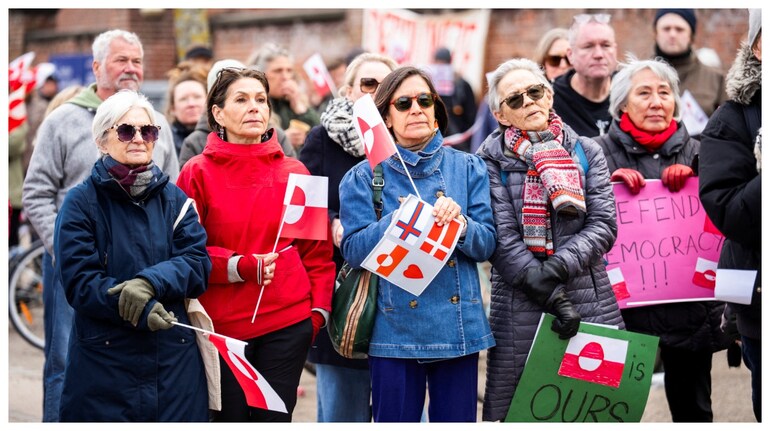

For decades, NATO has rested on a simple promise: An attack on one member is an attack on all. That idea is now being tested in a way few in Europe ever imagined.
Donald Trump’s administration has made clear it is actively exploring ways to acquire Greenland, the vast Arctic territory that belongs to Denmark, a NATO member. The White House says all options are on the table, including military ones. If that sounds extraordinary, it is. It would mean one NATO country openly threatening another, CNN reported.
A threat Europe cannot ignore
The US president’s team insists it is merely “discussing options,” including a possible purchase. But comments from senior officials have stripped away any sense that this is just talk. Stephen Miller, Trump’s deputy chief of staff, bluntly declared that America would “conduct itself as a superpower.”
Denmark’s prime minister, Mette Frederiksen, has not tried to soften the implications. She warned that if the US were to attack another NATO country, it would effectively end the alliance as it has existed since the Second World War.
Yet elsewhere in Europe, the reaction has been strikingly muted.
Why Europe is holding back
At a high-level meeting in Paris this week, European leaders avoided criticizing Washington in public. The reason is simple and uncomfortable: Europe still needs the United States.
With the war in Ukraine unresolved and Russia still a threat, European governments depend on US military power, intelligence and logistics. However uneasy they may feel about Trump’s tactics, they are reluctant to provoke a confrontation that could weaken American support for Kyiv.
That tension was on full display when journalists asked British Prime Minister Keir Starmer and French President Emmanuel Macron to respond to the Greenland issue. Both sidestepped the question, choosing instead to restate general support for Denmark.
The message was clear: Europe does not want to fight two battles at once.
A continent that outsourced its security
For years, European leaders have talked about “strategic autonomy.” In practice, most countries still rely heavily on the US for their defence. Rebuilding that capacity will take years, not months.
Mujtaba Rahman of the Eurasia Group puts it bluntly: Europe is not in a position to talk tough because it has spent decades outsourcing its security to Washington. Rearmament is under way, but it will take three to five years before it changes the balance in any meaningful way.
That leaves Europe trying to buy time.
Does Europe really have no leverage?
Some argue the picture is not quite so bleak. Daniel Fried, a former senior US diplomat, points out that European defence industries are more capable than they are often given credit for. Europe does not depend on the US for everything, and it could, in theory, start using trade, technology and procurement decisions as leverage.
Others are calling for bolder moves. A French MEP has suggested the EU should establish a permanent military presence in Greenland as a signal that Europe can guarantee the territory’s security without American “help.”
But many analysts warn that turning this into a military standoff would be reckless. A smarter approach, they argue, is to raise the political and diplomatic cost for Washington early, making it harder for Trump to act without openly breaking with America’s allies.
Public opinion and Trump’s instincts
Even in the US, the idea of using force to take Greenland is deeply unpopular. Polling suggests an overwhelming majority of Americans oppose it.
Trump, after all, built much of his political appeal on opposition to foreign wars. Yet his recent comments about Venezuela and Greenland suggest a worldview that is increasingly shaped by raw power politics rather than alliances or rules.
One British lawmaker put it privately: this time, Trump looks serious.
A dangerous waiting game
For now, European capitals are hoping the storm will pass, as it did the last time Trump floated the idea of buying Greenland. But there is a growing sense that this episode is different.
NATO was designed to deter external enemies. It was never built for a moment when the biggest threat to its unity might come from inside.
Europe’s strategy, such as it is, comes down to a single, uneasy goal: keep the United States engaged, avoid a rupture, and hold things together until it can finally stand on its own. Whether that will be enough is an open question.
Discover the latest Business News, Sensex, and Nifty updates. Obtain Personal Finance insights, tax queries, and expert opinions on Moneycontrol or download the Moneycontrol App to stay updated!
Find the best of Al News in one place, specially curated for you every weekend.
Stay on top of the latest tech trends and biggest startup news.





