






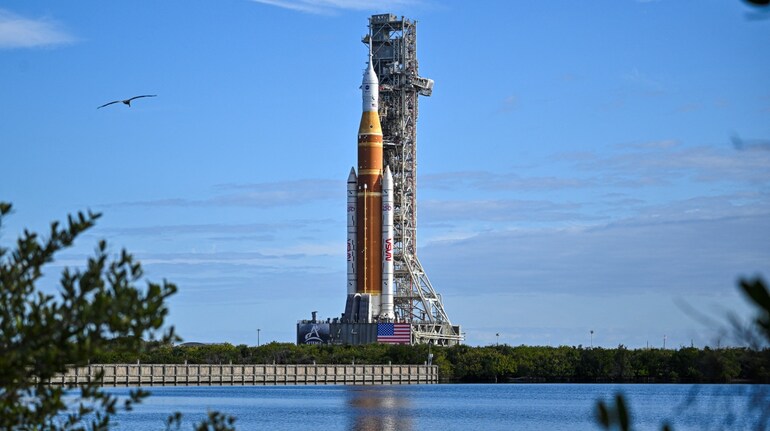

NASA has taken a major step toward returning humans to the Moon by beginning a two-day practice countdown for its Artemis II mission. The test will determine whether the space agency is ready for its first crewed lunar flight in more than 50 years.
The exercise, known as a wet dress rehearsal, began on Saturday night and will lead up to the full fuelling of NASA’s new Space Launch System rocket. The goal is to simulate launch-day conditions as closely as possible and confirm that all systems and teams are prepared.
What the practice countdown involves
NASA officially announced the start of the Artemis II countdown, saying launch teams will fuel the rocket and run through a full sequence of operations required for a real mission.
The countdown clock started at 8:13 pm EST, or 6:43 am Indian time, which was 40 minutes before a simulated launch window opened at 9 pm EST on February 2. The test is expected to continue until about 1 am on Wednesday, February 3, or 11:30 am IST.
According to NASA, the rehearsal includes loading cryogenic liquid propellants into the Space Launch System rocket’s tanks, conducting a full launch countdown, practicing the ability to stop and reset the countdown clock, and draining the tanks to rehearse scrub procedures.
Launch teams at Kennedy Space Center are being supported by Mission Control at NASA’s Johnson Space Center in Houston and other NASA centres across the United States.
Why this test is critical
The wet dress rehearsal is the final major technical milestone before astronauts are cleared for flight. The Space Launch System rocket, which stands 322 feet tall, was moved to the launch pad at Kennedy Space Center two weeks ago.
If the fuelling test is completed successfully, NASA could be ready to attempt a launch within a week. February 8 is currently the earliest possible launch date after an intense cold spell in the US delayed earlier preparations.
Crew preparations and safety measures
The Artemis II astronauts are not directly participating in the wet dress rehearsal, but NASA has included several crew-related milestones in the test timeline.
The Artemis closeout crew will practice sealing the Orion crew module and the launch abort system hatches, tasks that normally take place shortly before liftoff.
The four astronauts remain in quarantine in Houston to reduce the risk of illness before launch. NASA said heaters have been placed at the top of the Orion capsule to keep it warm, while purging systems have been adjusted to maintain safe conditions during colder weather.
Coordination with space station launch
NASA officials are also preparing for another mission at the same time. A crewed flight to the International Space Station is planned within days of a potential Artemis II launch.
Because of the tight schedule, the two missions are being closely coordinated to avoid operational conflicts.
Who is flying on Artemis II
Artemis II will be commanded by Reid Wiseman, with Victor Glover serving as pilot. Christina Koch from NASA and Jeremy Hansen from the Canadian Space Agency will fly as mission specialists.
This will be the first crewed flight test of the Space Launch System rocket and Orion spacecraft.
Mission profile and timeline
The four astronauts will lift off from Launch Complex 39B at Kennedy Space Center in Florida on a mission lasting nearly 10 days.
After launch, the Orion spacecraft’s service module will send the crew on a four-day outbound journey around the far side of the Moon. The spacecraft will travel more than 230,000 miles away from Earth before beginning its return.
The mission will end with a high-speed reentry through Earth’s atmosphere and a splashdown in the Pacific Ocean off the coast of San Diego.
A return to human lunar flight
NASA last sent astronauts to the Moon during the Apollo program between 1968 and 1972. Twenty-four astronauts travelled to lunar orbit, and 12 walked on the Moon’s surface.
Artemis II is designed to prove that the United States can once again safely send humans into deep space, paving the way for future lunar landings and long-term exploration.
Discover the latest Business News, Sensex, and Nifty updates. Obtain Personal Finance insights, tax queries, and expert opinions on Moneycontrol or download the Moneycontrol App to stay updated!
Find the best of Al News in one place, specially curated for you every weekend.
Stay on top of the latest tech trends and biggest startup news.





