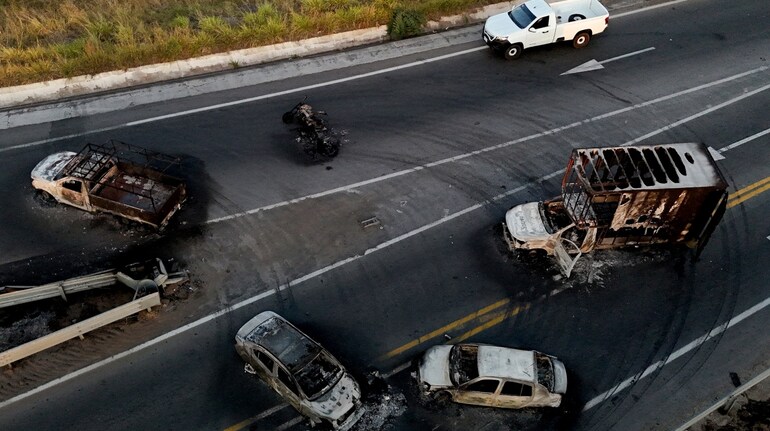
The death of Nemesio Oseguera Cervantes, better known as El Mencho, has removed the single most dominant figure in Mexico’s underworld. For more than a decade, he held together the Jalisco New Generation Cartel through a mix of violence, discipline and a loose franchise model that allowed smaller gangs to operate under his banner. With that central authority gone, the question is less about whether violence will spread and more about who is best positioned to exploit the gap, the New York Times reported.
Jalisco New Generation Cartel
The immediate uncertainty lies within Jalisco New Generation Cartel itself. El Mencho did not leave behind a clear successor. His son, Rubén Oseguera González, is serving a life sentence in the United States. His widow, Rosalinda González Valencia, is widely seen as a key financial operator, but analysts doubt she can command armed factions on the ground. Several senior commanders were killed during the operation that took El Mencho’s life, leaving surviving lieutenants to decide whether to cooperate, compete or break away. In the short term, the cartel is more likely to fragment than smoothly regroup.
Sinaloa Cartel
The most obvious rival is the Sinaloa Cartel, once the uncontested heavyweight of Mexico’s drug trade. It still controls vast trafficking networks and production hubs, particularly for fentanyl. But Sinaloa is weakened by internal war between the Chapitos faction, loyal to Joaquín “El Chapo” Guzmán, and the Mayos faction linked to Ismael Zambada García. That infighting limits its ability to move decisively into former Jalisco territory, even though it has every incentive to try.
Cártel del Noreste
In the northeast, Cártel del Noreste, the successor to the Zetas, remains violent and operational despite repeated leadership losses. Its focus on extortion, kidnapping and cross-border smuggling gives it leverage in border states, though its reach is narrower than Jalisco or Sinaloa. Any expansion would likely be opportunistic rather than transformative.
La Nueva Familia Michoacána
Operating mainly in Guerrero and Michoacán, La Nueva Familia Michoacána has quietly rebuilt after earlier crackdowns. Led by the Hurtado Olascoaga brothers, the group blends drug trafficking with local intimidation and protection rackets. It is well placed to absorb territory in rural zones where Jalisco’s franchise partners may be left exposed.
Cártel de Golfo
The Cártel de Golfo has endured for decades through cycles of arrests and releases. Its current leadership remains intact, and its presence along the Gulf coast gives it control over key smuggling corridors. While not dominant nationally, it has the capacity to fill gaps left by weaker rivals.
Cárteles Unidos
Finally, Cárteles Unidos represents a different model. It is not a single cartel but an alliance of local groups formed to resist Jalisco’s expansion. With El Mencho gone, that defensive coalition may pivot toward offense, especially in Michoacán, where control over meth production and agricultural extortion remains fiercely contested.
What comes next
El Mencho’s death does not simplify Mexico’s criminal map. It complicates it. Instead of one dominant cartel enforcing order through fear, the country now faces a more fluid and volatile balance, shaped by succession struggles, fragile alliances and the constant pressure of state crackdowns. History suggests that this kind of vacuum rarely stays empty for long.
Discover the latest Business News, Sensex, and Nifty updates. Obtain Personal Finance insights, tax queries, and expert opinions on Moneycontrol or download the Moneycontrol App to stay updated!
Find the best of Al News in one place, specially curated for you every weekend.
Stay on top of the latest tech trends and biggest startup news.