







Indian intelligence agencies are increasingly viewing Rohingya-linked crime, illegal migration and militancy as a single, interconnected security ecosystem, rather than separate problems, according to assessments accessed by CNN-News18. Officials believe this ecosystem sustains itself through narcotics money, exploits human movement for cover, and is ultimately driven by radical ideology.
At the centre of this network is the methamphetamine trade, which intelligence agencies describe as the main financial engine. Regional estimates suggest that 90 to 95 percent of Southeast Asia’s methamphetamine, commonly known as Yaba, is produced in Myanmar’s Shan State. From there, consignments are moved through Rakhine State and funnelled into Bangladesh, with Cox’s Bazar emerging as a critical transit hub. According to the assessments cited by CNN-News18, the wider regional meth trade is valued at $61 to $64 billion annually, with drugs from Cox’s Bazar feeding markets across South Asia.
Indian agencies say a portion of this drug revenue does not stay within criminal syndicates. Instead, it is diverted to support militant logistics, making it increasingly difficult to distinguish between organised crime and terrorism. Intelligence inputs accessed by CNN-News18 indicate that human trafficking routes from Cox’s Bazar into India deliberately overlap with narcotics corridors, allowing traffickers to mix Rohingya migrants, drug carriers and militant couriers in the same movement streams.
Officials estimate that more than 70 percent of cross-border movements involve this deliberate intermixing, a strategy designed to spread risk and reduce the chances of interception. Traffickers reportedly charge Rs 2 to 5 lakh per Rohingya adult to facilitate illegal entry into India. Women and children are often moved either free of cost or at heavily reduced rates, which agencies say is a calculated tactic to lower suspicion and conceal militant travel. Investigators believe a share of these payments is passed upward to militant handlers rather than remaining solely with trafficking operatives.
Once inside India, the process of blending in is swift. According to intelligence assessments cited by CNN-News18, forged Aadhaar cards, ration cards and voter IDs can be arranged within 30 to 90 days, typically costing Rs 20,000 to Rs 50,000 per identity set. This enables illegal migrants to move well beyond border areas into major cities and sensitive locations, significantly complicating monitoring, detection and deportation efforts.
Agencies further allege that the same facilitators who arrange transport, safe houses and identity documents are also involved in drug trafficking and arms movement, effectively erasing the line between criminal and militant networks. Intelligence inputs reviewed by CNN-News18 suggest that some handlers within this ecosystem have links to Inter-Services Intelligence, though officials stress that investigations are ongoing and threat assessments remain under continuous review.
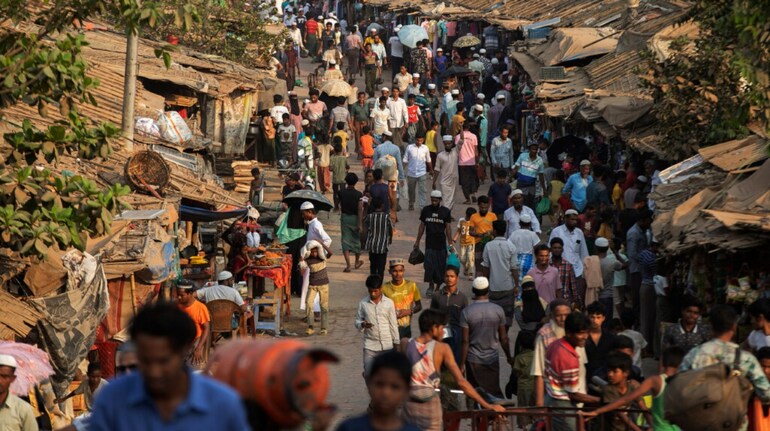
The challenge is magnified by the sheer scale of displacement in the region. More than 1.1 million Rohingya refugees are currently housed in 33 camps in Cox’s Bazar, making it the world’s largest refugee settlement. Fighting in Myanmar’s Rakhine State between 2023 and 2025 is estimated to have pushed around 150,000 additional people into Bangladesh. In India, intelligence agencies estimate that over 40,000 Rohingya are present illegally, spread across West Bengal, Assam, Jammu, Bihar and the Delhi-NCR.
Indian intelligence officials told CNN-News18 that addressing this threat requires abandoning siloed responses. Instead, drugs, illegal migration and militancy must be tackled as one integrated problem through tighter document verification, financial tracking of narcotics proceeds, disruption of trafficking networks and closer coordination with regional partners. Without such an approach, agencies warn, the ecosystem will continue to regenerate itself across borders.
Discover the latest Business News, Sensex, and Nifty updates. Obtain Personal Finance insights, tax queries, and expert opinions on Moneycontrol or download the Moneycontrol App to stay updated!
Find the best of Al News in one place, specially curated for you every weekend.
Stay on top of the latest tech trends and biggest startup news.





