







Amid nationwide anti-government protests in Iran that have left at least 648 people dead in a sweeping security crackdown, tensions with the United States have escalated sharply.
Iran’s Supreme Leader Ayatollah Ali Khamenei on Monday warned Washington against what he termed “deceitful actions” and reliance on “traitorous hirelings,” as the White House said President Donald Trump was keeping the option of airstrikes on Iran open.
The US has also announced a 25 per cent tariff on any country trading with Iran, further tightening pressure on Tehran’s theocratic regime. Meanwhile, Iran’s exiled Crown Prince Reza Pahlavi has emerged as a prominent voice backing the protesters, calling the unrest a nationwide movement against the Islamic Republic and repeatedly seeking support from the Trump administration.
In an interview with CBS News’ Norah O’Donnell on Monday, Pahlavi urged swift action, saying, “We need action to be taken.” His remarks come as demonstrations continue despite a deadly crackdown by security forces.
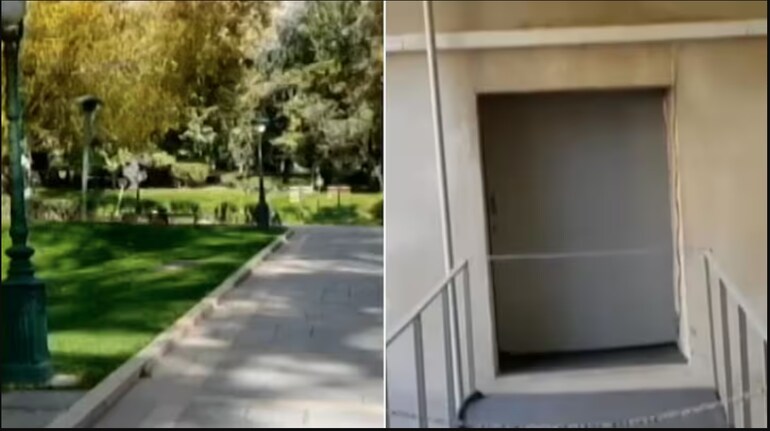
Adding a symbolic dimension to the unfolding crisis, an NDTV report from Tehran showed the stark contrast between the residences of Mohammad Reza Pahlavi, Iran’s last Shah, and Ayatollah Ruhollah Khomeini, who led the 1979 Islamic Revolution.
The visuals highlighted the deep ideological divide between the two leaders, underscoring how sharply their visions for Iran stood at opposite ends of the political and social spectrum.
Pahlavi House
Reza Shah Pahlavi, Iran’s last monarch, was forced into exile following the 1979 Islamic Revolution. His residence reflects the opulence of the former monarchy, surrounded by a vast manicured garden and marked by tall ceilings and a broad glass entrance. The house bears the unmistakable aura of old wealth, with deep blue murals and golden-yellow brickwork resembling the entrance of a luxury hotel.
Inside, the reception hall is vast, comparable in size to an auditorium, where guests would wait before meeting the Shah. A long dining table capable of seating more than two dozen people underscores the scale of the residence.
The home also features a private theatre with plush sofas, along with glass display tables showcasing collectibles, including a Moon rock gifted by the United States from the Apollo missions. The Shah’s famed collection of more than 400 cars and motorcycles is partially displayed, featuring high-end sports vehicles.
Reza Shah Pahlavi witnessed from exile as his father, Mohammad Reza Shah Pahlavi, once supported by Western allies, struggled to secure asylum and eventually died of cancer in Egypt.
Ayatollah Ruhollah Khomeini’s House
In sharp contrast stands the modest home of Ayatollah Ruhollah Khomeini. A metal plaque at the entrance outlines key details of his life, while the structure itself resembles a simple urban residence.
The living room, where visitors met Khomeini, contains just a single rectangular sofa, and personal belongings, including an umbrella he used, are preserved in a glass cabinet.
An adjoining hall, designed like a mosque interior, served as the space where Khomeini delivered his addresses. He spoke from a raised platform to audiences gathered below. The plain white walls, left unrepaired over the years, reinforce the simplicity of the space.
The stark difference between the two homes highlights the contrasting ideologies of the Shah and Khomeini, and helps explain how Khomeini was able to resonate with large sections of Iran’s population and mobilise support for the revolution that transformed the country.
Discover the latest Business News, Sensex, and Nifty updates. Obtain Personal Finance insights, tax queries, and expert opinions on Moneycontrol or download the Moneycontrol App to stay updated!
Find the best of Al News in one place, specially curated for you every weekend.
Stay on top of the latest tech trends and biggest startup news.





