






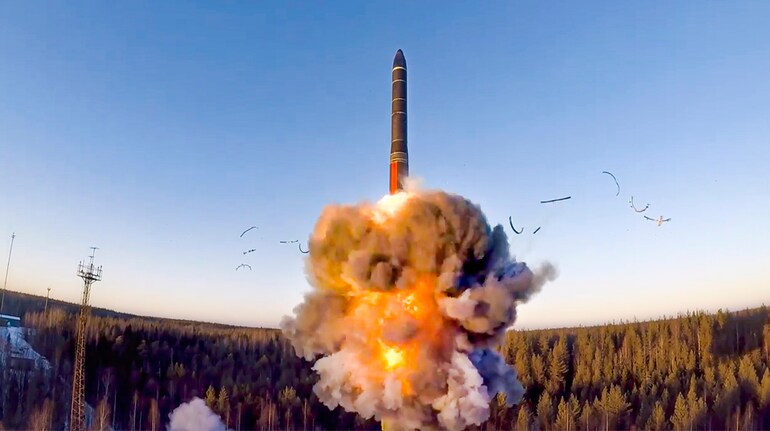
The final remaining treaty limiting the world’s two largest nuclear arsenals is on the brink of collapse, raising fears of an unconstrained arms race not seen in decades. The New START treaty between the United States and Russia is set to expire on Thursday, removing caps on deployed nuclear weapons for the first time in more than half a century.
Arms control advocates warn that its termination could usher in a far more dangerous era of nuclear competition involving not only Washington and Moscow, but also China — with global security consequences that extend well beyond the three powers.
What is new START and why does it matter?
Signed in 2010 by US President Barack Obama and then Russian President Dmitry Medvedev, New START limits each country to no more than 1,550 deployed nuclear warheads on a maximum of 700 missiles and bombers. It was designed to preserve strategic stability by capping arsenals, enhancing transparency and reducing the risk of miscalculation.
The treaty was originally due to expire in 2021 but was extended for five years. Its expiration now would mean there are no legally binding limits on US and Russian nuclear forces for the first time since the Cold War.
Failure to maintain those limits, experts say, would likely encourage both sides to increase deployments. “We’re at the point now where the two sides could, with the expiration of this treaty, for the first time in about 35 years, increase the number of nuclear weapons that are deployed on each side,” said Daryl Kimball, executive director of the Arms Control Association, speaking to The Associated Press.
Why the treaty is collapsing now
Russian President Vladimir Putin has said Moscow is willing to stick to New START’s limits for another year if Washington agrees to do the same, in order to buy time to negotiate a successor pact. However, the Kremlin says the US has not responded to that proposal.
US President Donald Trump has been noncommittal. While Trump has repeatedly said he supports limits on nuclear weapons, he has also pushed to include China in any future arms control framework — a condition Beijing has firmly rejected.
A White House official, speaking on condition of anonymity, told The Associated Press that Trump would decide on nuclear arms control “on his own timeline”.
Meanwhile, Putin has discussed the treaty’s expiration with Chinese President Xi Jinping, according to Kremlin adviser Yuri Ushakov. Russia, Ushakov said, “will act in a balanced and responsible manner based on thorough analysis of the security situation”.
The return of nuclear uncertainty
Without New START, predictability disappears. Kingston Reif of the RAND Corporation warned that “in the absence of the predictability of the treaty, each side could be incentivized to plan for the worst or to increase their deployed arsenals to show toughness and resolve, or to search for negotiating leverage”.
That uncertainty is magnified by Russia’s war in Ukraine. Since invading in 2022, Putin has repeatedly invoked Russia’s nuclear capabilities, warning Moscow could use “all means” to protect its security interests. In 2024, he signed a revised nuclear doctrine lowering the threshold for nuclear weapons use.
The risk, analysts say, is not just intentional escalation but miscalculation — particularly during crises when warning times are short and trust is low.
A broader collapse of arms control
New START’s demise would mark another chapter in the steady dismantling of Cold War-era arms control architecture.
Earlier agreements such as SALT I, the Anti-Ballistic Missile Treaty and the Intermediate-range Nuclear Forces Treaty once placed guardrails on competition. Most have since collapsed.
The INF Treaty, scrapped in 2019, had banned land-based missiles with ranges between 500 and 5,500 kilometres. Russia has since used a conventional version of its Oreshnik intermediate-range ballistic missile in strikes on Ukraine, demonstrating how quickly previously banned systems can re-emerge.
Russia has also developed new nuclear-capable weapons, including the Poseidon underwater drone and the Burevestnik cruise missile, which Moscow says it is preparing to deploy.
Missile defence and the ‘Golden Dome’
Compounding tensions is Trump’s proposed “Golden Dome” missile defence system. Russia and China see such systems as destabilising, arguing they weaken deterrence by enabling a first strike.
“They’re likely going to respond to Golden Dome by building up the number of offensive weapons they have to overwhelm the system,” Kimball said, adding that offensive weapons are cheaper and faster to build than defences.
Former Russian president Medvedev warned that Moscow would respond “promptly and firmly” to new threats, emphasising the link between offensive and defensive strategic weapons.
Why this matters globally
The consequences extend far beyond Washington and Moscow. Arms control advocates fear a three-way nuclear competition involving China, whose arsenal is smaller but expanding.
Kimball warned that an unconstrained race would increase instability and the risk of conflict, describing the current moment as “a potential turning point into a much more dangerous period of global nuclear competition”.
Concerns have also been raised by religious leaders. Pope Leo XIV urged that the treaty “not to be abandoned without seeking to ensure its concrete and effective continuation”.
Even the possibility of renewed nuclear testing has added to unease. Trump’s remarks last year about resuming US tests alarmed Moscow, which has warned it would respond in kind. Kimball said such a move “would blow a massive hole in the global system to reduce nuclear risk”, potentially encouraging other nuclear powers — including China and India — to follow suit.
The bottom line
With New START expiring, the world is poised to enter a nuclear era defined less by restraint than rivalry. The loss of limits, transparency and predictability increases the danger of arms racing, miscalculation and escalation at a time of deep geopolitical tension.
As one of the last pillars of nuclear stability crumbles, what replaces it — if anything — will shape global security for years to come.
(With AP inputs)
Discover the latest Business News, Sensex, and Nifty updates. Obtain Personal Finance insights, tax queries, and expert opinions on Moneycontrol or download the Moneycontrol App to stay updated!
Find the best of Al News in one place, specially curated for you every weekend.
Stay on top of the latest tech trends and biggest startup news.




