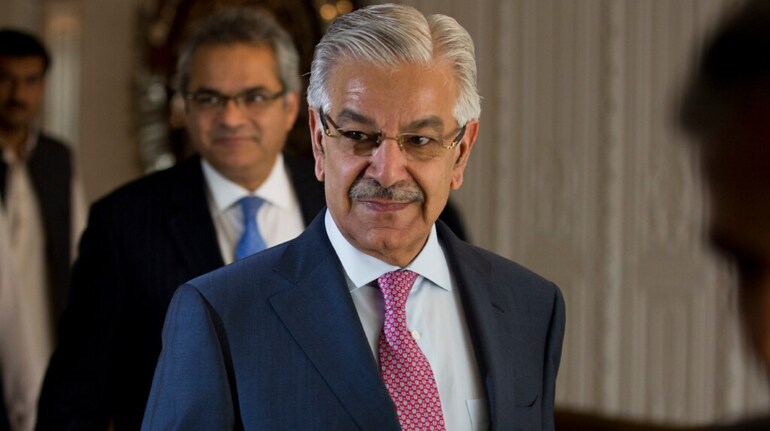

Pakistan’s long-standing contradictions on militancy surfaced again as Defence Minister Khawaja Asif issued fresh threats against Afghanistan’s Taliban regime while simultaneously admitting that Islamabad is in no position to act immediately. The remarks highlight a familiar cycle: Pakistan blames external actors for terrorism while struggling with the militant networks it once enabled. As violence linked to the Tehreek-e-Taliban Pakistan continues to rise, Asif’s statements reflect a state trapped between rhetoric and strategic weakness.
Threats without a timeline
Speaking amid regional uncertainty, Asif insisted that Pakistan’s policy toward the Afghan Taliban remains unchanged and is “not on the back-burner.” Yet he conceded that any response would be delayed and calibrated for political convenience.
“Yes, definitely Pakistan will take action against the Afghan Taliban at the right time and according to our own convenience,” he said, adding that Islamabad could opt for military operations or diplomatic disengagement.
The statement underscores a pattern in Pakistan’s security messaging: repeated warnings without clarity on intent, scope, or consequences.
Blaming Kabul for Pakistan’s militant blowback
Asif directly accused the Taliban government in Kabul of harbouring and facilitating the TTP, which has carried out multiple attacks inside Pakistan. Calling Afghanistan an “enemy country,” he argued that Islamabad’s patience was nearing its limit.
The accusation comes despite Pakistan’s long history of backing militant groups as tools of regional policy, a strategy that has increasingly rebounded inward as the TTP resurges.
Admitting strategic paralysis
Even as he escalated rhetoric, Asif acknowledged that Pakistan cannot act in the near term due to regional instability. Pointing to “heavy geopolitical turmoil,” he cited tensions involving Iran, wars in Palestine and Yemen, and unrest across Africa.
“This is not a favourable time to hit Afghanistan,” he said, effectively conceding that Pakistan lacks the strategic space to follow through on its threats.
Looking to Turkey for strategic cover
Asif also hinted at deeper defence engagement with Turkey, saying key issues were being discussed and that developments would “unfold and crystallise soon.” While no details were provided, the remarks suggest Islamabad is seeking external partnerships as its own regional leverage diminishes.
A pattern of deflection and delay
Pakistan has repeatedly urged the Afghan Taliban to prevent their territory from being used against it, demands that have gone largely ignored. Yet Islamabad’s public posture continues to rely on warnings rather than enforceable action.
Asif’s remarks reveal a deeper problem within Pakistan’s security policy: a state eager to assign blame, reluctant to acknowledge its own role in nurturing extremism, and increasingly constrained by internal instability and regional isolation.
Discover the latest Business News, Sensex, and Nifty updates. Obtain Personal Finance insights, tax queries, and expert opinions on Moneycontrol or download the Moneycontrol App to stay updated!





Find the best of Al News in one place, specially curated for you every weekend.
Stay on top of the latest tech trends and biggest startup news.