

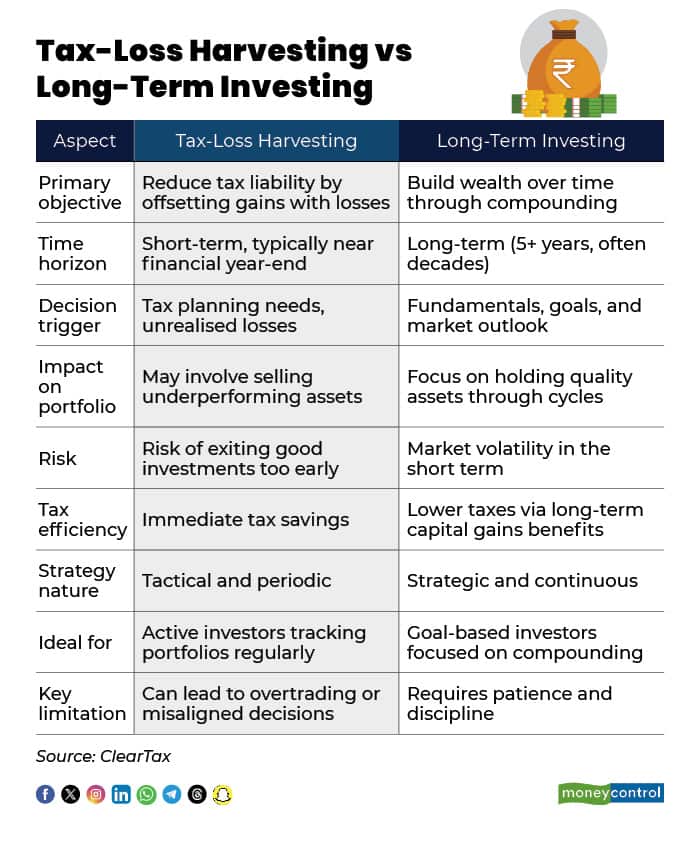
In today’s market, investors often find themselves balancing two key priorities: minimising taxes today and building wealth for the future. Tax-loss harvesting has emerged as a tactical way to optimise taxes, while long-term investing remains the backbone of compounding-led wealth creation. The real question is: how much importance should each get in your strategy?
Understanding tax harvesting
Tax harvesting is a portfolio strategy aimed at lowering the tax payable on capital gains, particularly from equities and equity mutual funds. It works by selling investments strategically, either to book gains within the exempt limit or to realise losses that can be adjusted against taxable gains.
At its core, tax harvesting is about proactive tax management. Instead of allowing gains or losses to build up unnoticed, investors plan transactions to reduce their tax burden while staying invested. The maximum amount of LTCG that you can make tax-free using this method is Rs 1.25 lakh.
March 31 is critical for tax harvesting because it marks the end of the financial year, requiring all capital gains and losses to be booked by this date to calculate tax liability for that specific year.
Broadly, tax harvesting is of two types: tax-gain harvesting and tax-loss harvesting. Each is applied in different market situations and serves a distinct objective in improving post-tax returns.
Tax-gain harvesting
Tax-gain harvesting is a strategy where an investor sells equity shares or equity mutual fund units held for more than 12 months to book LTCGs within the tax-exempt limit. The money is then reinvested, helping reset the purchase price and potentially reducing future tax liability.
Tax-loss harvesting
Tax-loss harvesting involves selling equity shares or equity mutual fund units at a loss. The realised capital loss can be used to offset taxable capital gains, thereby lowering the overall tax outgo.
Where tax harvesting fits in
Tax harvesting is best seen as a supporting strategy, not a primary one. It works well in the following scenarios:
“Tax harvesting can be an effective way to improve post-tax returns by optimising both gains and losses within a portfolio. However, it should be viewed as a supporting tool rather than the primary driver of investment decisions. An excessive focus on tax outcomes can sometimes lead to actions that are misaligned with long-term asset allocation and fundamentals,” said Archit Gupta, Founder & CEO, ClearTax.
Where long-term investing fits
Long-term investing remains the foundation of sustainable wealth creation, driven by the power of compounding and the ability to ride out market volatility. While tax strategies can enhance returns at the margins, they cannot replace the discipline required to stay invested through market cycles.
“Given that long-term capital gains are already taxed at a concessional rate of 12.5 percent, staying invested in quality stocks should not be driven by short-term tax harvesting triggers,” said Gopal Bohra, Partner – Tax, N.A. Shah Associates.
At the same time, experts caution that excessive focus on short-term tax adjustments can interfere with long-term portfolio goals. Investment decisions should ideally be guided by fundamentals, asset allocation, and financial objectives rather than tax considerations alone.
“Booking losses to offset current or future gains makes arithmetical sense, but an obsession with tax harvesting can quietly turn a long-term investor into an accidental trader. If you're selling fundamentally strong stocks just because they are temporarily in the red, you might end up disrupting your long-term strategy for a short-term tax benefit. Markets often recover faster than expected, and getting the timing wrong can cost you far more than the tax you saved,” said Hardik Mehta, Lead – Tax, Ionic Wealth.
Frequent buying and selling can also introduce additional costs, which may dilute the benefits of tax optimisation. Brokerage charges, exit loads in certain funds, and timing risks can all impact overall returns.
“Costs such as brokerage charges, exit loads in certain funds, and the impact of frequent buying and selling can reduce the actual benefit from tax harvesting. Another concern is that this may shift investors from a long-term mindset to a trading mindset. Hence, it should be treated as a supporting tool rather than the main investment strategy. The foundation of wealth creation lies in building a long-term portfolio,” said Aarti Desikan, Executive Director, Anand Rathi Wealth Limited.
Overall, tax experts suggest that when used wisely, tax efficiency and long-term discipline can work together to strengthen overall portfolio outcomes.
Disclaimer: The views and investment tips expressed by experts on Moneycontrol.com are their own and not those of the website or its management. Moneycontrol.com advises users to check with certified experts before taking any investment decisions.Discover the latest Business News, Sensex, and Nifty updates. Obtain Personal Finance insights, tax queries, and expert opinions on Moneycontrol or download the Moneycontrol App to stay updated!





Find the best of Al News in one place, specially curated for you every weekend.
Stay on top of the latest tech trends and biggest startup news.