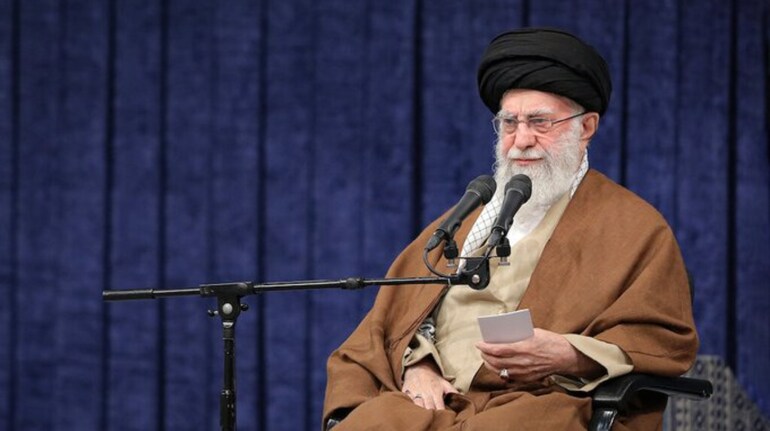
Ayatollah Ali Khamenei, Iran’s Supreme Leader and the ultimate decision-maker on matters of war and diplomacy, has not appeared in public or issued any statement for more than a week. His silence — during the most volatile and violent confrontation Iran has faced in years — has cast a shadow over the cease-fire with Israel and raised speculation over who is really in control of the Islamic Republic, the New York Times reported.
The concern was made explicit on Tuesday during a rare moment of candour on Iranian state television. A popular host acknowledged the flood of public anxiety over Khamenei’s absence and asked a senior official from the Supreme Leader’s office for reassurance. Instead of clarity, the audience received platitudes. “We should all be praying,” the official said, without addressing whether Khamenei was safe, ill or even alive.
Sources close to Iran’s security establishment say the 85-year-old leader is being protected in a secure underground bunker and has ceased electronic communications to avoid detection. Yet his total silence, even as Iran launched missile strikes on a US base in Qatar and signed a US-brokered cease-fire with Israel, is raising doubts about whether he is still directing the country’s response — or whether a new power structure is emerging in his absence.
Unseen leader, visible uncertainty
In Iran, where Khamenei traditionally signs off on every major military or diplomatic decision, his lack of presence has become both a political and psychological void. Multiple Iranian officials admitted to not having spoken to the leader in recent days, and the normally choreographed public messaging from his office has vanished. On social media and in government circles, speculation is rampant.
The stakes are high. Khamenei’s absence has opened the door to political jockeying among Iran’s ruling elite. President Masoud Pezeshkian, elected last year on a moderate platform, has aligned himself with the head of the judiciary and the new commander of Iran’s armed forces to steer the country toward renewed diplomacy. Pezeshkian’s message to his cabinet this week was pointed: “This is a golden opportunity for change.”
Hardliners push back
But the shift is far from unanimous. Hard-liners led by Saeed Jalili, a former nuclear negotiator and key figure in the Revolutionary Guards' political faction, have slammed the cease-fire as illegitimate and denounced Pezeshkian’s overtures to the West. Parliament members aligned with this bloc are calling for the continuation of Iran’s nuclear program and a more aggressive stance toward Israel and the US
For now, the diplomatic faction appears to have the upper hand. But the uncertainty surrounding Khamenei’s health has amplified tensions. Some fear that should his condition worsen or his death be confirmed, Iran could enter a chaotic period of elite conflict, with dangerous implications for both domestic governance and regional stability.
As Sanam Vakil of Chatham House noted, “If we don’t see Khamenei by Ashura [in early July], that is a bad sign.” Until then, Iran’s most fateful decisions may be made in a vacuum — or by those already preparing to fill one.
Discover the latest Business News, Sensex, and Nifty updates. Obtain Personal Finance insights, tax queries, and expert opinions on Moneycontrol or download the Moneycontrol App to stay updated!
Find the best of Al News in one place, specially curated for you every weekend.
Stay on top of the latest tech trends and biggest startup news.